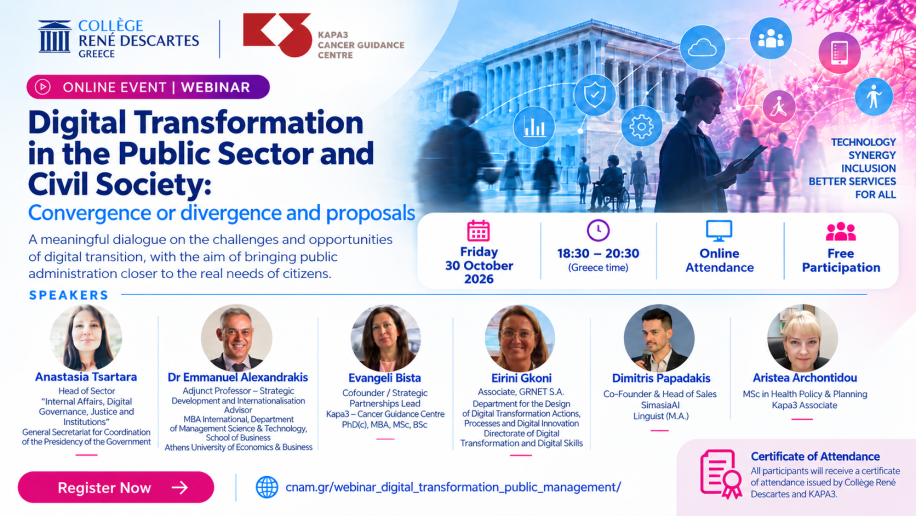
Online Webinar Digital Transformation in the Public Sector and Civil Society.Convergence or divergence and proposals

Kapa3 – Cancer Guidance Centre, in collaboration with Collège René Descartes, invites you to an online webinar entitled:

“Digital Transformation in the Public Sector and Civil Society: Convergence or divergence and proposals”

📅 Date: Friday, 30 October 2026
🕡 Time: 18:30 – 20:30
💻 Attendance: Online
🎫 Participation: Free of charge

Digital transformation is now a key factor shaping how public organisations operate, how services are delivered to citizens, and how social support and participation initiatives are developed. Although important progress has been made, the transition to a more digital environment does not unfold in the same way across all organisations and social groups.

This webinar aims to open a meaningful dialogue between theory and practice, examining digital transformation from both the perspective of the Public Sector and that of Civil Society. Special emphasis will be placed on:

  • the changes brought by digitalisation in the way organisations function,
  • the relationship between the state, organisations and citizens,
  • the opportunities created by digital technologies,
  • the challenges arising from unequal access to and use of digital tools,
  • and the need to develop sustainable, human-centred and inclusive digital solutions.

Main question of the discussion

Does digital transformation lead to greater convergence between the state, organisations and citizens, or does it create new forms of divergence and inequality?

Who should attend

The webinar is addressed to:

  • public sector professionals and employees,
  • representatives of civil society organisations,
  • professionals involved in the design or implementation of digital services,
  • management and human resources professionals,
  • social and humanitarian service professionals,
  • educators, researchers, academics and students,
  • and, more broadly, anyone interested in the relationship between technology, public administration and society.

Main topics

The webinar programme includes themes related to:

  • digital transformation as organisational change,
  • innovation in public administration,
  • practical experiences and good practices from the public sector,
  • inclusion, accessibility and social needs,
  • the relationship between the public sector and civil society,
  • artificial intelligence, data and new opportunities,
  • and proposals for a meaningful, sustainable and human-centred digital transition.

Speakers

The webinar features:

  • Anastasia Tsartara, Head of Sector “Internal Affairs, Digital Governance, Justice and Institutions”, General Secretariat for Coordination of the Presidency of the Government
  • Dr Emmanuel Alexandrakis, Adjunct Professor – Strategic Development and Internationalisation Advisor, Athens University of Economics & Business
  • Evangeli Bista, Cofounder / Strategic Partnerships Lead, Kapa3 – Cancer Guidance Centre
  • Eirini Gkoni, Associate, GRNET S.A.
  • Dimitris Papadakis, Co-Founder & Head of Sales, SimasiaAI
  • Aristea Archontidou, MSc in Health Policy & Planning, Kapa3 Associate.

Certificate of attendance

All participants will receive a certificate of attendance issued by Collège René Descartes and Kapa3.

Registration

Participation is free. You may register through the official form:
🔗 https://cnam.gr/webinar_digital_transformation_public_management/

Beyond Treatment: What Project 528 Reveals About Young Women Living with Advanced Breast Cancer

The hidden burden of diagnosis, the need for holistic care, and Kapa3’s commitment to patient navigation, psychosocial support and empowerment.

A cancer diagnosis at a young age affects far more than physical health. It can disrupt education, employment, family life, personal relationships, financial security and plans for the future. For young women living with advanced breast cancer, these challenges are often particularly complex, as they must navigate treatment and uncertainty while continuing to fulfil multiple personal, professional and family responsibilities.

The findings of Project 528, a global needs assessment led by the Young Survival Coalition (YSC), provide important evidence of these often-overlooked realities.

Presented at the 8th International Consensus Conference for Advanced Breast Cancer (ABC8) in Lisbon in November 2025, the survey gathered 3,881 responses from 67 countries. The findings presented at the conference focused on 385 young respondents under the age of 40 living with advanced breast cancer.

The results highlight significant gaps in access to information, psychological support, financial protection, practical assistance and meaningful participation in healthcare decisions.

Above all, they reinforce an essential message: cancer care must address the whole person, not only the disease.

The revealing findings of Project 528

The survey findings offer a compelling picture of the challenges experienced by young women with advanced breast cancer and demonstrate how deeply the disease affects everyday life.

Motherhood and family responsibilities

Almost half of the respondents (48%) had children under the age of 18.

For young mothers, living with advanced breast cancer means balancing demanding treatment schedules, physical symptoms and emotional uncertainty with the everyday responsibilities of raising children.

Childcare, family routines and concerns about their children’s future can become considerable sources of distress.

These findings highlight the importance of family-centred supportive care that recognises both the needs of patients and those of their loved ones.

Employment disruption and financial toxicity

The socioeconomic consequences of advanced breast cancer are substantial.

64% of respondents reported disruption to their employment following diagnosis, while 40% accumulated medical debt.

According to the detailed Project 528 report, the proportion of respondents who considered themselves financially secure fell from 51% before diagnosis to just 7% during treatment.

These findings illustrate the phenomenon of financial toxicity: the economic burden associated with cancer, including loss of income, treatment-related expenditure, travel costs, caregiving responsibilities and reduced employment opportunities.

Financial insecurity can further intensify emotional distress and create additional barriers to accessing appropriate care.

For younger patients, whose careers and financial independence may still be developing, the consequences can extend well beyond the treatment period.

Psychological distress and quality of life

80% of respondents reported psychological distress or mental health difficulties.

Concerns relating to body image, fertility, sexual health, emotional well-being and loss of independence were widespread, yet were often insufficiently addressed within routine cancer care.

For many young women, advanced breast cancer also raises difficult questions about identity, relationships, intimacy, motherhood and the future.

These challenges demonstrate why psychosocial support should not be viewed as an optional addition to cancer treatment.

It is an essential component of comprehensive, person-centred oncology care.

Delays in seeking care and diagnosis

The survey also revealed important gaps in awareness and early detection.

40% of respondents reported delaying their initial medical consultation. Contributing factors included fear, limited awareness of symptoms and experiences of having their concerns dismissed or underestimated by healthcare professionals.

Only 14% reported being diagnosed through screening or routine medical care, while 85% sought diagnosis after identifying symptoms themselves.

These findings point to the need for greater awareness of breast cancer in younger populations, timely clinical assessment of concerning symptoms and improved communication between patients and healthcare professionals.

They also remind us that young age should not automatically lead to the dismissal of potentially significant symptoms.

Gaps in information and access to precision medicine

The findings also identified differences in access to diagnostic testing and understanding of treatment options.

Although 90% reported undergoing genetic testing for inherited mutations, only 59% had received genomic or companion diagnostic testing to investigate characteristics of the tumour.

Such testing, when clinically indicated, can provide valuable information to support personalised treatment decisions.

Moreover, only 46% of respondents reported being offered more than one treatment option, while targeted therapies were among the least understood treatment approaches.

These results highlight the importance of accessible medical information, effective patient–professional communication and shared decision-making.

Online patient communities also emerged as valuable sources of information, peer support and empowerment. However, the detailed Project 528 report found that 43% had not been referred to peer-support or patient advocacy groups by their healthcare teams.

As Jennifer Merschdorf, Chief Executive Officer of the Young Survival Coalition, emphasised, healthcare systems too often place the burden of self-advocacy on patients who are already coping with fatigue, fear and financial strain.

The Kapa3 connection: From identifying needs to meaningful action

The findings of Project 528 are more than statistics. They reveal the personal, social and economic dimensions of cancer that healthcare systems must increasingly recognise and address.

Although the survey reflects experiences reported across different countries and healthcare contexts, many of the challenges it identifies are also relevant to the needs that cancer patients and families may encounter in Greece.

At Kapa3 – Cancer Guidance Center, we believe that the experience of cancer extends far beyond hospital appointments, medical consultations and treatment decisions.

Cancer affects the ability to work, care for loved ones, maintain financial stability, access essential services and participate fully in everyday life.

Our mission is to help bridge the gap between medical care and the practical, social and emotional needs that accompany a cancer diagnosis.

Patient navigation and guidance within healthcare and social support systems

As Professor Fatima Cardoso, President of the ABC Global Alliance, has highlighted, equitable access to appropriate diagnostics, personalised treatment and comprehensive supportive care is essential.

At Kapa3, we provide free patient navigation and social guidance services, helping people affected by cancer and their families better understand their rights and access available forms of support.

Our work includes guidance on administrative procedures, disability assessment and certification, social benefits, insurance-related matters, workplace rights and available community resources.

Through individualised support and cooperation with relevant services, we aim to reduce the bureaucratic and informational barriers that patients frequently encounter.

No person affected by cancer should have to navigate a complex health and welfare system alone.

Psychosocial support and quality of life

With psychological distress affecting such a high proportion of young patients in the Project 528 survey, emotional and psychosocial care must be recognised as a central part of the cancer journey.

Kapa3 provides psychological support services adapted to the needs of patients and caregivers, alongside social guidance and referrals to appropriate specialised services when necessary.

We recognise the importance of offering a supportive environment where people can discuss emotional uncertainty, changes in family and personal relationships, body image concerns, fear of recurrence or progression, and the challenges of adapting to life with cancer.

Our approach promotes dignity, emotional resilience and a more comprehensive understanding of quality of life.

Practical assistance and support for families

For a young mother living with advanced breast cancer, routine tasks can become overwhelming.

Childcare arrangements, travel for treatment, household responsibilities, employment obligations and financial pressures may all create additional burdens.

Kapa3 supports patients and caregivers by identifying their practical needs, providing information and connecting them with appropriate social services, community resources and support structures.

Through collaboration with local authorities, healthcare professionals and community organisations, we seek to strengthen continuity of support and help families navigate everyday challenges.

Empowerment, health literacy and patient advocacy

One of the strongest messages emerging from Project 528 is that reliable information is a fundamental resource for patient empowerment.

At Kapa3, we work to strengthen health literacy, informed participation and patient advocacy.

We encourage patients to ask questions, understand the information provided by their healthcare teams, become aware of relevant diagnostic and treatment options, and participate actively in decisions affecting their lives.

Our role is not to replace medical advice, but to help people access trustworthy information and feel better prepared to communicate with healthcare professionals.

At the same time, we advocate for more inclusive health and social policies that recognise the particular challenges experienced by adolescents and young adults affected by cancer (AYAs).

These include employment protection, financial security, psychosocial needs, family responsibilities, fertility-related concerns and continuity of care.

Moving forward together: Advocating for a better quality of life

Project 528 offers an important roadmap for researchers, healthcare professionals, patient organisations and policymakers.

It demonstrates the urgent need for healthcare systems that are not only medically effective, but also accessible, coordinated, compassionate and responsive to the realities of people’s lives.

The findings should be interpreted in the context of the survey’s limitations, including its reliance on self-reported experiences and uneven geographical representation. Nevertheless, they provide valuable patient-reported evidence that can inform further research and improvements in supportive care.

Behind every diagnosis is a woman who wants to continue living, loving, working, raising her children, building relationships and making plans for the future.

As Christina Thammasen, who shared her experience of living with metastatic breast cancer, reminds us:

“You have to keep fighting, you have to keep moving forward, you have to keep living your life.”

At Kapa3, we remain committed to ensuring that no woman, no young adult and no family affected by cancer has to face these challenges without information, guidance or support.

We advocate for a model of holistic, person-centred cancer care that extends beyond treatment and recognises every dimension of human life.

Because cancer care is not only about treatment. It is about protecting dignity, supporting everyday life and ensuring that no one is left behind.


Need support?

If you are a young person affected by cancer, a patient or a caregiver seeking guidance, psychological support or information about your rights, the Kapa3 team is here to help.

Kapa3 – Cancer Guidance Center

Telephone: +30 210 5221424
Email: info@kapa3.gr
Website: www.kapa3.gr

Sources and further reading

  1. Young Survival Coalition. Project 528 – First Look ABC Data: Global Needs Assessment of Young Adults Affected by Advanced Breast Cancer (2025).
    https://project528.youngsurvival.org/wp-content/uploads/2025/11/MBC-Report-Project528_11.2025.pdf
  2. ABC Global Alliance / ecancer. First global survey highlights challenges faced by young women with advanced breast cancer. 6 November 2025.
    https://ecancer.org/en/news/27226-first-global-survey-highlights-challenges-faced-by-young-women-with-advanced-breast-cancer
  3. Oncology Central. ABC8: Global survey highlights challenges that young breast cancer patients face. 6 November 2025.
    https://www.oncology-central.com/abc8-global-survey-highlights-challenges-that-young-breast-cancer-patients-face/
  4. Project 528 – Official website and research findings.
    https://project528.youngsurvival.org/results/

Article edited by:
Elena Panopoulou, Sociologist, Kapa3 Tripoli Team
Email: elenak3team@gmail.com
LinkedIn: Elena Panopoulou
MYRTO evolves: from information to meaningful navigation

The new version of MYRTO, Kapa3’s digital assistant for people affected by cancer and their caregivers, is now live.

This update is more than a technical upgrade. It represents another step towards a different model of digital support: moving from simply providing information to supporting understanding, guidance and navigation.

For people facing cancer, the challenge is not always a lack of information. Very often, the real difficulty is understanding which information applies to them and what they need to do next.

From information to the next step

The cancer journey involves much more than diagnosis and treatment. Patients and families may also need to navigate social rights and benefits, disability assessment, transportation, employment issues, psychosocial support and communication with multiple health and public services.

Information may be available, but it is often fragmented, complex or difficult to turn into action.

This is where navigation becomes essential.

It means supporting people to access, understand, evaluate and use the information they need.

MYRTO was developed with this principle in mind: transforming complex and fragmented information into guidance that is easier to understand and act upon.

What is new in MYRTO

The renewed version offers a more direct and accessible user experience.

Users can interact by text or voice, listen to responses, choose between Greek and English, and adjust text size. Suggested topics also help people who may not know how to begin or how to formulate their question.

Particular attention is given to the sources behind the information. MYRTO follows a source-grounded and human-supervised AI approach: Artificial Intelligence supports the retrieval and organisation of information, while reliability, transparency and human oversight remain central to its design.

Technology does not replace people

MYRTO is not a doctor and does not provide personalised medical advice. It does not replace social workers, psychologists, nurses or other healthcare professionals.

Its role is to reduce complexity, support orientation and help people move closer to the appropriate information, service or human support.

The same approach applies to caregivers, who often become care coordinators, information managers and navigators of rights and services. MYRTO is also designed with their needs in mind, recognising caregivers as an essential part of the cancer journey.

Accessibility, trust and data protection

At Kapa3, we believe that digital innovation is meaningful only when it remains accessible and inclusive.

For this reason, the renewed MYRTO places emphasis on plain language, voice interaction and features that can support people with different levels of digital and health literacy.

Users are also informed about the processing of their data and the use of Artificial Intelligence, with separate consent choices and the possibility to request data deletion.

Trust in a digital health tool is not only about the answers it provides. It is also about how it works, which sources it relies on and how it respects the people who use it.

“What do I need to do next?”

Perhaps this single question best captures the philosophy behind MYRTO:

“What do I need to do next?”

A person facing cancer should not have to know in advance which organisation is responsible, where the right information is located or which administrative process needs to be followed.

They should be able to express their need and receive guidance that is reliable, understandable, accessible and human-supported.

This is the direction of the renewed MYRTO.

From information to understanding.
From understanding to navigation.
And from navigation to the next step.

Find more :

https://kapa3-cag-rag-hybrid-deploy.onrender.com


MYRTO: From Real-World Needs to European Scientific Engagement

MYRTO, the digital Social Rights Navigator developed by Kapa3, is taking an important step from real-world experience to the European scientific community, with two studies accepted for presentation at EONS and ESMO events in 2026.

The first study, “MYRTO as an AI-Supported Navigation Model for Equitable Access to Cancer Care: Real-World Needs from 1,083 Beneficiaries”, will be presented as a poster at EONS19 at ESMO 2026 in Madrid, 24–26 October 2026.

The study draws on the real-world needs of 1,083 Kapa3 beneficiaries, identifying eight key navigation areas: rights and benefits, disability certification and administrative procedures, access to health and social services, transportation and geographical barriers, employment and social protection, health and digital literacy, caregiver support, and referral to human professionals when needed.

The findings highlight that equitable access to cancer care is not only about clinical information. It also depends on people’s ability to find, understand and use reliable information during an exceptionally demanding period of their lives.

From real-world needs to technology evaluation

The second study, “Source-Based Artificial Intelligence (AI) Navigation for Fragmented Nonclinical Cancer-Support Information: Pilot Evaluation of a Human-Supervised System”, has been accepted as an e-Poster at the ESMO AI & Digital Oncology Congress 2026, taking place on 16–18 November 2026.

This study focuses on the operation and evaluation of MYRTO as a source-grounded, human-supervised AI system.

The pilot evaluation drew on 448 authoritative documents and 29,148 indexed excerpts and assessed 100 predefined questions. For all 84 answerable questions, source-supported and actionable responses were generated without modifications following Kapa3 expert review. The system also applied clarification, abstention or redirection mechanisms when evidence was insufficient or when questions involved medical advice or fell outside its intended scope.

Two studies, one shared philosophy

The two studies reflect complementary dimensions of MYRTO: the real-world needs that led to its development and the way technology is being designed to respond to those needs through evidence, clear boundaries and human supervision.

For Kapa3, Artificial Intelligence is not intended to replace human support. Its role is to contribute to more accessible, understandable and trustworthy navigation, while keeping people at the centre.

MYRTO’s presence at two major European scientific events represents another step in bringing Kapa3’s field experience into the European dialogue on equitable access, digital health and the responsible use of Artificial Intelligence.

The MYRTO project is funded by the TIMA Charitable Foundation.

Find more about MYRTO https://kapa3-cag-rag-hybrid-deploy.onrender.com

Kapa3 at EPIONI’s 9th “Caring for Caregivers” Event

Putting caregivers at the centre: From psychological burden to integrated support

At the 9th “Caring for Caregivers” event in Thessaloniki, Kapa3 highlighted the need to recognise caregivers as care recipients in their own right.

Thessaloniki, 11 September 2026

In Thessaloniki, Kapa3 contributed with the presentation “Caregiver Burden in Cancer: The Psychological Dimension of Care and the Need for Integrated Psychosocial Support,” delivered by Evangeli Bista and Marilia Barka.

We highlighted the psychological and psychosocial burden of caregiving and the need to recognise caregivers as care recipients in their own right, with access to reliable information, guidance and integrated support.

We also introduced MYRTO, Kapa3’s digital assistant, as an accessible first point of information that complements human support and personalised navigation.

Caring for the caregiver is an essential part of caring for the patient.
Read more: dt -en

From access to continuity of care: when navigation becomes part of the solution

Why health systems need pathways, not just pilots

A test is not treatment. A referral does not necessarily mean that a person will reach the care they need. And a successful pilot does not, by itself, mean that a health system works for everyone.

This is the central message of a recent article by Gaurav Ghewade for the World Economic Forum, “Why healthcare systems need pathways, not just pilots.” The key question is no longer simply whether people can enter a health system, but whether the system can support them throughout the journey that follows.

In 2023, around 4.6 billion people worldwide were still not fully covered by essential health services. At the same time, chronic conditions, including cancer, require much more than a single intervention. They demand continuity, repeated contact with services, follow-up and coordinated support.

The critical question therefore becomes:

What happens after the first step?

Does a person know where to go next? Do they understand the procedures they need to follow? Are they aware of the rights and benefits available to them? Can they identify the appropriate services? Is there a clear pathway, or are they left to navigate a complex system on their own?

For people affected by cancer, the journey extends far beyond diagnosis and treatment. It can also involve administrative procedures, social and employment rights, financial and insurance benefits, access to social services, psychosocial support, caregiver needs and the return to everyday life.

This is why navigation is becoming an essential part of person-centred support.

From information to action: MYRTO

This is also the space in which MYRTO – Kapa3’s Digital Social Rights Navigator is being developed.

MYRTO does not replace doctors or healthcare professionals and does not provide treatment decisions. Its purpose is to help people affected by cancer and their caregivers access reliable and understandable information, better understand their social rights and available benefits, identify relevant services and move towards the next practical step in their journey. Kapa3 has positioned MYRTO within a broader approach to digital navigation, social accessibility and patient empowerment.

Because access is only the beginning.

What truly matters is ensuring that no one gets lost between the steps of their journey.

The development of MYRTO is supported by the TIMA Charitable Foundation, Founding Sponsor of MYRTO.

Source

Gaurav Ghewade, Why healthcare systems need pathways, not just pilots, World Economic Forum, 21 August 2026.

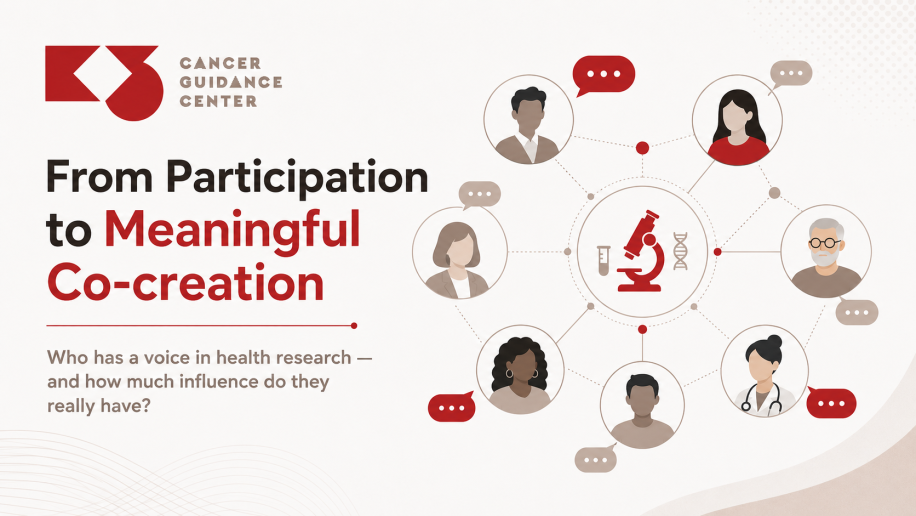
Co-creation in health research: from participation to meaningful influence

Co-creation in health research: from participation to meaningful influence

A new scientific study proposes a framework for understanding who participates in research, when they participate, how they contribute — and how much influence they actually have

Co-creation is becoming increasingly important across public health, research, social innovation and the design of healthcare services. Patients, caregivers, citizens, healthcare professionals, researchers and communities are more frequently being invited to contribute to the development of interventions, services and solutions.

Yet an important question remains:

What does “participation” actually mean?

The presence of a patient or community representative in a meeting does not necessarily mean that they can influence the design, decisions or outcomes of a research project. Similarly, being asked to complete a survey is fundamentally different from helping to design an intervention, interpret findings or determine how results are shared.

A new open-access study, published on 19 August 2026 in the Journal of Public Health, addresses this challenge. Katrina Messiha, Mai J. M. Chinapaw, Johannes C. F. Ket, Renée I. Wink and Teatske M. Altenburg developed the Co-creation Roles Framework, an operational framework designed to systematically describe and classify the roles of different stakeholders in co-creation research.

Moving beyond “who was involved?”

One of the study’s most valuable contributions is its shift away from simply recording whether stakeholders participated towards examining the nature, depth and quality of that participation.

The framework captures eight key dimensions:

  • the research stage at which participation occurs,
  • the target group or stakeholder involved,
  • the aim of involvement,
  • how stakeholder knowledge is used,
  • the level of engagement and influence,
  • the form of co-creation,
  • the platform through which engagement takes place,
  • and the duration of engagement.

The relevant question therefore becomes much more precise than “Were patients or citizens involved?”

Instead, researchers can ask:

When were they involved? What were they asked to contribute? How was their knowledge used? And how much influence did they actually have over decisions?

What did the study find?

To demonstrate the practical application of the framework, the researchers conducted a systematic review following PRISMA guidance.

They analysed 39 scientific articles representing 19 youth-focused public health projects based on co-creation, Youth Participatory Action Research or Community-Based Participatory Research approaches.

The analysis revealed substantial variation in the ways stakeholders were engaged.

One particularly striking finding was that, under the strict definition used in the framework, none of the 19 projects reached the highest level of engagement — “empowerment”, where stakeholders hold genuine decision-making authority.

During the implementation stage, consultation and involvement were the most frequent levels of engagement, while consultation was also the most common approach during evaluation.

This finding matters.

It demonstrates that describing a project as “co-created” does not automatically mean that the people for whom an intervention is being developed have meaningful power to shape it.

Participation should not end when the research ends

Another important finding concerned dissemination and reporting.

Only 4 of the 19 projects included a reporting stage extending beyond conventional academic publication.

In some cases, young stakeholders were involved in presenting findings, communicating results within their communities, or developing dissemination materials and practical tools. Overall, however, stakeholder involvement in the final stages of the research process remained limited.

This is highly relevant to health research.

People who contribute their lived experience, time and knowledge to a study should not be considered merely a source of data. They can also play an important role in interpreting findings, shaping key messages and helping return knowledge to the communities from which it originated.

From patient participant to patient co-creator

This discussion has particular relevance for cancer research and cancer care.

Patients and caregivers hold a form of knowledge that clinical evidence alone cannot provide: the lived experience of illness and care.

They understand what treatment means in everyday life; where administrative, social or practical barriers interfere with care; whether a digital health service is genuinely understandable and accessible; which questions remain unanswered; and which outcomes actually matter to the people living with cancer.

Using this knowledge is not simply a matter of representation.

It is a matter of research quality.

For a patient-support organisation such as Kapa3, co-creation therefore means more than inviting patients into an existing process. It requires creating the conditions in which lived experience can become knowledge, knowledge can shape design, and design can ultimately lead to more relevant, accessible and person-centred services.

A framework for planning future research

The authors emphasise that the Co-creation Roles Framework may be valuable not only for describing completed research, but also for planning and evaluating future projects.

Research teams may use it prospectively to clarify stakeholder roles from the beginning, while funders, ethics committees and scientific journals could potentially use such structured approaches to assess how clearly and meaningfully stakeholder participation has been planned and reported.

At the same time, the framework should not yet be regarded as a definitive standard.

The authors explicitly call for external validation across diverse co-creation settings. They also recognise an important limitation: non-academic stakeholders were not directly involved in developing the framework itself, which may limit its sensitivity to some experiential and contextual understandings of stakeholder roles.

Recognising these limitations is itself an important part of advancing more rigorous participatory research.

The next challenge: not simply more participation, but more meaningful participation

Co-creation should not become another box to tick in a research proposal.

The more important challenge is to be able to demonstrate:

who had a voice, when that voice was heard, how it influenced decisions and what ultimately changed because of that contribution.

As healthcare moves towards more participatory, person-centred and digitally supported models of care, the shift from research about patients to research with patients, and ultimately towards research shaped together with patients, may become one of the defining requirements for research that is both scientifically robust and genuinely relevant to people’s lives.

Scientific source

Messiha K, Chinapaw MJM, Ket JCF, Wink RI, Altenburg TM. Development and application of a framework for classifying stakeholder roles in co-creation research: a Health CASCADE study. Journal of Public Health. Published 19 August 2026. DOI: 10.1007/s10389-026-02881-2.

Messiha_et_al-2026-Journal_of_Public_Health

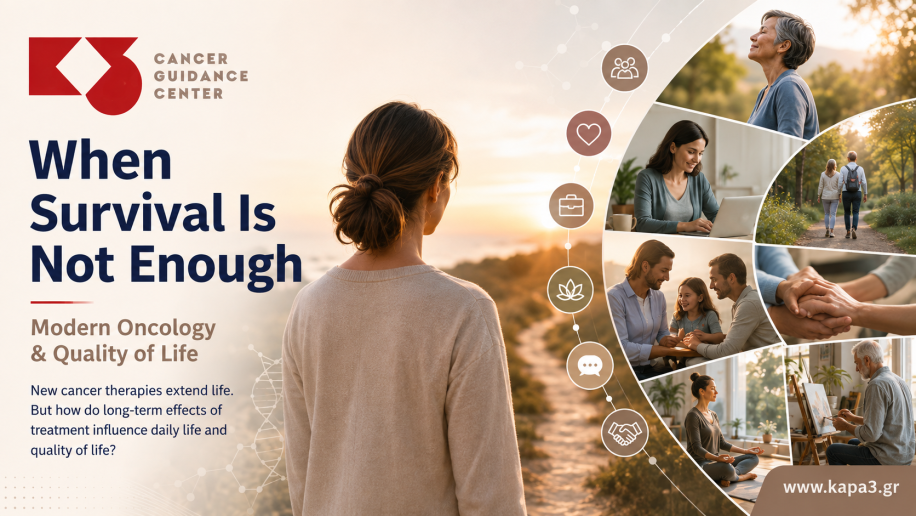
Modern Oncology: When Survival Is Not Enough

New therapies, “hidden” effects and the need to assess not only how long patients live, but how they live

Modern Oncology: When Survival Is Not Enough

New therapies, “hidden” effects and the need to assess not only how long patients live, but how they live

Modern oncology is changing at an unprecedented pace. Immunotherapies, antibody–drug conjugates (ADCs), bispecific antibodies and new targeted therapies are creating treatment opportunities that would have been unimaginable only a few years ago.

Cancer treatment is becoming increasingly personalised and tailored to the biological and molecular characteristics of each tumour, while overall survival is being extended for many people living with cancer.

Yet alongside this remarkable scientific progress, a critical question is emerging:

What does it really mean to live longer after — or with — cancer?

A recent Nature Medicine editorial, entitled “Oncology must confront hidden side effects”, highlights precisely this challenge. While cancer drug development is advancing at remarkable speed, the approaches used to record, assess and manage long-term treatment-related toxicities — and their impact on patients’ quality of life — have not evolved at the same pace.

When a “mild” side effect becomes a major burden

Therapeutic success can create a new reality: people are living longer, but some must also manage treatment-related adverse effects for months, years or even for the rest of their lives.

An adverse event classified clinically as low-grade is not necessarily insignificant to the person experiencing it.

A persistent rash, diarrhoea, stomatitis or other symptoms may substantially affect daily functioning, psychological wellbeing and social life when they continue over long periods.

Similarly, some immune-related adverse events associated with immune checkpoint inhibitors can become chronic, persist for years or even be irreversible.

This highlights an important limitation of the Common Terminology Criteria for Adverse Events (CTCAE), which are widely used to classify and grade treatment-related adverse events.

The duration of adverse events is not adequately reflected, while functional and psychological consequences may also remain outside traditional toxicity assessment.

As a result, what may be considered “manageable” according to conventional clinical criteria can feel very different to the patient living with it every day.

Quality of life cannot be an afterthought

A second important issue is the timing of quality-of-life evidence.

In some cases, quality-of-life findings are reported considerably later than the primary results of a clinical trial, and sometimes after a new drug has already been approved.

This means that patients making treatment decisions during the early years of a new therapy may not yet have a complete picture of how it could affect their daily functioning, emotional wellbeing and overall quality of life.

At the same time, the questionnaires and tools used to assess quality of life need to evolve continuously.

And this cannot happen without the direct involvement of patients themselves.

The experiences and priorities of people receiving treatment should form part of how treatment impact is assessed, rather than being treated as information that is added later.

The example of daraxonrasib

The Nature Medicine editorial highlights the pan-RAS inhibitor daraxonrasib as a telling example. The therapy has shown important survival benefits for patients with aggressive RAS-driven advanced pancreatic cancer, a setting in which treatment options have historically been limited.

At the same time, most patients experienced acneiform rash, with diarrhoea and stomatitis also reported as lower-grade treatment-related adverse events.

Full quality-of-life data — including information on daily functioning and emotional wellbeing — were not yet available because follow-up remained relatively short.

This example illustrates a much wider issue.

If we know that a therapy can significantly extend life, but we do not yet fully understand what that life will be like, an essential part of the information is missing from the conversation between patients and their healthcare teams.

This also has direct implications for informed consent.

Whenever evidence is available, patients need information not only about response rates and survival but also about the potential short- and long-term consequences of treatment for their everyday lives.

The same treatment is not experienced in the same way by everyone

The toxicity profile of a treatment is not identical for every patient.

It may vary according to the drug’s mechanism of action, a person’s physical condition, co-existing long-term conditions, genetic background and other individual characteristics.

Particular attention is needed for populations that have historically been excluded from, or underrepresented in, clinical trials, as their experiences of treatment-related toxicity may differ.

The editorial points, for example, to sex-related differences in adverse events associated with immunotherapy and racial disparities in adverse events observed with CAR-T cell therapy.

This makes real-world data particularly important.

Clinical trials remain fundamental to establishing the safety and efficacy of new treatments. However, broader use in everyday clinical practice may reveal treatment effects that were not fully captured in the populations included in initial studies.

One example is the bispecific antibody amivantamab in lung cancer, where the full extent and severity of some skin toxicities became clearer after a broader patient population was exposed to the treatment.

Moving beyond clinical silos

This changing landscape also demands a different approach to the organisation of cancer care.

The adverse effects of modern cancer therapies do not always fit within a single organ system or medical specialty.

Traditional clinical and disciplinary silos can limit the transfer of knowledge needed to identify, monitor and manage emerging toxicities effectively.

The response therefore needs to be interdisciplinary.

Collaborative networks, updated guidance, systematic reporting, dedicated registries and effective knowledge exchange are increasingly important so that new or rare adverse effects can be recognised early and managed appropriately.

Above all, the patient voice must be heard

Perhaps the most important change concerns how we define treatment success itself.

Survival remains a fundamental goal of oncology.

But it cannot be the only one.

We also need to understand whether people can work, move, sleep, eat, participate in family and social life, maintain as much independence as possible and manage the effects of treatment on their everyday lives.

In other words, we need to know not only how much time a treatment adds to life, but also what that time means to the person living it.

Patients should therefore not enter the process only at the end, as recipients of treatment.

Their perspectives need to be incorporated from the design of clinical trials and assessment tools through to post-approval monitoring and the real-world use of new cancer therapies.

From survival to living after — and with — cancer

Progress in oncology is undeniable, and it brings genuine hope.

The next challenge is to ensure that longer survival is accompanied by quality of life, functioning, meaningful information, participation and dignity.

Modern cancer care therefore needs to move beyond asking only:

“How much longer can this patient live?”

and give equal importance to another question:

“How will this person live during that additional time?”

For Kapa3, this discussion goes to the heart of truly person-centred cancer care: care that sees not only the disease and the treatment, but the person, their everyday life, their needs, their choices and the life that continues during and after cancer.

Source and references

Main source:
Nature Medicine. “Oncology must confront hidden side effects.” Volume 32, July 2026. Published online 8 July 2026. DOI: 10.1038/s41591-026-04554-9.

  1. Barron CC et al. Journal for ImmunoTherapy of Cancer. 2023;11.
  2. Gyawali B et al. Lancet Oncology. 2025;26–e89.
  3. O’Reilly EM et al. New England Journal of Medicine. 2026. DOI: 10.1056/NEJMoa2605555.
  4. Unger JM et al. Journal of Clinical Oncology. 2022;40:1474–1486.
  5. Rayapureddy AK et al. Journal of Clinical Oncology. 2026;44.
  6. Hines MR et al. Transplantation and Cellular Therapy. 2023;29:438.e1–438.e16.

find more s41591-026-04554-9

Κapa3 at IEEE CBMS 2026 | AI for Equitable Oncology Information

Kapa3 at IEEE CBMS 2026: Artificial Intelligence in Support of Equitable Patient Information in Oncology Care

New scientific publication in the Proceedings of the 39th IEEE International Symposium on Computer-Based Medical Systems

The voice and lived experience of patients must remain at the centre of the emerging era of Artificial Intelligence in healthcare.

Kapa3 – Cancer Guidance Centre contributes to a new scientific publication presented in the Proceedings of the 2026 IEEE 39th International Symposium on Computer-Based Medical Systems (CBMS), focusing on how Artificial Intelligence and Retrieval-Augmented Generation can support more equitable, reliable and patient-centred access to information in oncology.

The paper, entitled:

“Informed, Empowered, and Heard: AI and Retrieval-Augmented Generation as Tools for Equitable Patient Information in Oncology”

is authored by Lars Münter, Evangeli Bista, Maria Lavdaniti and Christos Frantzidis, with Evangeli Bista representing Kapa3 as Co-founder.

From access to information to meaningful patient empowerment

A cancer diagnosis creates an immediate need for information that is reliable, understandable and relevant to the individual patient.

At the same time, patients and their families are often expected to understand complex medical terminology, treatment options, prognosis discussions and administrative procedures at a moment of intense psychological and emotional pressure.

The paper highlights that acute stress associated with a serious diagnosis can affect working memory, attention and the ability to process new information. This means that patient information cannot be designed for an ideal, fully attentive reader; it must respond to the real cognitive and emotional conditions experienced by people facing cancer.

The key question is therefore not simply:

“How much information do we provide?”

but rather:

“Are we providing the right information, at the right time, in a form that people can understand and act upon?”

AI and Retrieval-Augmented Generation: towards trustworthy and evidence-grounded information

The publication places particular emphasis on Retrieval-Augmented Generation (RAG).

RAG architectures combine the generative capabilities of large language models with the retrieval of information from curated and verified knowledge sources. In a healthcare setting, this can include clinical guidelines, validated patient information resources, regulatory documents and peer-reviewed literature.

This approach offers an important advantage over purely generative AI systems: responses can be grounded in identifiable sources, supporting greater transparency and enabling patients and healthcare professionals to verify where information comes from.

In oncology, this is especially important.

A patient does not simply need a quick answer. They need information that is:

accurate, current, understandable, accessible and appropriate to their individual situation.

Artificial Intelligence as a tool for equity

One of the central themes of the paper is inequality in access to high-quality oncology information.

Geography, language, socioeconomic circumstances, health literacy, digital literacy and access to specialised healthcare services can significantly influence a person’s ability to understand their diagnosis, treatment options and rights.

The publication pays particular attention to the Greek context, where patients living in large urban centres may experience a very different information environment from those living in rural, remote or island communities.

When equity is treated as a core design principle, AI-RAG systems can potentially support:

  • multilingual access to health information,
  • different levels of language and information complexity,
  • voice-based interfaces,
  • shorter and more manageable units of information,
  • low-bandwidth or offline-capable solutions,
  • and opportunities for patients to return to information when they are ready to process it.

Technology alone, however, does not create equity.

The way technology is designed determines whether it reduces existing inequalities or reproduces them.

Designed with patients, for patient needs

The paper calls for an important shift in the way digital health systems are developed.

Many traditional health information systems are designed primarily around institutional or clinical workflows, with patient-facing communication added later.

For patient-centred AI, this logic must be reversed.

Systems should be designed with patients and around patient needs, with patients and informal carers actively involved in shaping the knowledge base, the questions the system is expected to answer and the ways information is presented.

This also means moving beyond systems that simply respond to individual questions.

A meaningful AI-supported information environment could help patients prepare for clinical consultations, organise their questions, understand the next steps in their care and become more aware of their rights.

The paper highlights applications such as consultation preparation guides, question prompts before appointments and post-consultation summaries as examples of how technology can support patients before, during and after important healthcare interactions.

AI should strengthen, not replace, human relationships

Perhaps the most important message of the publication is that the transformative potential of AI in oncology is not primarily technical. It is relational.

Artificial Intelligence should not create distance between patients and healthcare professionals.

It should help strengthen their communication.

A better-informed patient can arrive at a clinical consultation more prepared, identify questions and concerns more clearly, participate more actively in shared decision-making and communicate more effectively with the healthcare team.

The same applies to informal carers, who often carry a significant part of the informational and emotional burden of cancer care.

For this reason, the paper argues that AI-RAG systems should be designed to strengthen the relationship between patients, carers and healthcare professionals, rather than to replace any part of this human network of care.

For healthcare professionals, trustworthy information systems may also reduce the time required for basic information provision, allowing more of the clinical encounter to focus on nuanced discussions, decision-making and the human aspects of care that technology cannot replicate.

From information to trust

This scientific contribution adds to an increasingly important discussion about the future of healthcare:

How can Artificial Intelligence be developed and used in ways that genuinely respond to human needs?

The answer does not lie only in more powerful AI models or larger volumes of data.

It also lies in evidence, transparency, accessibility, co-design, equity and respect for patient rights.

As the paper concludes, people affected by cancer in Greece and across Europe deserve access to information that is accurate, personalised, accessible and respectful of their rights, regardless of where they live, the language they speak or the socioeconomic resources available to them.

For Kapa3, participating in this scientific discussion also reflects a broader commitment: ensuring that real patient needs, lived experience and equitable access are represented in the design and evaluation of the next generation of digital health and AI-supported tools.

Publication details

Title: Informed, Empowered, and Heard: AI and Retrieval-Augmented Generation as Tools for Equitable Patient Information in Oncology

Authors: Lars Münter, Evangeli Bista, Maria Lavdaniti, Christos Frantzidis

Published in: 2026 IEEE 39th International Symposium on Computer-Based Medical Systems (CBMS)

DOI: 10.1109/CBMS69103.2026.00302

find more 499901b523

Kapa3 joins PERIFORMANCE: From Information to Trust in Cancer Care

Kapa3 – Cancer Guidance Centre is pleased to announce that its proposal, “From Information to Trust: MYRTO Patient & Citizen Lab for Equal Access in Cancer Care,” has been selected for funding under the PERIFORMANCE Open Call for Bottom-Up Stakeholder Engagement Initiatives in Cancer Research & Care.

The initiative places patients, caregivers, healthcare and social care professionals, civil society organisations and local communities at the heart of the process, creating a participatory framework for the ethical, trustworthy and inclusive use of AI-enabled cancer navigation.

Putting patients and citizens at the centre

The project is closely linked to MYRTO, Kapa3’s AI-enabled digital social assistant designed to support people affected by cancer in navigating health, social care, administrative procedures and rights-related information.

PERIFORMANCE funding will not support the core technical development of MYRTO. Instead, the project will focus on building the participatory, educational and ethical layer around the tool, ensuring that its future development is shaped by the real needs, experiences and expectations of the people who will use it.

This approach reflects a key principle for Kapa3: technology should not replace human care. When designed responsibly, however, it can become a powerful tool for improving access, empowerment and equality.

From local communities to a national dialogue

The engagement pathway will include regional listening activities, a thematic focus on vulnerable and underrepresented groups, and a central MYRTO Patient & Citizen Lab in Athens.

Particular attention will be given to caregivers, older patients, migrants, people with disabilities, people with low health or digital literacy, socially vulnerable groups and people living far from specialised oncology services.

The Athens Lab will be integrated into Kapa3’s national conference “Equality in Access”, creating a space for synthesising regional experiences, identifying trust criteria and collecting patient and caregiver perspectives on AI-supported navigation.

What does trust in AI-supported cancer navigation mean?

At the heart of the project lies a fundamental question:

What does a person need in order to trust a digital tool during one of the most sensitive periods of their life?

Through co-creation and stakeholder engagement, the initiative will explore issues such as:

  • reliability and clarity of information,
  • data protection and privacy,
  • accessibility and digital inclusion,
  • responsible use of Artificial Intelligence,
  • prevention of bias and exclusion,
  • human oversight,
  • and clear referral pathways to appropriate professionals when human support is needed.

Bringing together science, civil society and lived experience

Kapa3 will coordinate the initiative and lead its design, implementation, facilitation, patient and community outreach, dissemination and reporting.

The project will be supported by a multidisciplinary academic and scientific collaboration network involving the International Hellenic University – Department of Nursing, University of West Attica – Department of Occupational Therapy, Democritus University of Thrace – Department of Social Work, and University of the Peloponnese – Department of Nursing. simasiaAI will provide technical support for MYRTO-related digital materials and the AI navigation environment.

The project is expected to produce practical resources including a Patient Guidance Toolkit, a Trust & Human Escalation Checklist, a Training and Dissemination Package, and an Engagement & Trust Report.

From information to trust

For Kapa3, participation in PERIFORMANCE marks another step towards ensuring that the patient voice is present not only when new services and technologies are evaluated, but from the very beginning of their design.

With MYRTO, the question is no longer simply:

“How can we provide more information?”

It is increasingly:

“How can we turn information into understanding, trust, safety and real access?”

Because responsible digital health innovation begins with people.