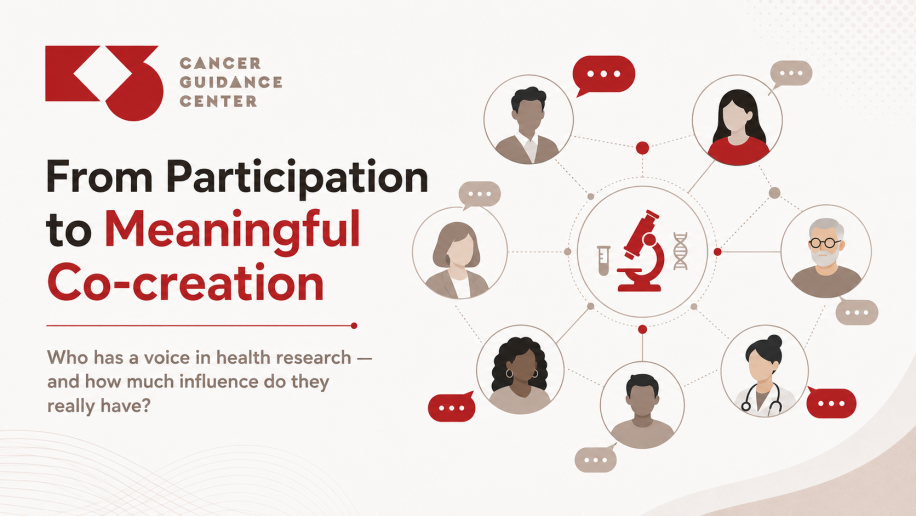
Co-creation in health research: from participation to meaningful influence

Co-creation in health research: from participation to meaningful influence

A new scientific study proposes a framework for understanding who participates in research, when they participate, how they contribute — and how much influence they actually have

Co-creation is becoming increasingly important across public health, research, social innovation and the design of healthcare services. Patients, caregivers, citizens, healthcare professionals, researchers and communities are more frequently being invited to contribute to the development of interventions, services and solutions.

Yet an important question remains:

What does “participation” actually mean?

The presence of a patient or community representative in a meeting does not necessarily mean that they can influence the design, decisions or outcomes of a research project. Similarly, being asked to complete a survey is fundamentally different from helping to design an intervention, interpret findings or determine how results are shared.

A new open-access study, published on 19 August 2026 in the Journal of Public Health, addresses this challenge. Katrina Messiha, Mai J. M. Chinapaw, Johannes C. F. Ket, Renée I. Wink and Teatske M. Altenburg developed the Co-creation Roles Framework, an operational framework designed to systematically describe and classify the roles of different stakeholders in co-creation research.

Moving beyond “who was involved?”

One of the study’s most valuable contributions is its shift away from simply recording whether stakeholders participated towards examining the nature, depth and quality of that participation.

The framework captures eight key dimensions:

  • the research stage at which participation occurs,
  • the target group or stakeholder involved,
  • the aim of involvement,
  • how stakeholder knowledge is used,
  • the level of engagement and influence,
  • the form of co-creation,
  • the platform through which engagement takes place,
  • and the duration of engagement.

The relevant question therefore becomes much more precise than “Were patients or citizens involved?”

Instead, researchers can ask:

When were they involved? What were they asked to contribute? How was their knowledge used? And how much influence did they actually have over decisions?

What did the study find?

To demonstrate the practical application of the framework, the researchers conducted a systematic review following PRISMA guidance.

They analysed 39 scientific articles representing 19 youth-focused public health projects based on co-creation, Youth Participatory Action Research or Community-Based Participatory Research approaches.

The analysis revealed substantial variation in the ways stakeholders were engaged.

One particularly striking finding was that, under the strict definition used in the framework, none of the 19 projects reached the highest level of engagement — “empowerment”, where stakeholders hold genuine decision-making authority.

During the implementation stage, consultation and involvement were the most frequent levels of engagement, while consultation was also the most common approach during evaluation.

This finding matters.

It demonstrates that describing a project as “co-created” does not automatically mean that the people for whom an intervention is being developed have meaningful power to shape it.

Participation should not end when the research ends

Another important finding concerned dissemination and reporting.

Only 4 of the 19 projects included a reporting stage extending beyond conventional academic publication.

In some cases, young stakeholders were involved in presenting findings, communicating results within their communities, or developing dissemination materials and practical tools. Overall, however, stakeholder involvement in the final stages of the research process remained limited.

This is highly relevant to health research.

People who contribute their lived experience, time and knowledge to a study should not be considered merely a source of data. They can also play an important role in interpreting findings, shaping key messages and helping return knowledge to the communities from which it originated.

From patient participant to patient co-creator

This discussion has particular relevance for cancer research and cancer care.

Patients and caregivers hold a form of knowledge that clinical evidence alone cannot provide: the lived experience of illness and care.

They understand what treatment means in everyday life; where administrative, social or practical barriers interfere with care; whether a digital health service is genuinely understandable and accessible; which questions remain unanswered; and which outcomes actually matter to the people living with cancer.

Using this knowledge is not simply a matter of representation.

It is a matter of research quality.

For a patient-support organisation such as Kapa3, co-creation therefore means more than inviting patients into an existing process. It requires creating the conditions in which lived experience can become knowledge, knowledge can shape design, and design can ultimately lead to more relevant, accessible and person-centred services.

A framework for planning future research

The authors emphasise that the Co-creation Roles Framework may be valuable not only for describing completed research, but also for planning and evaluating future projects.

Research teams may use it prospectively to clarify stakeholder roles from the beginning, while funders, ethics committees and scientific journals could potentially use such structured approaches to assess how clearly and meaningfully stakeholder participation has been planned and reported.

At the same time, the framework should not yet be regarded as a definitive standard.

The authors explicitly call for external validation across diverse co-creation settings. They also recognise an important limitation: non-academic stakeholders were not directly involved in developing the framework itself, which may limit its sensitivity to some experiential and contextual understandings of stakeholder roles.

Recognising these limitations is itself an important part of advancing more rigorous participatory research.

The next challenge: not simply more participation, but more meaningful participation

Co-creation should not become another box to tick in a research proposal.

The more important challenge is to be able to demonstrate:

who had a voice, when that voice was heard, how it influenced decisions and what ultimately changed because of that contribution.

As healthcare moves towards more participatory, person-centred and digitally supported models of care, the shift from research about patients to research with patients, and ultimately towards research shaped together with patients, may become one of the defining requirements for research that is both scientifically robust and genuinely relevant to people’s lives.

Scientific source

Messiha K, Chinapaw MJM, Ket JCF, Wink RI, Altenburg TM. Development and application of a framework for classifying stakeholder roles in co-creation research: a Health CASCADE study. Journal of Public Health. Published 19 August 2026. DOI: 10.1007/s10389-026-02881-2.

Messiha_et_al-2026-Journal_of_Public_Health

New Scientific Publication with the Participation of Kapa3: Cancer Survivorship in the Post-COVID-19 Era

New scientific publication involving the Cancer Patient Guidance Center – Kapa3 highlights the significant psychological, social, and functional challenges that people living with and beyond cancer continue to face following the COVID-19 pandemic.

The article, entitled “Cancer Survivorship After COVID-19: Psychological Burden, Symptom Experience, and Social Support,” was published in the international peer-reviewed journal Medicina. It examines psychological distress, symptom experience, quality of life, and the protective role of social support among people affected by cancer.

What Did the Study Examine?

The research involved 162 adults diagnosed with cancer in Greece during the post-COVID-19 period. Participants completed validated questionnaires assessing depression, anxiety, stress, health-related quality of life, and perceived social support.

The results revealed a substantial and persistent psychological burden:

  • 32.1% of participants reported severe or extremely severe depression.
  • 40.1% reported severe or extremely severe anxiety.
  • 29% reported severe or extremely severe stress.

The overall quality of life of participants was found to be moderate. Emotional and social functioning were among the most affected areas, while fatigue, insomnia, breathlessness, and financial difficulties emerged as some of the most significant challenges in everyday life.

The Close Relationship Between Mental Health and Quality of Life

One of the study’s key findings was the strong relationship between psychological distress and poorer quality of life.

Higher levels of depression, anxiety, and stress were associated with:

  • poorer daily and functional performance;
  • lower perceived overall health;
  • greater symptom severity;
  • increased difficulty in emotional and social functioning.

The results demonstrate that psychological well-being cannot be separated from the physical, social, and practical experience of cancer.

Social Support as a Protective Factor

At the same time, the study underlines the important protective role of social support.

Support from family members, friends, and other significant people was associated with better overall health and functioning, lower levels of depression, anxiety, and stress, and reduced symptom burden.

The findings show that social connection is not simply an additional element of care. It is a meaningful component of recovery, adaptation, and quality of life throughout the cancer journey.

Cancer Survivorship Does Not End When Treatment Is Completed

The findings reinforce the need to move beyond a model of oncology care focused exclusively on treating the disease.

Cancer survivorship requires a comprehensive, person-centred approach that addresses the physical, psychological, social, functional, and financial dimensions of life with and after cancer.

Routine psychological assessment, early identification of emotional distress, timely referral to psycho-oncology services, rehabilitation, social support, and the meaningful involvement of families and caregivers should become integral parts of standard oncology care.

The study also points to the potential value of telehealth and digital support services in improving access to supportive care. At the same time, it highlights inequalities related to digital literacy, healthcare accessibility, and the ability of all patients to benefit equally from digital services.

The experience of the COVID-19 pandemic demonstrated that effective cancer care must be resilient, accessible, multidisciplinary, and capable of maintaining continuity even during periods of crisis.

Read more medicina-4429149

January – Cervical Cancer Awareness Month

January is internationally dedicated to raising awareness about cervical cancer. Known as Cervical Cancer Awareness Month, it aims to highlight the importance of prevention, early detection, and vaccination against the human papillomavirus (HPV), which is responsible for nearly all cases of the disease.

Cervical cancer remains a major public health issue worldwide. According to the World Health Organization, approximately 660,000 new cases are diagnosed globally each year, and more than 350,000 women lose their lives to the disease. It is among the most common cancers affecting women, particularly in regions where access to preventive screening and vaccination is limited. At the same time, it is one of the few cancers that can largely be prevented through organized prevention and early detection programmes.

In Greece, available data indicate that around 700 new cases of cervical cancer are diagnosed annually, while more than 280 deaths are attributed to the disease each year. The estimated incidence is approximately 8 cases per 100,000 women. Although this places Greece close to the European average, it also highlights the need for further improvement in prevention and early diagnosis.

Cervical cancer is closely linked to chronic infection with human papillomavirus (HPV), a very common virus transmitted mainly through sexual contact.

HPV vaccination, combined with regular gynaecological screening through Pap tests and HPV tests, can significantly reduce the development of precancerous lesions and cervical cancer. In this context, the World Health Organization has set the goal of eliminating cervical cancer as a public health problem by 2030, through high vaccination coverage, universal screening, and timely treatment.

January serves as an important reminder that information and prevention save lives. Open discussion around women’s health, free from fear and stigma, empowers women to take care of themselves and to claim prevention as a fundamental right.

Special emphasis should be placed on the systematic education of younger generations, as prevention begins long before any symptoms appear. Access to reliable information, preventive screening services, and vaccination programmes is a key factor in reducing health inequalities and protecting future generations.

At KAPA3, we believe that information and prevention are core pillars of care and empowerment. Through the dissemination of reliable information and the support of initiatives that promote public health, we stand alongside every woman who needs knowledge, prevention, and timely care.

Because cervical cancer can be prevented, we encourage everyone to take action. Give a meaningful gift to the women you care about: daughters, sisters, mothers, friends, partners, spouses. Talk openly about women’s health, share information, support initiatives, challenge taboos, and promote early diagnostic screening.

Information and open dialogue are the strongest tools we have.

Sources:

World Health Organization (WHO)
Cervical cancer – Fact sheet

WHO – Global strategy to accelerate the elimination of cervical cancer

International Agency for Research on Cancer (IARC / WHO)
Cervical Cancer Awareness Month

ICO / IARC HPV Information Centre – Greece Factsheet

Ministry of Health – National Immunization Programme

Hellenic National Public Health Organization (EODY)
HPV and cervical cancer

Text/adaptation: Ifiyenia Anastasiou for Kapa3

2025 – Moving Forward with Vision

The Kapa3 Annual Review 2025 reflects a year of determination and vision, as Kapa3 strengthened its impact through initiatives and collaborations focused on holistic cancer care.During the first half of the year alone, we managed more than 400 individual requests, with support for the process of Disability Certification standing out as a key service—confirming that personalized, hands-on support remains at the core of our mission.

A milestone moment in 2025 was Kapa3’s participation, alongside 13 European partners, in the EU4Health programme MELODIC, which focuses on improving mental health support for young adult cancer patients (18–39 years old). Through research mapping the training needs of healthcare professionals, the project highlights the urgent need for better detection and management of psychological distress among young patients—many of whom still lack access to adequate psychosocial care.

MELODIC promotes innovative wellbeing interventions, such as physical activity in green and blue spaces combined with psychosocial support, emphasizing the healing power of nature and community in mental health recovery. As an active partner, Kapa3 works to ensure that these actions reach patients directly, fostering community engagement and equitable access to quality care.

At the same time, our participation in the second cycle of the SmartHEALTH programme, supported by CERTH, strengthened the digital integration of healthcare services and empowered patients through smart technologies, improving efficiency, accessibility, and transparency.

Our collaboration with FairLife within the BREATH programme for lung cancer patients highlighted the importance of holistic and interdisciplinary care. In parallel, our presence at conferences and scientific events—such as COST Action INECSC CA21125 and the 7th conference “Caregivers and Depression”—consistently brought attention to the needs of caregivers and the empowerment of patients.

At both national and international levels, Kapa3 presented its work at the Lazord International Conference, the Pan-Macedonian Scientific Nursing Conference, and the ESMO World Congress in Berlin. We also participated in major events such as the Patients Summit, Morning Health Talks by EIT Health, and the 18th Panhellenic Conference on Nutrition & Dietetics.

A particularly important moment was our action in the Municipality of Megara, where a new Cancer Patient Guidance and Counselling Station was established, offering direct and personalized support to patients and their families.

Prevention and awareness remain fundamental pillars of our work. Breast self-examination initiatives, participation in the Action4Obesity network, presence at the Thessaloniki Disability Festival, and the launch of new nutrition-related sections on our website all contribute to improving the quality of life of patients and caregivers—combining scientific guidance with lived experience.

Awards 2025

In 2025, Kapa3 received significant recognition for the digital platform Cancer Care Connect, winning a Gold Award at the Diversity, Equity & Inclusion Awards, as well as the Gold Award for “NGO of the Year – Health and Social Care at the Hellenic Responsible Business Awards 2025.
In addition, our collaboration with the University of Peloponnese received a Silver Award at the Healthcare Business Awards 2025 for the programme “Community co-design and implementation of holistic educational practices for nutrition and mental health.”

Every initiative, every partnership, and every participation brings us closer to our vision: holistic, human-centred care where the voices of patients and caregivers truly matter.

To explore our full journey from the foundation of Kapa3 through the end of 2025, you can view our comprehensive activity report here.

The Kapa3 Annual Review 2025 reaffirms our commitment to holistic, human-centred care, where the voices of patients and caregivers truly matter.

As we step into the new year, we move forward with enthusiasm, commitment, and optimism—to continue supporting patients and caregivers, investing in innovation and education, and strengthening care and participation across all our actions.

We wish everyone a year filled with health, strength, and inspiration.

The Kapa3 Team