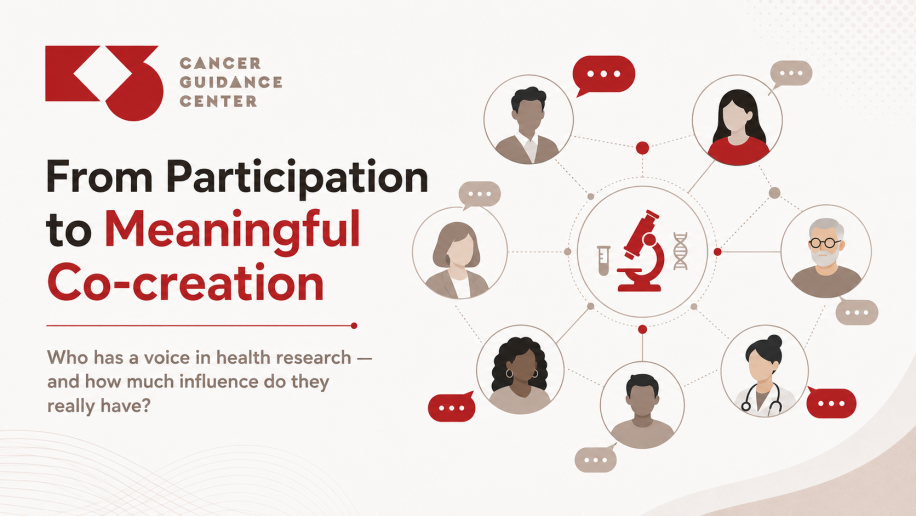
Co-creation in health research: from participation to meaningful influence
A new scientific study proposes a framework for understanding who participates in research, when they participate, how they contribute — and how much influence they actually have
Co-creation is becoming increasingly important across public health, research, social innovation and the design of healthcare services. Patients, caregivers, citizens, healthcare professionals, researchers and communities are more frequently being invited to contribute to the development of interventions, services and solutions.
Yet an important question remains:
What does “participation” actually mean?
The presence of a patient or community representative in a meeting does not necessarily mean that they can influence the design, decisions or outcomes of a research project. Similarly, being asked to complete a survey is fundamentally different from helping to design an intervention, interpret findings or determine how results are shared.
A new open-access study, published on 19 August 2026 in the Journal of Public Health, addresses this challenge. Katrina Messiha, Mai J. M. Chinapaw, Johannes C. F. Ket, Renée I. Wink and Teatske M. Altenburg developed the Co-creation Roles Framework, an operational framework designed to systematically describe and classify the roles of different stakeholders in co-creation research.
Moving beyond “who was involved?”
One of the study’s most valuable contributions is its shift away from simply recording whether stakeholders participated towards examining the nature, depth and quality of that participation.
The framework captures eight key dimensions:
- the research stage at which participation occurs,
- the target group or stakeholder involved,
- the aim of involvement,
- how stakeholder knowledge is used,
- the level of engagement and influence,
- the form of co-creation,
- the platform through which engagement takes place,
- and the duration of engagement.
The relevant question therefore becomes much more precise than “Were patients or citizens involved?”
Instead, researchers can ask:
When were they involved? What were they asked to contribute? How was their knowledge used? And how much influence did they actually have over decisions?
What did the study find?
To demonstrate the practical application of the framework, the researchers conducted a systematic review following PRISMA guidance.
They analysed 39 scientific articles representing 19 youth-focused public health projects based on co-creation, Youth Participatory Action Research or Community-Based Participatory Research approaches.
The analysis revealed substantial variation in the ways stakeholders were engaged.
One particularly striking finding was that, under the strict definition used in the framework, none of the 19 projects reached the highest level of engagement — “empowerment”, where stakeholders hold genuine decision-making authority.
During the implementation stage, consultation and involvement were the most frequent levels of engagement, while consultation was also the most common approach during evaluation.
This finding matters.
It demonstrates that describing a project as “co-created” does not automatically mean that the people for whom an intervention is being developed have meaningful power to shape it.
Participation should not end when the research ends
Another important finding concerned dissemination and reporting.
Only 4 of the 19 projects included a reporting stage extending beyond conventional academic publication.
In some cases, young stakeholders were involved in presenting findings, communicating results within their communities, or developing dissemination materials and practical tools. Overall, however, stakeholder involvement in the final stages of the research process remained limited.
This is highly relevant to health research.
People who contribute their lived experience, time and knowledge to a study should not be considered merely a source of data. They can also play an important role in interpreting findings, shaping key messages and helping return knowledge to the communities from which it originated.
From patient participant to patient co-creator
This discussion has particular relevance for cancer research and cancer care.
Patients and caregivers hold a form of knowledge that clinical evidence alone cannot provide: the lived experience of illness and care.
They understand what treatment means in everyday life; where administrative, social or practical barriers interfere with care; whether a digital health service is genuinely understandable and accessible; which questions remain unanswered; and which outcomes actually matter to the people living with cancer.
Using this knowledge is not simply a matter of representation.
It is a matter of research quality.
For a patient-support organisation such as Kapa3, co-creation therefore means more than inviting patients into an existing process. It requires creating the conditions in which lived experience can become knowledge, knowledge can shape design, and design can ultimately lead to more relevant, accessible and person-centred services.
A framework for planning future research
The authors emphasise that the Co-creation Roles Framework may be valuable not only for describing completed research, but also for planning and evaluating future projects.
Research teams may use it prospectively to clarify stakeholder roles from the beginning, while funders, ethics committees and scientific journals could potentially use such structured approaches to assess how clearly and meaningfully stakeholder participation has been planned and reported.
At the same time, the framework should not yet be regarded as a definitive standard.
The authors explicitly call for external validation across diverse co-creation settings. They also recognise an important limitation: non-academic stakeholders were not directly involved in developing the framework itself, which may limit its sensitivity to some experiential and contextual understandings of stakeholder roles.
Recognising these limitations is itself an important part of advancing more rigorous participatory research.
The next challenge: not simply more participation, but more meaningful participation
Co-creation should not become another box to tick in a research proposal.
The more important challenge is to be able to demonstrate:
who had a voice, when that voice was heard, how it influenced decisions and what ultimately changed because of that contribution.
As healthcare moves towards more participatory, person-centred and digitally supported models of care, the shift from research about patients to research with patients, and ultimately towards research shaped together with patients, may become one of the defining requirements for research that is both scientifically robust and genuinely relevant to people’s lives.
Scientific source
Messiha K, Chinapaw MJM, Ket JCF, Wink RI, Altenburg TM. Development and application of a framework for classifying stakeholder roles in co-creation research: a Health CASCADE study. Journal of Public Health. Published 19 August 2026. DOI: 10.1007/s10389-026-02881-2.