January – Cervical Cancer Awareness Month

January is internationally dedicated to raising awareness about cervical cancer. Known as Cervical Cancer Awareness Month, it aims to highlight the importance of prevention, early detection, and vaccination against the human papillomavirus (HPV), which is responsible for nearly all cases of the disease.

Cervical cancer remains a major public health issue worldwide. According to the World Health Organization, approximately 660,000 new cases are diagnosed globally each year, and more than 350,000 women lose their lives to the disease. It is among the most common cancers affecting women, particularly in regions where access to preventive screening and vaccination is limited. At the same time, it is one of the few cancers that can largely be prevented through organized prevention and early detection programmes.

In Greece, available data indicate that around 700 new cases of cervical cancer are diagnosed annually, while more than 280 deaths are attributed to the disease each year. The estimated incidence is approximately 8 cases per 100,000 women. Although this places Greece close to the European average, it also highlights the need for further improvement in prevention and early diagnosis.

Cervical cancer is closely linked to chronic infection with human papillomavirus (HPV), a very common virus transmitted mainly through sexual contact.

HPV vaccination, combined with regular gynaecological screening through Pap tests and HPV tests, can significantly reduce the development of precancerous lesions and cervical cancer. In this context, the World Health Organization has set the goal of eliminating cervical cancer as a public health problem by 2030, through high vaccination coverage, universal screening, and timely treatment.

January serves as an important reminder that information and prevention save lives. Open discussion around women’s health, free from fear and stigma, empowers women to take care of themselves and to claim prevention as a fundamental right.

Special emphasis should be placed on the systematic education of younger generations, as prevention begins long before any symptoms appear. Access to reliable information, preventive screening services, and vaccination programmes is a key factor in reducing health inequalities and protecting future generations.

At KAPA3, we believe that information and prevention are core pillars of care and empowerment. Through the dissemination of reliable information and the support of initiatives that promote public health, we stand alongside every woman who needs knowledge, prevention, and timely care.

Because cervical cancer can be prevented, we encourage everyone to take action. Give a meaningful gift to the women you care about: daughters, sisters, mothers, friends, partners, spouses. Talk openly about women’s health, share information, support initiatives, challenge taboos, and promote early diagnostic screening.

Information and open dialogue are the strongest tools we have.

Sources:

World Health Organization (WHO)
Cervical cancer – Fact sheet

WHO – Global strategy to accelerate the elimination of cervical cancer

International Agency for Research on Cancer (IARC / WHO)
Cervical Cancer Awareness Month

ICO / IARC HPV Information Centre – Greece Factsheet

Ministry of Health – National Immunization Programme

Hellenic National Public Health Organization (EODY)
HPV and cervical cancer

Text/adaptation: Ifiyenia Anastasiou for Kapa3

International Universal Health Coverage Day – December 12

International Universal Health Coverage (UHC) Day is observed every year on December 12 to remind us that access to quality, affordable healthcare is a fundamental human right and a cornerstone of just and sustainable societies. The United Nations established this day to strengthen global commitment so that all people, everywhere, can access the health services they need without financial hardship. (WHO)

Statistics

Universal health coverage is not just a goal. It is a central element of the United Nations  Sustainable Development Goals for 2030. Despite progress in recent decades, the reality remains challenging. Approximately 4.6 billion people worldwide still lack access to essential health services. At the same time, 2.1 billion face financial hardship in accessing care. Finally 1.6 billion pushed into poverty due to health expenditures.

These statistics demonstrate that universal coverage remains far from fully achieved, with significant inequalities between countries and within societies: poorer populations, rural residents, people with lower education, and other vulnerable groups face much greater barriers to healthcare. (WHO – World Bank Report)

Situation in Greece

In Greece, although universal coverage exists in principle through the National Health System, access to care is not always equitable or complete. Only a small percentage of citizens report high satisfaction with service availability, while around 12.1% of people have unmet healthcare needs, a rate significantly higher than the OECD average. (OECD)

Out-of-pocket healthcare expenses particularly affect lower-income households. Nearly nearly 10% of households facing catastrophic health spending, forcing families to sacrifice essentials such as food or housing. (WHO – Health Care Greece)

These inequalities are not just numbers—they have real consequences for quality of life. For cancer patients, universal coverage means timely diagnosis, access to treatments, continuous monitoring, psychosocial support, and palliative care. Lack of comprehensive, accessible care can worsen disease outcomes and increase psychological and financial burden for patients and their families.

At Kapa3, we strive to ensure that no cancer patient or their loved ones feel alone. Through educational initiatives, experiential programs, psychosocial support, and guidance materials, we advocate for healthcare access that respects human dignity, life, and real needs.

Universal Health Coverage Day is not just a date—it is a call to action for broader access, reduced inequalities, and genuine support for all. Together, we can make meaningful change.

Text/adaptation: Ifiyenia Anastasiou for Kapa3

KAPA3 at the 18th Panhellenic Congress of Nutrition & Dietetics

The 18th Panhellenic Congress of Nutrition & Dietetics took place at the Athens Concert Hall from 4–6 December 2025, bringing together scientists and professionals to discuss the latest developments in nutrition under the central theme “Bridging Research and Practice.”

The Congress covered topics ranging from alternative proteins to eating disorders, through lectures, workshops, and roundtable discussions.

During the session “Co-Creating Health: Participatory Research with Cancer Patients on Nutrition and Mental Resilience”, held on Friday, 5 December in Hall MC3, participants included Andrea Paola Rojas Gil, Associate Professor of Biology – Biochemistry and Director of the Laboratory of Basic Health Sciences at the University of Peloponnese, a close KAPA3 collaborator in the field of nutrition, with the topic “Nutrition as a Tool to Support Treatment and Wellbeing: Comparison of Co-Design Programs for Oncology Patients in Greece and Colombia”; Evagelia Bista on behalf of KAPA3 with “Nutrition as a Social Determinant of Health: Inequalities, Education, Environment and Policies”; and Ioanna Sideri with “Mental Health and Strategies for Empowerment and Resilience”.

Nutrition as a Social Determinant of Health

Evagelia Bista emphasized that nutrition is not merely a personal choice but one of the most critical social determinants of health, directly affecting the prevention, progression, and quality of life of oncology patients. Nearly half of people worldwide lack access to healthy food, and socio-economic inequalities determine who can follow a nutritious diet. Greece is no exception: the economic crisis, the high cost of healthy foods, and the turn towards cheap, highly processed options have worsened the situation.

Key points highlighted in the presentation included:

  • Income, education level, and food availability determine dietary quality, with low-income households experiencing higher rates of obesity and chronic diseases.

  • A shift from the Mediterranean diet towards Western-style options due to economic and social factors.

  • A double burden for vulnerable populations: undernutrition and obesity coexist, particularly affecting those facing food insecurity.

  • Impacts on oncology patients: adequate nutrition is crucial for treatment tolerance, recovery, and quality of life, yet many patients face financial and treatment-related barriers.

Ms. Bista presented KAPA3’s actions with a focus on nutritional support and the participatory approach applied in online Experiential Sessions, conducted in collaboration with the University of Peloponnese. These sessions continue a series dedicated to holistic care for body and mind, emphasizing both nutrition and mental health for oncology patients and their caregivers.

KAPA3 underlines that nutrition cannot be seen as an individual behavior alone but as the result of social, economic, and environmental factors. Reducing inequalities and ensuring access to healthy food for all is essential for better health outcomes, especially in oncology care.

Text/Adaptation: Ifiyenia Anastasiou for Kapa3

This Year’s Good-Luck Charm (2026): A Symbol of Self-Care

The Good Luck Charm of the Year (2026) for Kapa3: The Crown

A Symbol of Self-Care

This year’s good luck charm is dedicated to self-care — a small, daily reminder of the deep importance of tending to ourselves with gentleness, respect, and consistency.
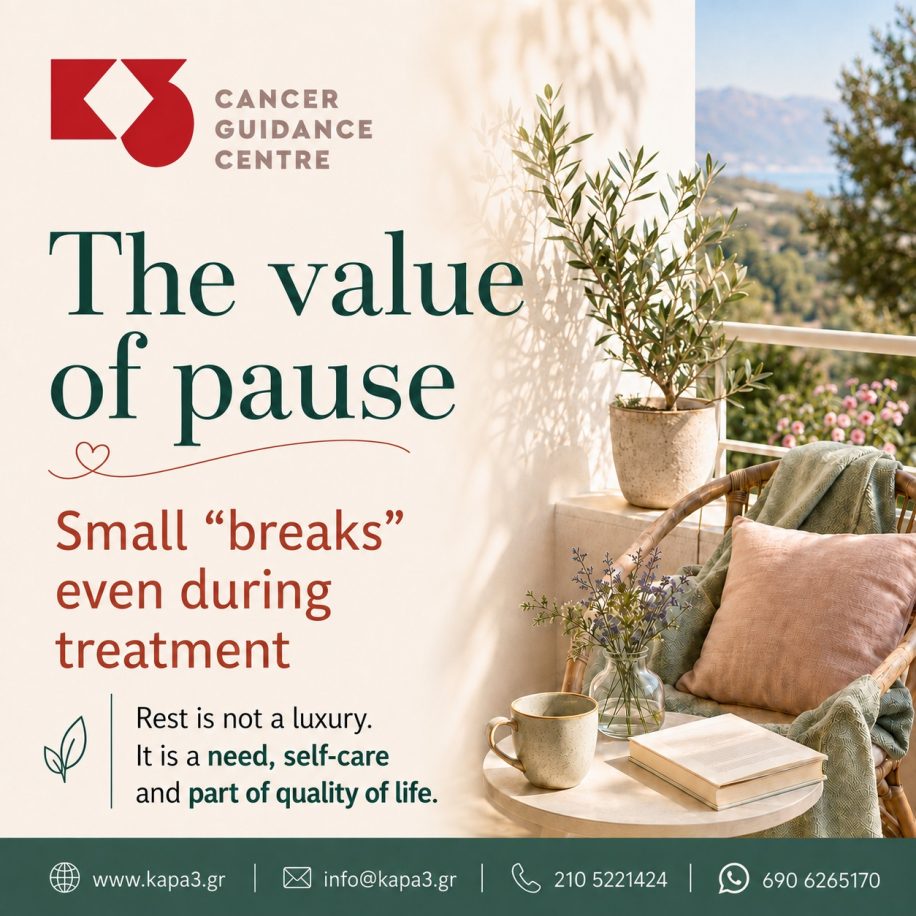
In a time when everyday life becomes increasingly demanding, this charm reminds us that self-care is not a luxury, but a necessity.

It symbolizes all those small acts that keep us standing: the pause, the breath, the moment of rest; the warm embrace we offer ourselves. The choice to listen to our bodies, to acknowledge our limits, and to prioritize our health, joy, and inner balance.

And it is precisely this “pause” that led us to our good-luck charm for 2026: the Crown — a symbol that carries far more than what meets the eye.

In music, the crown (fermata) is the pause held by the performer —
the moment of emphasis before the melody continues.
So it is with every struggle: it requires breaths, pauses, small breaks — not to stop, but to continue.

A crown is also a circle. And a circle means you are not alone; around you are people, care, support — a circle that holds you.

If there were a title of honor for those who fight cancer, it would be a crown. Not as a symbol of power, but as a recognition of dignity.

Cancer can sometimes feel like a thorny wreath — heavy, painful, relentless.
And yet, depending on how we choose to face it, it can transform into a wreath of victory: the victory of persistence, endurance, return — and above all, the victory of effort.

Because behind every crown lies a story: of a parent, a friend, a child, a partner, someone who is fighting or supporting someone who fights.

That is why the crown is not just a piece of jewelry — it is a message of strength:

It is not what happens to us that defines us —
but how we choose to face it.

It reminds us that when we care for ourselves, we can truly care for others. That strength, well-being, and kindness begin within us.

May this year’s charm be a small talisman accompanying us each day, inspiring us to make space for what nourishes us, to embrace our vulnerability, and to celebrate our worth.

For a year filled with more care, more peace, and more love — beginning with ourselves.

Let’s fill our days with small acts that make a difference.
Let’s uplift one another.
Let’s turn self-care into a habit.

And for all of us at Kapa3, the invitation is simple: To weave self-care into our everyday lives.

Join the #kapa3gouri Self-Care Challenge

Inspired by this year’s charm — dedicated to self-care — we invite you to join the #kapa3gouri Self-Care Challenge, a collective action that brings us together through moments of care, calm, and mindfulness.

How the challenge works:
  1. Take one small self-care action during your day.
    It can be something simple: a walk, a breathing break, a warm cup of tea, a few minutes away from screens, journaling your thoughts, a hug you needed.

  2. Capture a photo or write a few words that reflect that moment.

  3. Share it on Instagram or Facebook using the hashtag #kapa3gouri.

  4. Tag two friends to keep the chain of self-care going.

Our goal is not the “perfect” image — but the daily reminder that we deserve time, space, and care. Each post becomes a small mosaic of tenderness toward ourselves.
A collective message that wellbeing begins within.

For 2026, choose the Crown — as a symbol of hope, strength, and dignity.
Wear it. Offer it. Share its power.

Thank you for being part of this journey.


The Kapa3 Team


World Diabetes Day – November 14

World Diabetes Day is observed every year on November 14, reminding us of the importance of prevention, early diagnosis and proper management of the disease.

The date was established in 1991 by the International Diabetes Federation (IDF) and the World Health Organization (WHO) to mark the birthday of Frederick Banting, the Canadian scientist who discovered insulin in 1921 — a breakthrough that transformed millions of lives around the world.

What is Diabetes

Diabetes is a chronic condition that affects how the body regulates blood glucose. There are two main types: Type 1 diabetes, in which the immune system destroys the insulin-producing beta cells of the pancreas, and Type 2 diabetes, which is often linked to risk factors such as obesity, poor diet and physical inactivity.

Type 1 diabetes cannot be prevented; however, with proper management, modern treatments and the right support, people living with it can enjoy a completely normal and active life.

Prevention Tips for Type 2 Diabetes

In Greece, the number of people living with diabetes continues to rise, highlighting the urgent need for prevention, especially for Type 2 diabetes. Education and early diagnosis can significantly reduce complications. Emotional support from family and friends also improves quality of life.

In addition, good diabetes management requires both knowledge and daily habits. For example, small actions can make a real difference. Maintain a balanced diet low in sugar and fats. Exercise regularly. Schedule checkups, monitor blood sugar. And last but not least, make to care for your mental well-being.

In today’s fast-paced and stressful world, self-care is not a luxury; it’s a necessity.

Equally important is prevention. By following a healthy diet, engaging in regular physical activity, and maintaining a stable weight, you can greatly reduce the risk of developing Type 2 diabetes.

Therefore, World Diabetes Day reminds us that prevention begins with small, everyday choices. Let’s take care of ourselves, stay informed and support those around us. Because health is a priority and an act of love for life itself.

At Kapa3, we believe that information and support should be accessible to everyone. Through meaningful community initiatives, open communication and genuine care for people, we stand beside those facing chronic conditions — today and every day.

Sources:

Text/Adaptation: Ifiyenia Anastasiou for Kapa3

When Art Meets Science: How CREATE Platform May Strengthen Emotional Regulation in Cancer Care

At Kapa3, we recognize that cancer affects far more than the body, challenging the emotions, sense of self, relationships, and quality of life of those suffering. Despite the high prevalence of co-occuring mental health issues such as anxiety and depression, access to mental health services remains limited. This gap between patient needs and healthcare provisions is precisely what motivated us to help develop CREATE, an innovative digital platform designed to support emotional resilience through a powerful combination of art, technology, and emotional engagement (Ladas et al., 2025).

The CREATE (Creative and Resilience through Arts, Technology, and Emotions) platform uses computerised cognitive training (CCT) designed to enhance emotional regulation by integrating working memory training, engagement with famous artwork, and creative emotional expression. Unlike other platforms, it only targets one cognitive function: working memory. Evidence suggests that focusing on a single cognitive function is more effective than targeting multiple ones. Working memory in particular has been found to influence emotional regulation, a skillset with established benefits for anxiety and depression.

CREATE therefore introduces a unified framework that addresses cognitive function, emotional expression, and biological influences such as sleep quality and dopamine activity. Such digital health solutions are increasingly recognized as promising alternatives to standard psychotherapy, offering greater accessibility and affordability while still capable of reducing symptoms of depression and anxiety.

Findings from the pilot study on CREATE were very promising; the participants found the platform easy to use and enjoyable, and showed increased emotional and creative engagement. Although this early research focused on feasibility and validity rather than therapeutic effectiveness, initial findings indicate improvements in emotional regulation. Importantly, the study demonstrated positive relationships between working memory, emotional regulation, and expression of emotion, while also suggesting that sleep and dopamine may mediate these effects.

These insights highlight the importance of lifestyle and biological data in developing personalized digital mental health tools. It is well established in neuroscience that working memory plays a central role in emotional regulation. A stronger working memory allows individuals to better cope with distressing thoughts, shift their attention, and respond more calmly to challenges. For people living with cancer, supporting these cognitive and emotional capacities makes daily life more manageable. Improved thinking skills can facilitate treatment adherence, informed decision-making, and a more effective management of the emotional turbulence that often accompanies illness.

The study relied on a convenience sample made up mostly of cancer-related healthcare professionals, and only one cancer survivor participated. To address this limitation, the next phase of research will focus entirely on cancer patients and survivors. Their unique challenges, including cancer-related fatigue and treatment-related cognitive changes, will be central to refining the platform and ensuring that CREATE is tailored to the needs of those it aims to benefit the most. This creates not only a more impactful intervention but also empowers patients to have a voice in shaping the future of supportive cancer care.

As we look ahead, CREATE offers a hopeful vision for digital mental-health support. It is scalable, affordable, and adaptable, making it especially valuable for people who lack access to mental health care. Intervening early and supporting emotional well-being throughout treatment and survivorship may reduce the long-term strain on healthcare services associated with mental health conditions.  As cancer treatment continues to evolve, we must make sure that psychological care develops along with it. And CREATE does just that.

Read the full study

References

Ladas, A. I., Katsoridou, C., Gravalas, T., Klados, M. A., Stravoravdi, A. S., Tsompanidou, N., Fragkedaki, A., Bista, E., Chorafa, T., Petrovic, K., Vlotinou, P., Tsiakiri, A., Papazisis, G., & Frantzidis, C. A. (2025). Creativity and REsilience Through Arts, Technology and Emotions: A Pilot Study on the Feasibility and Validity of the CREATE Platform. Brain Sciences15(11), 1171.

Article by Despina Chrysostomidou, Psychologist, for Kapa3 Research Insights

Giving Voice to People with Primary Biliary Cholangitis (PBC) in Greece

Promitheas launches MyPBCVoice, an innovative initiative aimed at empowering and supporting people with Primary Biliary Cholangitis (PBC) in Greece. PBC is a rare, chronic autoimmune liver disease with symptoms such as fatigue, itching, abdominal discomfort, and psychological challenges.

MyPBCVoice focuses on patient education, information, and mutual support to improve quality of life. Activities include:

  • Questionnaires to assess patient needs (fill here)
  • A PBC-focused microsite
  • Interactive Facebook community for communication and support (join here)
  • Short videos and vidcasts with patients and experts
  • Online webinars
  • Digital archive of complaints and reports to map access barriers

We encourage everyone to share and promote this initiative to reach more patients and health professionals.

Kapa3 is proud to support initiatives like MyPBCVoice, which empower patients and foster connection and knowledge within the community.

Text/adaptation: Ifiyenia Anastasiou for Kapa3