
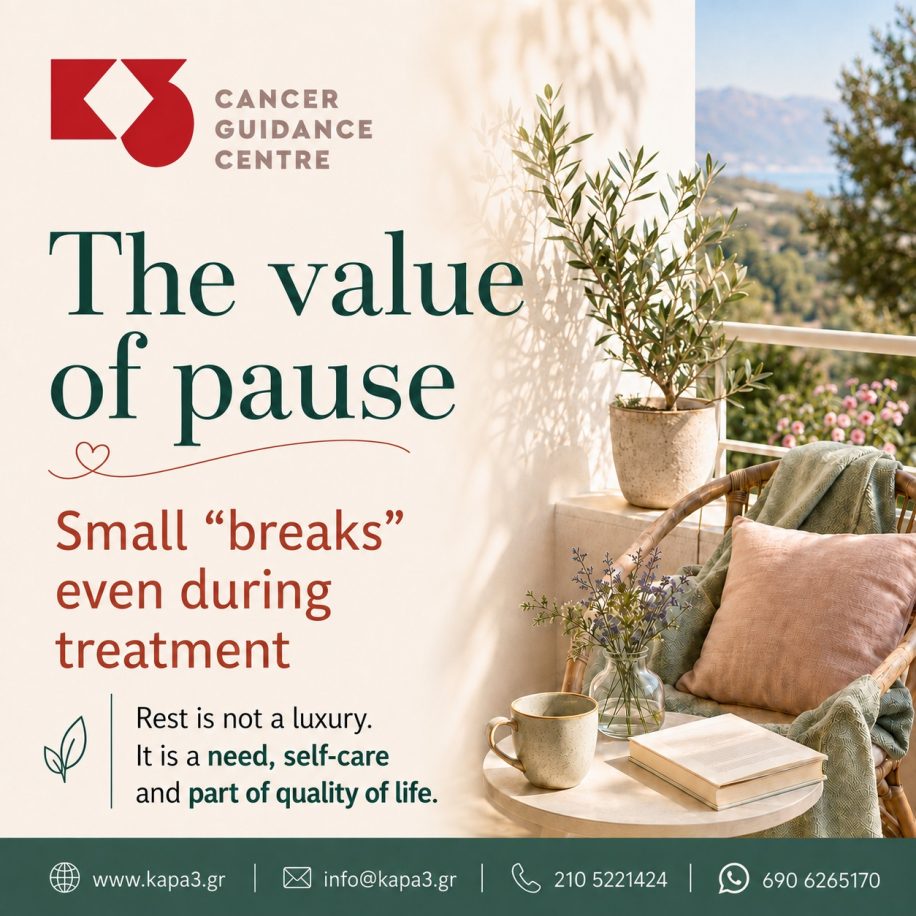
The Value of Pause: Why We Need to “Disconnect” Even During Treatment

Summer is often associated with the idea of holidays. Images of the sea, travel, and carefree moments fill our daily lives, creating the impression that rest requires a suitcase, a destination, and distance from obligations.

However, for cancer patients who are undergoing treatment, recovering from surgery, or waiting for test results, holidays are often not possible. Medical appointments, treatments, side effects, physical fatigue, and uncertainty about one’s health can make travelling difficult or even impossible.

And yet, the need for rest does not diminish. On the contrary, it often becomes even more important.

Perhaps, then, it is worth redefining what a “holiday” means. Not as travelling somewhere else, but as the ability to pause, even briefly, the relentless cycle of stress, worry, and constant vigilance that often accompanies serious illness. It can be a reminder that life is not only about the disease.

Rest is not a luxury — it is a need

Recent scientific literature shows that people need periods of recovery in order to maintain psychological and physical balance. Recovery is not simply “resting”; it is a process through which the body reduces the physiological and psychological burden caused by chronic stress.

In psychology, the term psychological detachment is used to describe the mental ability to step away from sources of pressure. This means allowing oneself, even for a short while, not to think constantly about what feels overwhelming.

Research by Sonnentag, Binnewies, and Mojza (2010) showed that psychological detachment is associated with lower emotional exhaustion, better mood, and greater resilience in everyday life. Similarly, Fritz and colleagues (2010) found that people who are able to mentally disengage from stress experience higher levels of well-being, energy, and functioning.

Although these studies were mainly conducted among workers, the underlying mechanism applies to every person: when the brain remains in a constant state of alert, it struggles to recover its strength.

In this sense, these small pauses matter not because they make us “forget” the illness, but because they give the brain an opportunity to step out, even temporarily, of a continuous state of alarm.

When illness takes over every thought

The experience of cancer is not limited to treatment days. It often affects everyday life as a whole. Thoughts about tests, medical decisions, bodily changes, work, family, and the future may accompany a person from morning to night.

This constant mental vigilance is exhausting in itself.

International guidelines from the National Comprehensive Cancer Network (NCCN) recognise that psychological distress is a common part of the cancer experience and recommend integrating psychosocial support into overall patient care. Likewise, guidelines from the American Society of Clinical Oncology (ASCO) and the European Society for Medical Oncology (ESMO) emphasise that mental health care and quality of life are essential parts of cancer management.

Holidays are not always about travelling

It is easy to believe that rest requires a trip. Yet scientific research suggests that the greatest benefit of holidays does not necessarily come from the destination itself, but from a change of pace and temporary distance from stressors.

Nawijn and colleagues (2010) found that people tend to feel greater well-being shortly before and during holidays, but that this feeling often fades relatively soon after they return.

This finding reminds us of something important: psychological renewal does not depend only on a few days of holiday each year, but also on the small moments of relief that we can create in everyday life.

For someone undergoing treatment, these moments may be even more valuable.

What does it mean to “pause” as a cancer patient?

To pause does not mean ignoring reality or neglecting one’s health. It means allowing oneself to remember, even for a little while, that life is not only about illness.

This may include:

  • a few quiet minutes on the balcony or in the garden,
  • a short walk in nature, when possible,
  • listening to favourite music,
  • reading a book,
  • engaging in a creative activity,
  • spending time with people who make us feel safe,
  • a few minutes of relaxation or mindful breathing, when appropriate for one’s health condition.

These moments do not change the diagnosis. But they can change the experience of the day.

The importance of quality of life

In modern oncology, quality of life is now considered a key therapeutic goal. Treating the disease is not enough; it is equally important for the person to maintain as much functionality, autonomy, emotional balance, and sense of meaning as possible.

This importance is also reflected in the value framework for cancer treatments developed by the American Society of Clinical Oncology (ASCO). According to this framework, the value of a treatment is not determined solely by its effectiveness, but also by its toxicity, its impact on quality of life, and the personal priorities and preferences of the patient.

This highlights the importance of personalised, patient-centred care, in which the person’s everyday experience is an essential part of the therapeutic process.

Within this perspective, small moments of pause, the continuation of pleasant activities, and connection with what brings joy are not secondary aspects of life. They are meaningful elements that contribute to preserving quality of life. They are not luxuries, signs of weakness, or attempts to avoid reality. They are forms of self-care.

The same applies to family caregivers, who often experience high levels of emotional and physical burden. Taking some time for their own rest is not selfishness; it is a necessary condition for continuing to support their loved one in a meaningful way.

The value of a small pause

The experience of cancer often extends beyond the limits of the disease itself, affecting a person’s self-image, social roles, and daily life. Intense psychological distress and uncertainty can gradually allow the illness to occupy more and more space in life.

In this context, psycho-oncological education appears particularly important. Its aim is to help patients and family caregivers understand the emotional reactions that naturally accompany diagnosis and treatment, develop more effective coping strategies, and actively participate in treatment decisions.

In this way, the sense of control and self-efficacy is strengthened, while also preserving the sense that a person remains something more than their illness.

When health does not allow for travel, it is easy to feel deprived of something important. Yet perhaps the essence of a holiday lies not in the distance we travel, but in the distance we allow ourselves to take from stress.

To “pause” does not mean to stop being a patient. It means allowing oneself, even for a little while, to be something more than the illness.

Perhaps, in the end, the most meaningful holidays are not those that take us far from home, but those that allow us to rest the body, calm the mind, and turn toward ourselves with greater care.

A peaceful sunlit balcony with a chair, a book, a cup, flowers, and an olive tree, illustrating the importance of small moments of rest and self-care during cancer treatment.

By Marilia Barka
Psychology Student
Kapa3 Volunteer

Return to Work after Cancer: Challenges and Needs for Young Adults

Returning to work after cancer presents significant challenges for young adults (18–40 years old) who wish to continue or reintegrate into their professional life. The study Needs Assessment: Young Adults Navigating Work & Cancer, conducted by Cancer & Careers in collaboration with the Andrea Argenio Foundation, explores the experiences of this group, highlighting key problems, needs, and preferences for workplace support.

The survey included 516 participants and was conducted online from December 2024 to February 2025. Participants were young adult cancer patients or survivors, and the study focused on return to work, the difficulties they face, necessary accommodations, and the types of support they find most helpful.

Key Findings

The study clearly identifies the multiple challenges young adults face during professional reintegration:

  • Balancing treatment and work emerged as the most common challenge.

  • About 50.8% reported physical limitations, and 37.8% cognitive difficulties affecting job performance. Younger participants (18–25) reported even higher challenges (~70.3% physical, ~56.8% cognitive).

  • Concerns about job security and career progression were significant: around 1 in 3 participants worried about their position or professional identity, while for ages 35–40, concern about job security reached 50.8%.

  • Participants expressed a need for workplace support, mainly through:

    • Flexible working hours (77.5%)

    • Remote work / working from home (62.2%)

    • Additional paid leave (50%)

    • Mental health support (45.2%)

Open-ended responses also highlighted the need for better employer education, support in job search and career development, as well as broader psychosocial support.

The Greek Context and the Need for Action

Despite the importance of this issue, Greece lacks systematic data on return to work after cancer, particularly for young adults. There are few studies or official statistics documenting experiences, challenges, or needs, creating a significant knowledge and policy gap.

In this context, raising awareness, providing reliable information, and connecting survivors to trusted resources are critical. Initiatives focusing on young adults with cancer help create a more supportive environment for returning to work, addressing both practical and psychosocial aspects.

European tools and collaborations, such as the MELODIC project, in which Kapa3 participates actively, are particularly valuable. MELODIC focuses on the psychological support of young adult cancer patients, highlighting the close link between mental health, quality of life, and professional functioning after cancer.

The Cancer & Careers study demonstrates that returning to work after cancer is not a straightforward process. Physical and cognitive limitations, concerns about job security, and the need for flexibility are daily challenges for many young adults. In Greece, the lack of data does not mean the problem is absent; rather, it underscores the need for more knowledge, targeted initiatives, and meaningful support.

Through information, networking, and participation in European initiatives, returning to work can become more realistic and sustainable for young adults who have experienced cancer.

Sources: Needs Assessment: Young Adults Navigating Work & Cancer

Text/Adaptation: Ifiyenia Anastasiou for Kapa3

This Year’s Good-Luck Charm (2026): A Symbol of Self-Care

The Good Luck Charm of the Year (2026) for Kapa3: The Crown

A Symbol of Self-Care

This year’s good luck charm is dedicated to self-care — a small, daily reminder of the deep importance of tending to ourselves with gentleness, respect, and consistency.
In a time when everyday life becomes increasingly demanding, this charm reminds us that self-care is not a luxury, but a necessity.

It symbolizes all those small acts that keep us standing: the pause, the breath, the moment of rest; the warm embrace we offer ourselves. The choice to listen to our bodies, to acknowledge our limits, and to prioritize our health, joy, and inner balance.

And it is precisely this “pause” that led us to our good-luck charm for 2026: the Crown — a symbol that carries far more than what meets the eye.

In music, the crown (fermata) is the pause held by the performer —
the moment of emphasis before the melody continues.
So it is with every struggle: it requires breaths, pauses, small breaks — not to stop, but to continue.

A crown is also a circle. And a circle means you are not alone; around you are people, care, support — a circle that holds you.

If there were a title of honor for those who fight cancer, it would be a crown. Not as a symbol of power, but as a recognition of dignity.

Cancer can sometimes feel like a thorny wreath — heavy, painful, relentless.
And yet, depending on how we choose to face it, it can transform into a wreath of victory: the victory of persistence, endurance, return — and above all, the victory of effort.

Because behind every crown lies a story: of a parent, a friend, a child, a partner, someone who is fighting or supporting someone who fights.

That is why the crown is not just a piece of jewelry — it is a message of strength:

It is not what happens to us that defines us —
but how we choose to face it.

It reminds us that when we care for ourselves, we can truly care for others. That strength, well-being, and kindness begin within us.

May this year’s charm be a small talisman accompanying us each day, inspiring us to make space for what nourishes us, to embrace our vulnerability, and to celebrate our worth.

For a year filled with more care, more peace, and more love — beginning with ourselves.

Let’s fill our days with small acts that make a difference.
Let’s uplift one another.
Let’s turn self-care into a habit.

And for all of us at Kapa3, the invitation is simple: To weave self-care into our everyday lives.

Join the #kapa3gouri Self-Care Challenge

Inspired by this year’s charm — dedicated to self-care — we invite you to join the #kapa3gouri Self-Care Challenge, a collective action that brings us together through moments of care, calm, and mindfulness.

How the challenge works:
  1. Take one small self-care action during your day.
    It can be something simple: a walk, a breathing break, a warm cup of tea, a few minutes away from screens, journaling your thoughts, a hug you needed.

  2. Capture a photo or write a few words that reflect that moment.

  3. Share it on Instagram or Facebook using the hashtag #kapa3gouri.

  4. Tag two friends to keep the chain of self-care going.

Our goal is not the “perfect” image — but the daily reminder that we deserve time, space, and care. Each post becomes a small mosaic of tenderness toward ourselves.
A collective message that wellbeing begins within.

For 2026, choose the Crown — as a symbol of hope, strength, and dignity.
Wear it. Offer it. Share its power.

Thank you for being part of this journey.


The Kapa3 Team


4 November: International Stress Awareness Day

Stress is a natural response to life’s challenges and changes. It helps us respond, adapt, and stay motivated. But when it becomes prolonged, it can turn into an invisible, exhausting companion that affects every aspect of daily life — body, mind, relationships, and mood. International Stress Awareness Day (4 November) is a reminder to pause, take a deep breath, and acknowledge that mental health deserves the same care as physical health.

In Greece, the mental health burden remains significant. According to the OECD (2023, Country Health Profile), around 6% of the population experiences anxiety disorders, while 7% report symptoms of depression. At the same time, more recent studies in younger age groups show that stress affects a much larger proportion: in a 2020 survey of university students, high levels of moderate to severe stress and extreme anxiety were reported. Additionally, international daily stress measurements indicate that about 58% of Greeks felt stress the previous day, placing the country among the highest in Europe and globally. These figures highlight that anxiety touches a substantial part of the population and significantly impacts daily life, emphasizing the importance of awareness and support.

Stress can manifest in multiple ways: rapid heartbeat, difficulty concentrating, insomnia, irritability, or simply feeling like there’s “never enough time.” Too often we dismiss it as “part of life.” But caring for our mind and emotions is not a luxury — it is a responsibility to ourselves. Support from mental health professionals, physical activity, connection with nature, music, art, or even a simple conversation with someone we trust can become small breaths of balance.

People living with chronic illnesses, including cancer, often face heightened stress. Anxiety about treatment, uncertainty about the future, and the physical impact of disease can intensify tension and worry. Recognizing and validating this stress is essential, as support through networks, counseling, and accessible resources can make a meaningful difference.

At Kapa3, we believe no one should face stress or illness alone. Through our programs, initiatives, and community, we offer guidance, emotional support, and practical help, highlighting that mental well-being is a shared journey and empathy is key.

Today is more than a reminder of the risks of stress. It is an invitation to speak openly without fear or shame, to create space for understanding and acceptance. Let’s learn to listen to our bodies and minds, recognize the signs, and seek help when needed. Calmness is not a luxury — it is a right for everyone.

Read more in previous articles of Kapa3: Article1, Article2, Article3

Sources:

OECD (2023), Country Health Profile: Greece
Stress, Anxiety and Depression Prevalence among Greek University Students during the COVID-19 Pandemic (2023, PLOS ONE / PMC)
Gallup Global Emotions Report 2024 – Ελλάδα: Daily Stress Measurement (58%)

Text/adaptation: Ifiyenia Anastasiou for Kapa3