As the first half of 2026 draws to a close, the Cancer Patient Guidance Center (Kapa3) continues to systematically expand its reach, thereby strengthening the system of care and information for both cancer patients and their caregivers.
During the first half of the year, the organization implemented a series of high-level initiatives and forged partnerships at both the national and European levels, thereby solidifying its position.
The organization’s activities got off to a strong start in January with the welcome of its European partners in the MELODIC Consortium project at a productive two-day workshop (January 19–20), hosted by the School of Public Health at the University of West Attica.
In early February, on the occasion of World Cancer Day, Kapa3 played an active role as a partner of René Descartes College in the webinar “Cancer, Patient Navigation & Health Management: From Prevention to Life Coordination.”
At the same time, significant initiatives were carried out in the local community, such as the “Knowledge Workshop in Megara—From Prevention to Life Coordination,” held on February 8 in collaboration with the Municipality of Megara.
In the area of scientific programs, the Cancer Patient Guidance Center, in collaboration with the Laboratory of Basic Health Sciences (EBEY) of the Department of Nursing at the University of the Peloponnese (PA.PEL), launched a series of online meetings running from February through June, focusing on mental health and nutrition.
The month concluded with the organization’s participation in the international conference “Mapping the Unknown in Oncology – From Hospitals to Homes, Mapping the Future of Oncology Care,” held on February 27 and 28.
March marked a strengthening of Kapa3’s “digital presence” with its official membership in the Hellenic Digital Health Cluster (HDHC), a strategic move aimed at linking healthcare with technological advancements. As an extension of this collaboration, the organization participated in a closed-door members’ meeting as part of Athens Digital Health Week 2026.
On March 11, representatives of the organization attended the diaNEOsis event “Facing the Challenge of Artificial Intelligence” at the Lighthouse of the Stavros Niarchos Foundation Cultural Center, while in the middle of the month, Kapa 3 played a prominent role in the scientific conference “Cancer in 2026: Challenges and Disruptions.” Furthermore, on March 19–20, the organization was represented at the 6th Western Macedonia Nursing Conference on the theme “Innovation and Empathy: Balancing Technology with Human Contact in Nursing.”
In parallel, the organization’s co-founder, Ms. Evangelia Bista, gave an interview on the show “All About Health” on Dion TV—which covered a variety of topics related to health, nutrition, autoimmune diseases, and more—the implementation of the free, 8-week Melodic pilot educational program began.
Kapa3’s scientific credibility was reaffirmed by the publication of the research paper “Person-First or Disease-First? Language Choices in Cancer Communication” in the journal *Nursing Reports*, as well as by Kapa3’s participation in the European project associated with Melodic, titled: “Educational Needs Regarding Mental Health of Professionals Working with Young Adults with Cancer: A European Survey,” which was also published; the organization also participated in the MELODIC Online Symposium 2026 on April 24, contributing to the dissemination of results in Greece.
May was marked by a strong outward focus and new collaborations, as the organization joined the European program Service Learning 2: 0:CoLab, was selected as one of six nonprofit organizations to receive financial support from the Alpha Bank-Match For Good initiative, and began its collaboration with the USTEP INSTITUTE.
At the same time, an awareness campaign was held in Soufli to highlight Kapa3’s activities; Ms. Bista gave an interview to iatronet.gr, and representatives of the organization participated in an international conference at the Medical School of the University of Coimbra in Portugal
Within the organization, the new Psychological Support team was established with great enthusiasm, while on the social media front, the Kapa3 team won six medals at the 4th Vouliagmeni Summer Swim.
As the semester came to a close, June began with the signing of an official cooperation agreement with the Department of Occupational Therapy at the University of West Attica, while partnerships were solidified with the non-profit organization “Karkinaki” and the PRAXI Network of the Foundation for Research and Technology – Hellas (FORTH) to strengthen international networking and access to modern funding tools.
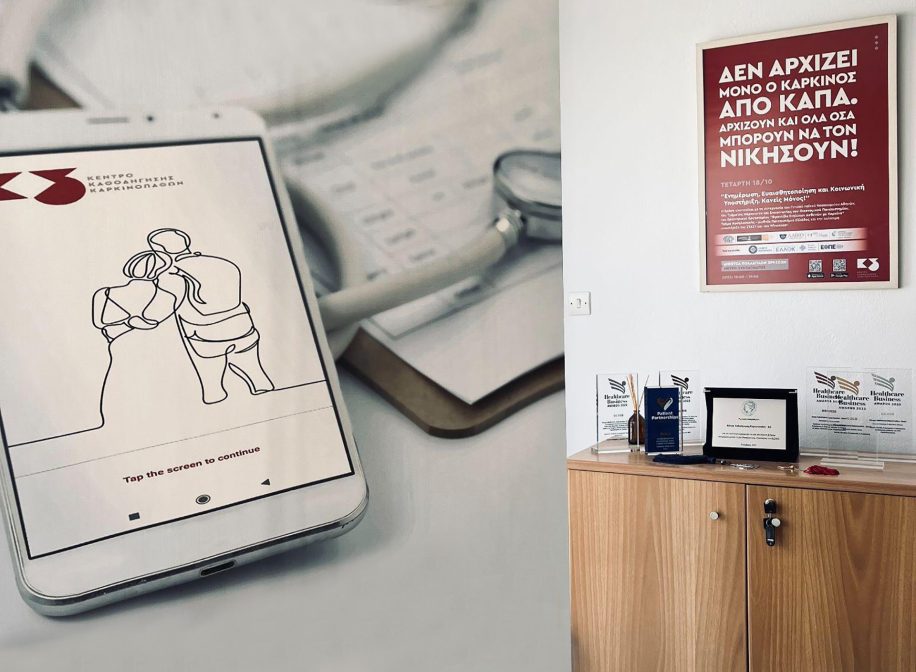
Having completed five years of uninterrupted service in supporting cancer patients through digital guidance, Kapa 3 is entering a new era with the development of the innovative “Myrto” project. This is a pioneering Social Artificial Intelligence (Social AI) initiative in the field of care for cancer patients in Greece. “Myrto” will function as an advanced digital health and rights navigator (Patient Empowerment e-Navigator) for patients, caregivers, and healthcare professionals—a project for which the strategic partnership with SimasiaAi for its co-development was crucial. Finally, the first closed workshop of the MYRTO Al Health Innovation Lab was held for the “Myrto” application, with the support of René Descartes College.
The results of this first half-year clearly demonstrate that Kapa 3 serves as a link connecting innovation, scientific research, and the digital age in the field of oncology care. By combining academic knowledge, European partnerships, and technological development, Kappa 3 transforms every challenge into sustainable, people-centered solutions. Partnerships with leading organizations, investors, and partners who share the same values of social responsibility are also essential to realizing this vision, ensuring that every patient has immediate, reliable, and equitable access to healthcare and their rights.
The KAPA3 team stands steadfastly by patients and caregivers to provide guidance and safeguard their rights. For any information or support, please feel free to contact us.
You can contact the KAPA3 team
13 Kostis Palamas Street, 3rd floor (Hours: 9:00 a.m. – 5:00 p.m.).
Phone Numbers: 210 5221424 & 6906265170.
Email: info@kapa3.gr