Kapa3 at IEEE CBMS 2026: Artificial Intelligence in Support of Equitable Patient Information in Oncology Care
New scientific publication in the Proceedings of the 39th IEEE International Symposium on Computer-Based Medical Systems
The voice and lived experience of patients must remain at the centre of the emerging era of Artificial Intelligence in healthcare.
Kapa3 – Cancer Guidance Centre contributes to a new scientific publication presented in the Proceedings of the 2026 IEEE 39th International Symposium on Computer-Based Medical Systems (CBMS), focusing on how Artificial Intelligence and Retrieval-Augmented Generation can support more equitable, reliable and patient-centred access to information in oncology.
The paper, entitled:
“Informed, Empowered, and Heard: AI and Retrieval-Augmented Generation as Tools for Equitable Patient Information in Oncology”
is authored by Lars Münter, Evangeli Bista, Maria Lavdaniti and Christos Frantzidis, with Evangeli Bista representing Kapa3 as Co-founder.
From access to information to meaningful patient empowerment
A cancer diagnosis creates an immediate need for information that is reliable, understandable and relevant to the individual patient.
At the same time, patients and their families are often expected to understand complex medical terminology, treatment options, prognosis discussions and administrative procedures at a moment of intense psychological and emotional pressure.
The paper highlights that acute stress associated with a serious diagnosis can affect working memory, attention and the ability to process new information. This means that patient information cannot be designed for an ideal, fully attentive reader; it must respond to the real cognitive and emotional conditions experienced by people facing cancer.
The key question is therefore not simply:
“How much information do we provide?”
but rather:
“Are we providing the right information, at the right time, in a form that people can understand and act upon?”
AI and Retrieval-Augmented Generation: towards trustworthy and evidence-grounded information
The publication places particular emphasis on Retrieval-Augmented Generation (RAG).
RAG architectures combine the generative capabilities of large language models with the retrieval of information from curated and verified knowledge sources. In a healthcare setting, this can include clinical guidelines, validated patient information resources, regulatory documents and peer-reviewed literature.
This approach offers an important advantage over purely generative AI systems: responses can be grounded in identifiable sources, supporting greater transparency and enabling patients and healthcare professionals to verify where information comes from.
In oncology, this is especially important.
A patient does not simply need a quick answer. They need information that is:
accurate, current, understandable, accessible and appropriate to their individual situation.
Artificial Intelligence as a tool for equity
One of the central themes of the paper is inequality in access to high-quality oncology information.
Geography, language, socioeconomic circumstances, health literacy, digital literacy and access to specialised healthcare services can significantly influence a person’s ability to understand their diagnosis, treatment options and rights.
The publication pays particular attention to the Greek context, where patients living in large urban centres may experience a very different information environment from those living in rural, remote or island communities.
When equity is treated as a core design principle, AI-RAG systems can potentially support:
- multilingual access to health information,
- different levels of language and information complexity,
- voice-based interfaces,
- shorter and more manageable units of information,
- low-bandwidth or offline-capable solutions,
- and opportunities for patients to return to information when they are ready to process it.
Technology alone, however, does not create equity.
The way technology is designed determines whether it reduces existing inequalities or reproduces them.
Designed with patients, for patient needs
The paper calls for an important shift in the way digital health systems are developed.
Many traditional health information systems are designed primarily around institutional or clinical workflows, with patient-facing communication added later.
For patient-centred AI, this logic must be reversed.
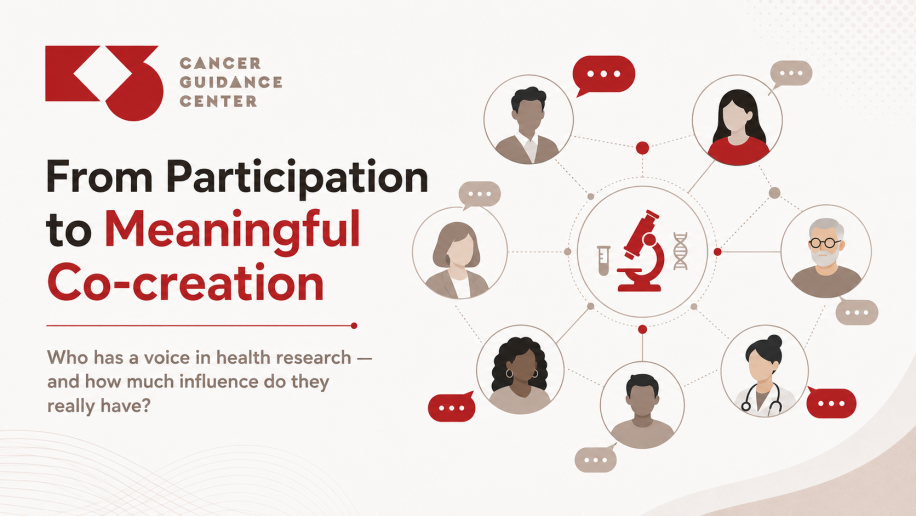
Systems should be designed with patients and around patient needs, with patients and informal carers actively involved in shaping the knowledge base, the questions the system is expected to answer and the ways information is presented.
This also means moving beyond systems that simply respond to individual questions.
A meaningful AI-supported information environment could help patients prepare for clinical consultations, organise their questions, understand the next steps in their care and become more aware of their rights.
The paper highlights applications such as consultation preparation guides, question prompts before appointments and post-consultation summaries as examples of how technology can support patients before, during and after important healthcare interactions.
AI should strengthen, not replace, human relationships
Perhaps the most important message of the publication is that the transformative potential of AI in oncology is not primarily technical. It is relational.
Artificial Intelligence should not create distance between patients and healthcare professionals.
It should help strengthen their communication.
A better-informed patient can arrive at a clinical consultation more prepared, identify questions and concerns more clearly, participate more actively in shared decision-making and communicate more effectively with the healthcare team.
The same applies to informal carers, who often carry a significant part of the informational and emotional burden of cancer care.
For this reason, the paper argues that AI-RAG systems should be designed to strengthen the relationship between patients, carers and healthcare professionals, rather than to replace any part of this human network of care.
For healthcare professionals, trustworthy information systems may also reduce the time required for basic information provision, allowing more of the clinical encounter to focus on nuanced discussions, decision-making and the human aspects of care that technology cannot replicate.
From information to trust
This scientific contribution adds to an increasingly important discussion about the future of healthcare:
How can Artificial Intelligence be developed and used in ways that genuinely respond to human needs?
The answer does not lie only in more powerful AI models or larger volumes of data.
It also lies in evidence, transparency, accessibility, co-design, equity and respect for patient rights.
As the paper concludes, people affected by cancer in Greece and across Europe deserve access to information that is accurate, personalised, accessible and respectful of their rights, regardless of where they live, the language they speak or the socioeconomic resources available to them.
For Kapa3, participating in this scientific discussion also reflects a broader commitment: ensuring that real patient needs, lived experience and equitable access are represented in the design and evaluation of the next generation of digital health and AI-supported tools.
Publication details
Title: Informed, Empowered, and Heard: AI and Retrieval-Augmented Generation as Tools for Equitable Patient Information in Oncology
Authors: Lars Münter, Evangeli Bista, Maria Lavdaniti, Christos Frantzidis
Published in: 2026 IEEE 39th International Symposium on Computer-Based Medical Systems (CBMS)
DOI: 10.1109/CBMS69103.2026.00302
find more 499901b523