Kapa3 at the 13th Panhellenic Oncology Nursing Symposium: From Knowledge to Practice, with People at the Centre of Care

Three scientific contributions highlighting healthcare professionals’ educational needs, the financial burden of cancer, and the importance of patient navigation in comprehensive oncology care.

30 October – 1 November 2026 | Montana Hotel, Karpenisi, Greece

Kapa3 – Cancer Guidance Centre will participate in the 13th Panhellenic Oncology Nursing Symposium, organised by the Oncology Nursing Sector of the Hellenic Nurses Association (ESNE), taking place from 30 October to 1 November 2026 in Karpenisi, Greece.

Under the central theme “Driving Change, Creating Hope,” this year’s Symposium will provide an important opportunity for scientific exchange, interdisciplinary collaboration and discussion on the future of oncology nursing and comprehensive cancer care.

Kapa3’s participation will include three confirmed scientific contributions, bringing together healthcare professional education, the socioeconomic consequences of cancer and the role of structured patient navigation in improving access to care.

Although these topics address different dimensions of oncology, they share a common objective: to explore how scientific knowledge can be translated into meaningful, accessible and measurable improvements in the care provided to people affected by cancer.

1. Educational Needs of Healthcare Professionals: From Knowledge Acquisition to Meaningful Change

Saturday, 31 October 2026 | 17:30–19:00

Open Scientific Discussion

“Educational Needs of Healthcare Professionals: A Critical Issue for Contemporary Oncology Care”

Moderator: Evangeli Bista, PhD(c), MBA, MSc, BSc, Co-founder of Kapa3 – Cancer Guidance Centre.

Modern oncology care is evolving rapidly. New therapeutic approaches, personalised care, increasing psychosocial needs, digital transformation and the integration of Artificial Intelligence are fundamentally changing the knowledge and competencies required of healthcare professionals.

However, participation in educational activities does not automatically translate into improvements in professional practice.

This scientific discussion will address a central challenge in continuing professional education: how to move beyond the delivery of scientific information towards the effective assimilation, application and evaluation of knowledge.

The discussion will follow a structured pathway:

Identifying Needs → Education → Knowledge Acquisition → Assimilation → Application → Evaluation → Improved Care

Particular attention will be given to absorptive capacity, knowledge translation, organisational learning, interdisciplinary collaboration and the development of professional and digital competencies.

An important dimension of the discussion concerns the organisational environment in which healthcare professionals are expected to apply their knowledge.

Leadership, trust, organisational culture, staffing, mentoring, access to information and opportunities for continuous learning can either facilitate or hinder the translation of scientific knowledge into everyday clinical practice.

The discussion will bring together the following participants:

  • Ourania Govina
  • Theocharis Konstantinidis
  • Giorgos Kapetanakis
  • Theodora Kappou
  • Maria Lavdaniti
  • Aikaterini Manousou
  • Aikaterini Papadimitriou
  • Dimitrios Papageorgiou

Drawing on different academic, clinical, professional, managerial and patient-centred perspectives, the discussion aims to identify shared priorities for continuing education in contemporary oncology care.

The central question is:

How can we move from delivering knowledge to ensuring its meaningful assimilation and practical application, while developing healthcare professionals and organisations capable of continuous learning and measurable improvement?

2. Accessibility in Cancer Care: The Intersection of Health, Society and Economy

Scientific Roundtable

“Access to Healthcare Services for Patients with Malignant Neoplastic Disease: A Health–Society–Economy Perspective”

Session Chairs: Ioanna Tsatsou and Maria Lavdaniti.

As part of this roundtable, Evangeli Bista will deliver a presentation entitled:

“The Financial Burden of Cancer on Patients and Their Families”

A cancer diagnosis is not solely a medical event. It frequently brings substantial social and financial consequences that affect both patients and their families.

Loss or reduction of income, frequent travel for treatment, additional healthcare-related expenses, caregiving responsibilities and difficulties maintaining employment can significantly affect quality of life and access to appropriate care.

The concept of financial toxicity describes the economic hardship and distress associated with cancer and its treatment.

Financial toxicity may contribute to psychological distress, financial insecurity, reduced social participation and inequalities in access to healthcare and supportive resources.

Drawing on Kapa3’s experience in social guidance, patient navigation and support for people affected by cancer, the presentation will explore financial burden as an essential dimension of person-centred oncology care.

The roundtable will also include:

  • Georgios Manomenidis: “Social Determinants of Access to Oncology Care”
  • Maria Lavdaniti: “The Role of Nurses and the Interdisciplinary Team in Reducing Barriers to Access”

Together, these contributions will examine accessibility from complementary perspectives, highlighting the complex relationship between health services, socioeconomic conditions and interdisciplinary collaboration.

Equitable access to care depends not only on the availability of healthcare services, but also on people’s actual ability to access and use them.

3. The Role of Patient Navigation in Oncology Care: A Systematic Review

Oral Scientific Presentation

“The Role of Patient Navigation in Oncology Care: A Systematic Review”

Authors:

Maria-Garyfallia Barka
Psychology student, Panteion University of Social and Political Sciences; Volunteer, Kapa3 – Cancer Guidance Centre.

Evangeli Bista
Social Scientist, PhD(c), MBA, MSc, BSc; Co-founder, Kapa3 – Cancer Guidance Centre.

This scientific contribution falls within the field of psychosocial oncology care and examines the role of structured patient navigation in improving continuity, coordination and accessibility throughout the cancer journey.

Cancer diagnosis and treatment are associated with multiple needs extending beyond clinical management.

Patients and their families often require assistance in understanding medical and administrative information, navigating healthcare services, accessing social rights and benefits, managing practical difficulties and obtaining psychosocial support.

The systematic review examines international scientific literature published between 2015 and 2026, drawing on searches conducted in PubMed and Embase.

The review focuses on patient navigation, psychosocial support, counselling and care coordination, exploring their contribution to comprehensive oncology care.

In addition, practice-based data collected through Kapa3’s activities are considered in order to connect international evidence with the needs of patients and caregivers in the Greek healthcare and social support context.

The findings highlight the importance of organised, interdisciplinary navigation models involving healthcare professionals, social workers, psychologists and other relevant professionals.

Patient navigation is not simply the provision of information.

It is a structured process of identifying needs, supporting decision-making, facilitating access to appropriate services and helping patients navigate the multiple challenges arising throughout their cancer journey.

The presentation reinforces the importance of developing coordinated and person-centred support pathways that address medical, psychological, social and practical needs.

From Scientific Research to Kapa3’s Everyday Practice

Kapa3’s three scientific contributions reflect the organisation’s commitment to connecting research, professional education and social support with the lived experiences of people affected by cancer.

The education of healthcare professionals, the recognition of cancer-related financial hardship and the implementation of structured patient navigation are not isolated priorities.

They represent interconnected dimensions of a broader approach to oncology care.

Effective professional education can strengthen the ability to identify patient needs. Recognition of socioeconomic barriers can improve the relevance of supportive services. Structured navigation can help connect patients with appropriate professionals, resources and care pathways.

Together, these elements contribute to a model of healthcare that is more coordinated, equitable and responsive to people’s real needs.

This approach is also reflected in the development of MYRTO – Kapa3’s AI-Supported Digital Social Navigator, an innovative initiative designed to improve access to evidence-informed information about social rights, benefits, administrative procedures and available support services.

MYRTO is developed in collaboration with SimasiaAI, with the valuable support of the TIMA Charitable Foundation.

The initiative demonstrates Kapa3’s commitment to combining digital innovation with human-centred guidance, health literacy, social inclusion and responsible use of Artificial Intelligence.

Driving Change, Creating Hope

For Kapa3, participating in the 13th Panhellenic Oncology Nursing Symposium represents another opportunity to strengthen scientific dialogue, share knowledge and develop collaborations between healthcare professionals, academic institutions and civil society organisations.

Patients’ lived experiences provide valuable insights into the challenges that healthcare systems must address.

When these experiences are systematically documented, examined through scientific research and incorporated into professional education and service development, they can become a powerful source of meaningful change.

Scientific progress creates real value when it translates into better everyday experiences, fewer barriers and more effective support for people living with cancer.

At Kapa3, we remain committed to advancing a model of oncology care that recognises the full complexity of patients’ needs and supports people throughout every stage of their cancer journey.

Because care does not end with treatment. It embraces the whole of life.


Symposium Information

13th Panhellenic Oncology Nursing Symposium
“Driving Change, Creating Hope”

Dates: 30 October – 1 November 2026
Venue: Montana Hotel, Karpenisi, Greece

Organiser: Hellenic Nurses Association (ESNE) – Oncology Nursing Sector

Official event website:
https://oncologynursingcongress.esne.gr/

Kapa3 – Cancer Guidance Centre
https://www.kapa3.gr

Explore MYRTO – Digital Social Navigator
https://kapa3-cag-rag-hybrid-deploy.onrender.com/

MYRTO: From Real-World Needs to European Scientific Engagement

MYRTO, the digital Social Rights Navigator developed by Kapa3, is taking an important step from real-world experience to the European scientific community, with two studies accepted for presentation at EONS and ESMO events in 2026.

The first study, “MYRTO as an AI-Supported Navigation Model for Equitable Access to Cancer Care: Real-World Needs from 1,083 Beneficiaries”, will be presented as a poster at EONS19 at ESMO 2026 in Madrid, 24–26 October 2026.

The study draws on the real-world needs of 1,083 Kapa3 beneficiaries, identifying eight key navigation areas: rights and benefits, disability certification and administrative procedures, access to health and social services, transportation and geographical barriers, employment and social protection, health and digital literacy, caregiver support, and referral to human professionals when needed.

The findings highlight that equitable access to cancer care is not only about clinical information. It also depends on people’s ability to find, understand and use reliable information during an exceptionally demanding period of their lives.

From real-world needs to technology evaluation

The second study, “Source-Based Artificial Intelligence (AI) Navigation for Fragmented Nonclinical Cancer-Support Information: Pilot Evaluation of a Human-Supervised System”, has been accepted as an e-Poster at the ESMO AI & Digital Oncology Congress 2026, taking place on 16–18 November 2026.

This study focuses on the operation and evaluation of MYRTO as a source-grounded, human-supervised AI system.

The pilot evaluation drew on 448 authoritative documents and 29,148 indexed excerpts and assessed 100 predefined questions. For all 84 answerable questions, source-supported and actionable responses were generated without modifications following Kapa3 expert review. The system also applied clarification, abstention or redirection mechanisms when evidence was insufficient or when questions involved medical advice or fell outside its intended scope.

Two studies, one shared philosophy

The two studies reflect complementary dimensions of MYRTO: the real-world needs that led to its development and the way technology is being designed to respond to those needs through evidence, clear boundaries and human supervision.

For Kapa3, Artificial Intelligence is not intended to replace human support. Its role is to contribute to more accessible, understandable and trustworthy navigation, while keeping people at the centre.

MYRTO’s presence at two major European scientific events represents another step in bringing Kapa3’s field experience into the European dialogue on equitable access, digital health and the responsible use of Artificial Intelligence.

The MYRTO project is funded by the TIMA Charitable Foundation.

Find more about MYRTO https://kapa3-cag-rag-hybrid-deploy.onrender.com

DISABILITY CARD OR TRANSPORTATION PASS FOR PEOPLE WITH DISABILITIES 2026. WHAT BENEFICIARIES NEED TO KNOW.

The new explanatory circular regarding transportation for people with disabilities (PWDs) for 2026 has raised several questions among beneficiaries and their families who are trying to understand what the current rules are. The most common question is: “I have the plastic Disability Card. Do I also need to get a PWD Transportation Pass?” The answer is that the Disability Card has not completely replaced the Transportation Pass. Both of these documents remain valid simultaneously, and the need for one or the other depends on the mode of transportation used by each eligible person. To make this clearer, here’s what applies in each case.

Athens and Thessaloniki: The Disability Card can be used for urban travel

For travel on OASA transit in Athens and OSETH transit in Thessaloniki, the plastic Disability Card can be used by eligible beneficiaries.

Cardholders can travel by validating their card at the designated machines, without needing to obtain a separate Travel Pass specifically for these transit services.

The following are required:

  • the Disability Card must be valid,
  • must bear the designated disability level II or III designation,
  • or the beneficiary must receive disability financial assistance from OPEKA,
  • and income criteria must be met where required.

URBAN KTEL BUSES IN THE PROVINCE: THE TRAVEL PASS REMAINS NECESSARY

This is the point that has caused the most confusion. Possession of a Disability Card does not mean that the Travel Pass is no longer required for all trips.

For urban KTEL buses operated by the Regional Units, as well as by the municipalities of Kos and Rhodes, a Mobility Card for People with Disabilities is required, even if the beneficiary holds a Disability Card.

Therefore, those who use urban KTEL buses in their area should apply:

  • at the Citizen Service Centers (KEP),
  • or at the relevant offices of the Regional Unit.

FOR 2026, THE PROCESS BEGINS ON JULY 1, 2026, AND ENDS ON NOVEMBER 30, 2026.

Intercity Buses (KTEL): 50% Discount on Fares

For travel on intercity buses (KTEL)—that is, for trips from one city to another—a 50% discount is available.

The discount can be obtained with:

  • A valid Disability Card,
  • or a Transportation Pass for People with Disabilities.

Thus, for intercity routes, the beneficiary has more options.


Are there income criteria for free transportation?

One point that often causes confusion concerns income. There are no income criteria for issuing the Disability Card.

The income limits apply to eligibility for free transportation.

For 2026, the limits are as follows:

  • individual taxable income up to 23,000 euros,
  • declared family income up to 29,000 euros.

The family income limit increases by 5,600 euros for each additional person with a disability of 67% or higher who lives with and is financially dependent on the taxpayer.

It is important to note that: OPEKA disability benefits are not included in the above income limits. A relevant certificate from OPEKA may be required to exclude them.


Who is exempt from the income criteria?

People who are totally blind are exempt from the income criteria.

What applies to the companion?

In many cases, a companion is also entitled to travel.

If the Disability Card is marked with an “S” (Companion):

  • in Athens and Thessaloniki, the companion travels with the cardholder upon a single validation of the card. For KTEL buses, however, the prescribed procedure and the corresponding Companion Travel Pass are required where necessary.

So, what do beneficiaries need to keep?

The Disability Card is a significant benefit, but it does not mean that the Travel Pass is being eliminated.

In simple terms:

Disability Card:

✔ Athens and Thessaloniki

✔ Intercity KTEL buses for a 50% discount

Travel Pass:

✔ Provincial KTEL buses

✔ Situations where a companion’s entitlement is required

✔ Those who do not have a Disability Card


At Kapa3, we believe that accurate information can save time, trips, and unnecessary hassle, especially for people who already face increased challenges due to a disability or a serious illness.


View the circular here: TRANSPORTATION 2026

DISABILITY CIRCULAR

For more information, please don’t hesitate to contact the Kapa3 team:

📍Athens: 13 Kosti Palama, 3rd floor, (9:00 AM – 5:00 PM)

📍13 Kosti Palama, 11141 Athens

☎️210 5221424

📱6906265170

www.kapa3.gr

info@kapa3.gr

Information about the actions of Kapa3 in Soufli. An initiative of the Branch and the Social Service of the Municipality of Soufli

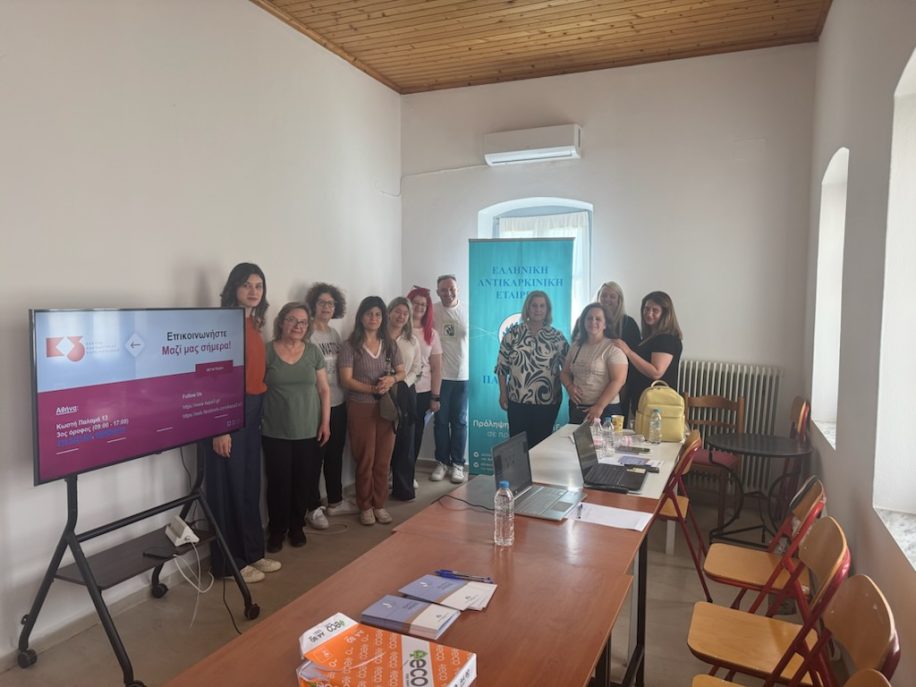
On Friday, May 29, 2026, a working meeting was held at the offices of the Evros Branch of the Hellenic Anti-Cancer Society in Soufli, at the initiative of the Branch and the Social Service of the Municipality of Soufli, with the aim of strengthening the support of oncology patients and the cooperation between local bodies.

The meeting was attended by the President of the Evros Branch of the Hellenic Anti-Cancer Society, Ms. Theodora Rokka, the Head of the Social Service of the Municipality of Soufli, Mr. Marinos Mantziaras, Ms. Aristea Archontidou from KAPA3, social workers of the Municipality of Soufli, as well as health professionals of the Soufli Health Center.

Particularly important was the presence of Ms. Kalliopi Kafetzaki, a social worker at the Day Center for Children, Adolescents and Young Adults with Neoplastic Diseases of the Hellenic Anti-Cancer Society, who presented the services of the Day Center and the hostel in Athens, as well as the challenges faced by oncology patients in the region.

The actions of KAPA3 were also presented, while information was provided on digital tools that can facilitate citizens’ access to health services, such as the Health Insurance Fund, the National Health Insurance Fund and the myHealth application. At the same time, the development of “Myrto”, a digital assistant that will support patients, caregivers and health professionals in searching for information and services, was discussed. During the discussion, issues related to inequalities in access to health services in the region, as well as the difficulties that patients encounter in administrative procedures and social benefits, were highlighted.

The meeting concluded with a joint commitment to continue cooperation and develop initiatives that will strengthen the support of oncology patients and their families in the Evros region. We are particularly happy about the presence of Kappa3 throughout Greece and for the trust of social services in our Organization. We remain faithful to the vision and mission of the Organization. For anything you need, please do not hesitate to contact us. The Kappa3 team is constantly by the patients and caregivers’ side to guide and ensure their rights. For any information or support, you can contact us.

You can contact the Kapa3 team at 13 Kostis Palamas, 3rd floor (Opening hours: 09:00 – 17:00). Contact numbers: 210 5221424 & 6906265170. Email: info@kapa3.gr

New Joint Ministerial Decision on the 2026 Aerotherapy Allowance: A Detailed Guide for KAPA3 Beneficiaries

At the Cancer Patient Guidance Center—KAPA3, we remain committed to providing accurate and timely information to cancer patients and their families regarding the rights and social benefits to which they are entitled. With the aim of making your daily life easier and ensuring you have full access to beneficial legislative provisions, we present a comprehensive guide to the granting of the air therapy allowance, in accordance with the recent Joint Ministerial Decision (No. 89399 EX 2026) published in the Government Gazette, Issue B, No. 3295, dated June 11, 2026.

The air therapy allowance applies to the summer season of 2026.

The amount is set at 250.00 euros and will be paid as a lump sum to the beneficiaries’ bank accounts on July 10, 2026.

The amount is unseizable and fully exempt from any tax or withholding.

  1. Who Are the Beneficiaries

The benefit is granted to disabled retirees of the State and the e-EFKA. Specifically, beneficiaries are those who fall into the following categories:

a) Pensioners referred to in subparagraphs (a) and (b) of paragraph 1 of Article 6 of Legislative Decree 4605/1966.

b) Pensioners under subparagraph (c) of the aforementioned paragraph 1 of Article 6 of Legislative Decree 4605/1966, who, according to 

the opinion of the competent Health Committee for the years 2020 through 2026, have been deemed to be in need of this allowance and belong to the following categories of retirees:

  1. Disabled officers under Law No. 2588/1921 and Law No. 875/1979 on military retirement.
  2. Disabled officers under Law No. 362/1943.

iii. Disabled enlisted personnel under Article 1 of Legislative Decree 1044/1971, as amended by Article 1 of 

Law 1043/1980.

Disabled members of the former Municipal Police who were subject to Legislative Decree 330/1947.

Disabled members of the Security Forces under Law 1579/1950 and those disabled members of the Coast Guard,

the Fire Department, and the Agricultural Police who are treated as equivalent to them.

Disabled members of the National Resistance under Provisional Act 1855/1951, Legislative Decree 412/1970, and Law 1543/1985.

vii. Persons with disabilities under Law 1370/1944 (who sustained their disabilities during peacetime while in service and as a result thereof, and 

receive a disability pension).

viii. Persons with disabilities from the anti-dictatorship struggle under Law 1543/1985.

Disabled civilians under Law 812/1943.

Disabled civilians under Law 1863/1989.

c) Civilian retirees who sustained disabilities as a result of their service (Decision of the Ministry of Labor and Social Security No. 

754.6/117/3912/March 24, 1969) and

d) OSE retirees who left the service and are receiving a pension due to tuberculosis.

3. Who Is Exempt from Payment

According to the Government Gazette, the following categories are not eligible for the air therapy allowance:

Recipients of other benefits: Those who have received or are set to receive a corresponding air therapy allowance from any other source (such as public entities, private entities, public benefit organizations, etc.).

Spa Therapy Beneficiaries: Those who have been deemed eligible for spa therapy for the year 2026 by the Directorate for Reserve Combatants, Veterans, War Victims, and War Disabled (DEPATHA).

New Pensioners: Citizens whose pension is payable after September 30, 2026, or whose order for registration in the Pensioner Registers is issued after October 31, 2026.

  1. What to Do in Case of Non-Payment

If you are eligible but the benefit does not appear in your account by the scheduled date of July 10, 2026, the law entitles you to file a retroactive claim.

You may submit a request by December 31, 2026, at the latest, to the following agencies (depending on your category):

To Section E of the Income Policy Directorate of the General Accounting Office (p. 2) .

To the General Directorate of Public Sector Pensions of e-EFKA (p. 2).

You can contact the Kapa3 team 

13 Kostis Palamas Street, 3rd floor (Hours: 9:00 a.m. – 5:00 p.m.).

Contact Numbers: 210 5221424 & 6906265170.

Email: info@kapa3.gr

Alpha Bank and Its Employees Support Kapa3 through the Match for Good Initiative

The Cancer Guidance Center – Kapa3 warmly thanks Alpha Bank and its employees for their meaningful support through the Match for Good initiative, through which Alpha Bank doubled the contribution of its employees.

Through this initiative, six non-profit organisations from across Greece received financial support during a special event held at Alpha Bank’s headquarters, in the presence of representatives of the organisations. The event was hosted by the Chairman of Alpha Bank’s Board of Directors, Mr. Dimitris Tsitsiragos, and the Chief Human Resources Officer, Ms. Fragiski Melissa.

Mr. Dimitris Tsitsiragos highlighted that the Match for Good initiative puts into practice Alpha Bank’s commitment to consistently support organisations that create a positive social impact. He underlined that when the individual contribution of employees is combined with the Bank’s support, it becomes a collective force with tangible results.

Ms. Fragiski Melissa noted that Match for Good reflects the Bank’s new culture in practice, giving employees an active role in selecting, participating in and supporting initiatives with social value.

Kapa3 was represented by Ms. Evangeli Bista, co-founder of the Organisation, and Ms. Despoina Chrysostomidou, collaborating psychologist. During the event, they had the opportunity to present Kapa3’s work and discuss the social impact that can be created when corporate responsibility meets the active participation of employees.

For all of us at Kapa3, this support is particularly meaningful. It strengthens our daily effort to stand beside people with lived experience of cancer, as well as their families and caregivers, offering guidance, information, support in accessing rights and services, and practical empowerment tools.

Kapa3 acts as a navigation and support organisation for cancer patients, bridging the gap between need and information, between rights and real access. For many people, especially those living outside major urban centres, the challenge is not only the disease itself. It is uncertainty, bureaucracy, lack of information about available rights, financial burden, transportation difficulties, psychosocial pressure and the need for a reliable companion.

Through initiatives like this, social contribution gains multiplying power and becomes real support for those who need it. The support of Alpha Bank and its employees strengthens Kapa3’s mission: ensuring that no person is left alone when facing cancer, searching for information, navigating procedures or claiming a right they are entitled to.

Health is not only a medical act. It is access, information, dignity, social care and meaningful presence. Every contribution to Kapa3 becomes more guidance, more information, more empowerment and more care for people and families going through a difficult and demanding journey.

We warmly thank Alpha Bank and its employees for their trust, choice and support of Kapa3’s work.

Because when giving becomes collective, it can meaningfully change people’s everyday lives.


20260310 Match For Good Programme Part2 Alpha Bank Via Solid Havas / Thalia Galanopoulou

Match for Good – Alpha Bank (1)

International Volunteer Day – 5 December

Celebrating the people who give their time to make the world better

International Volunteer Day (IVD) is celebrated every year on 5 December, following a United Nations resolution that recognises the contribution of volunteers to peace, social cohesion, and sustainable development.
It is a day dedicated to acknowledging the millions of people who offer care, support, skills, and solidarity — quietly and consistently.

What volunteering means today

Volunteering goes far beyond goodwill.
It strengthens communities, bridges inequalities, supports public health systems and safety nets, and empowers people to take action where it’s needed most.

Across the world, volunteers contribute to:

  • health and patient support

  • social care and community services

  • disaster response and humanitarian aid

  • education and youth programmes

  • environmental protection and sustainability

  • advocacy for vulnerable groups

The scale of volunteering

Global landscape

According to UN Volunteers (UNV):

  • Around 862.4 million people aged 15+ volunteer every month worldwide.

  • This represents nearly 15% of the global working-age population.

  • The total global volume of volunteer work is equivalent to the labour of 109 million full-time workers.

  • Organised (formal) volunteering accounts for about 6.5%, while informal volunteering reaches 14.3% globally.

Volunteering in Greece

ILO (ILOSTAT, 2022) reports that in Greece:

  • 543,010 people engage in direct (informal) volunteering.

  • 669,712 people contribute through voluntary organisations.

These figures reflect a strong and active culture of solidarity, participation, and civic engagement across the country.

Volunteering and cancer care

In the field of cancer, volunteering plays a vital and deeply human role.
Volunteers offer:

  • practical assistance to patients and caregivers

  • support in navigating health services and rights

  • companionship during demanding procedures or appointments

  • participation in awareness and prevention activities

  • emotional support and empowerment

Their presence brings stability, trust, and hope during some of the most challenging moments in a patient’s journey.

Volunteering at Kapa3

International Volunteer Day highlights the dedication of Kapa3 volunteers and the fact that our volunteers are an essential part of our mission.
Through their contribution, they:

  • support patients and caregivers in their day-to-day needs

  • assist in awareness, prevention, and advocacy actions

  • strengthen our European programmes, research activities, and community outreach

  • bring compassion, knowledge, and willingness to every corner of our work

Thanks to them, our vision — no one should face cancer alone — becomes reality.

Become a volunteer at Kapa3

If you wish to support cancer patients and their families, contribute to your community, and become part of our mission, you can join our volunteer network.

Click here to join our volunteer team: here

On International Volunteer Day, the Kapa3 team honours those who not only give their time, care, and heart but also support patients and caregivers in countless ways.
To every volunteer: thank you for your kindness, your consistency, and your strength.
Thank you for helping us build a world of dignity and hope.

Text/Adaptation: Ifiyenia Anastasiou for Kapa3

Sources

United Nations Volunteers (UNV), State of the World’s Volunteerism Report (2022)

International Labour Organization (ILO) – ILOSTAT, Volunteer Work Statistics (Greece, 2022)

Trvst – Volunteering Facts & Global Volunteer Work Analysis