New therapies, “hidden” effects and the need to assess not only how long patients live, but how they live
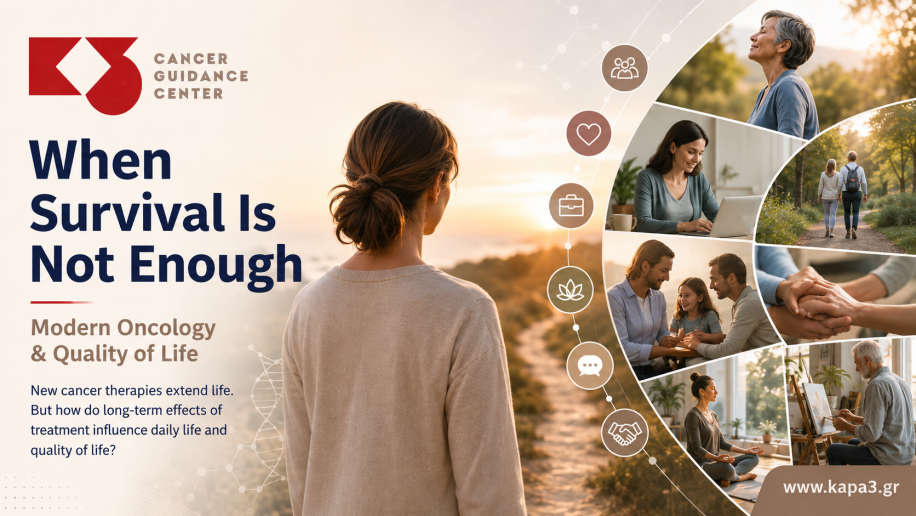
Modern Oncology: When Survival Is Not Enough
New therapies, “hidden” effects and the need to assess not only how long patients live, but how they live
Modern oncology is changing at an unprecedented pace. Immunotherapies, antibody–drug conjugates (ADCs), bispecific antibodies and new targeted therapies are creating treatment opportunities that would have been unimaginable only a few years ago.
Cancer treatment is becoming increasingly personalised and tailored to the biological and molecular characteristics of each tumour, while overall survival is being extended for many people living with cancer.
Yet alongside this remarkable scientific progress, a critical question is emerging:
What does it really mean to live longer after — or with — cancer?
A recent Nature Medicine editorial, entitled “Oncology must confront hidden side effects”, highlights precisely this challenge. While cancer drug development is advancing at remarkable speed, the approaches used to record, assess and manage long-term treatment-related toxicities — and their impact on patients’ quality of life — have not evolved at the same pace.
When a “mild” side effect becomes a major burden
Therapeutic success can create a new reality: people are living longer, but some must also manage treatment-related adverse effects for months, years or even for the rest of their lives.
An adverse event classified clinically as low-grade is not necessarily insignificant to the person experiencing it.
A persistent rash, diarrhoea, stomatitis or other symptoms may substantially affect daily functioning, psychological wellbeing and social life when they continue over long periods.
Similarly, some immune-related adverse events associated with immune checkpoint inhibitors can become chronic, persist for years or even be irreversible.
This highlights an important limitation of the Common Terminology Criteria for Adverse Events (CTCAE), which are widely used to classify and grade treatment-related adverse events.
The duration of adverse events is not adequately reflected, while functional and psychological consequences may also remain outside traditional toxicity assessment.
As a result, what may be considered “manageable” according to conventional clinical criteria can feel very different to the patient living with it every day.
Quality of life cannot be an afterthought
A second important issue is the timing of quality-of-life evidence.
In some cases, quality-of-life findings are reported considerably later than the primary results of a clinical trial, and sometimes after a new drug has already been approved.
This means that patients making treatment decisions during the early years of a new therapy may not yet have a complete picture of how it could affect their daily functioning, emotional wellbeing and overall quality of life.
At the same time, the questionnaires and tools used to assess quality of life need to evolve continuously.
And this cannot happen without the direct involvement of patients themselves.
The experiences and priorities of people receiving treatment should form part of how treatment impact is assessed, rather than being treated as information that is added later.
The example of daraxonrasib
The Nature Medicine editorial highlights the pan-RAS inhibitor daraxonrasib as a telling example. The therapy has shown important survival benefits for patients with aggressive RAS-driven advanced pancreatic cancer, a setting in which treatment options have historically been limited.
At the same time, most patients experienced acneiform rash, with diarrhoea and stomatitis also reported as lower-grade treatment-related adverse events.
Full quality-of-life data — including information on daily functioning and emotional wellbeing — were not yet available because follow-up remained relatively short.
This example illustrates a much wider issue.
If we know that a therapy can significantly extend life, but we do not yet fully understand what that life will be like, an essential part of the information is missing from the conversation between patients and their healthcare teams.
This also has direct implications for informed consent.
Whenever evidence is available, patients need information not only about response rates and survival but also about the potential short- and long-term consequences of treatment for their everyday lives.
The same treatment is not experienced in the same way by everyone
The toxicity profile of a treatment is not identical for every patient.
It may vary according to the drug’s mechanism of action, a person’s physical condition, co-existing long-term conditions, genetic background and other individual characteristics.
Particular attention is needed for populations that have historically been excluded from, or underrepresented in, clinical trials, as their experiences of treatment-related toxicity may differ.
The editorial points, for example, to sex-related differences in adverse events associated with immunotherapy and racial disparities in adverse events observed with CAR-T cell therapy.
This makes real-world data particularly important.
Clinical trials remain fundamental to establishing the safety and efficacy of new treatments. However, broader use in everyday clinical practice may reveal treatment effects that were not fully captured in the populations included in initial studies.
One example is the bispecific antibody amivantamab in lung cancer, where the full extent and severity of some skin toxicities became clearer after a broader patient population was exposed to the treatment.
Moving beyond clinical silos
This changing landscape also demands a different approach to the organisation of cancer care.
The adverse effects of modern cancer therapies do not always fit within a single organ system or medical specialty.
Traditional clinical and disciplinary silos can limit the transfer of knowledge needed to identify, monitor and manage emerging toxicities effectively.
The response therefore needs to be interdisciplinary.
Collaborative networks, updated guidance, systematic reporting, dedicated registries and effective knowledge exchange are increasingly important so that new or rare adverse effects can be recognised early and managed appropriately.
Above all, the patient voice must be heard
Perhaps the most important change concerns how we define treatment success itself.
Survival remains a fundamental goal of oncology.
But it cannot be the only one.
We also need to understand whether people can work, move, sleep, eat, participate in family and social life, maintain as much independence as possible and manage the effects of treatment on their everyday lives.
In other words, we need to know not only how much time a treatment adds to life, but also what that time means to the person living it.
Patients should therefore not enter the process only at the end, as recipients of treatment.
Their perspectives need to be incorporated from the design of clinical trials and assessment tools through to post-approval monitoring and the real-world use of new cancer therapies.
From survival to living after — and with — cancer
Progress in oncology is undeniable, and it brings genuine hope.
The next challenge is to ensure that longer survival is accompanied by quality of life, functioning, meaningful information, participation and dignity.
Modern cancer care therefore needs to move beyond asking only:
“How much longer can this patient live?”
and give equal importance to another question:
“How will this person live during that additional time?”
For Kapa3, this discussion goes to the heart of truly person-centred cancer care: care that sees not only the disease and the treatment, but the person, their everyday life, their needs, their choices and the life that continues during and after cancer.
Source and references
Main source:
Nature Medicine. “Oncology must confront hidden side effects.” Volume 32, July 2026. Published online 8 July 2026. DOI: 10.1038/s41591-026-04554-9.
- Barron CC et al. Journal for ImmunoTherapy of Cancer. 2023;11.
- Gyawali B et al. Lancet Oncology. 2025;26–e89.
- O’Reilly EM et al. New England Journal of Medicine. 2026. DOI: 10.1056/NEJMoa2605555.
- Unger JM et al. Journal of Clinical Oncology. 2022;40:1474–1486.
- Rayapureddy AK et al. Journal of Clinical Oncology. 2026;44.
- Hines MR et al. Transplantation and Cellular Therapy. 2023;29:438.e1–438.e16.
find more s41591-026-04554-9