Modern Oncology: When Survival Is Not Enough

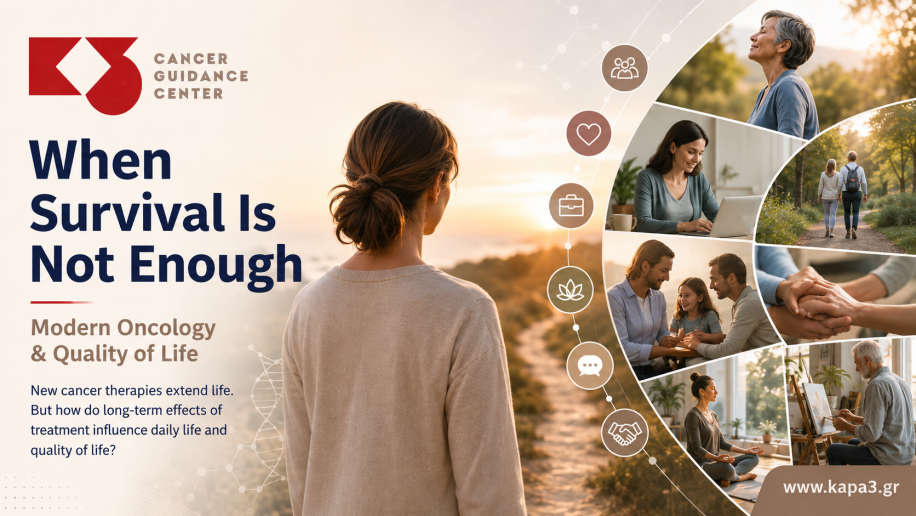
New therapies, “hidden” effects and the need to assess not only how long patients live, but how they live

Modern Oncology: When Survival Is Not Enough

New therapies, “hidden” effects and the need to assess not only how long patients live, but how they live

Modern oncology is changing at an unprecedented pace. Immunotherapies, antibody–drug conjugates (ADCs), bispecific antibodies and new targeted therapies are creating treatment opportunities that would have been unimaginable only a few years ago.

Cancer treatment is becoming increasingly personalised and tailored to the biological and molecular characteristics of each tumour, while overall survival is being extended for many people living with cancer.

Yet alongside this remarkable scientific progress, a critical question is emerging:

What does it really mean to live longer after — or with — cancer?

A recent Nature Medicine editorial, entitled “Oncology must confront hidden side effects”, highlights precisely this challenge. While cancer drug development is advancing at remarkable speed, the approaches used to record, assess and manage long-term treatment-related toxicities — and their impact on patients’ quality of life — have not evolved at the same pace.

When a “mild” side effect becomes a major burden

Therapeutic success can create a new reality: people are living longer, but some must also manage treatment-related adverse effects for months, years or even for the rest of their lives.

An adverse event classified clinically as low-grade is not necessarily insignificant to the person experiencing it.

A persistent rash, diarrhoea, stomatitis or other symptoms may substantially affect daily functioning, psychological wellbeing and social life when they continue over long periods.

Similarly, some immune-related adverse events associated with immune checkpoint inhibitors can become chronic, persist for years or even be irreversible.

This highlights an important limitation of the Common Terminology Criteria for Adverse Events (CTCAE), which are widely used to classify and grade treatment-related adverse events.

The duration of adverse events is not adequately reflected, while functional and psychological consequences may also remain outside traditional toxicity assessment.

As a result, what may be considered “manageable” according to conventional clinical criteria can feel very different to the patient living with it every day.

Quality of life cannot be an afterthought

A second important issue is the timing of quality-of-life evidence.

In some cases, quality-of-life findings are reported considerably later than the primary results of a clinical trial, and sometimes after a new drug has already been approved.

This means that patients making treatment decisions during the early years of a new therapy may not yet have a complete picture of how it could affect their daily functioning, emotional wellbeing and overall quality of life.

At the same time, the questionnaires and tools used to assess quality of life need to evolve continuously.

And this cannot happen without the direct involvement of patients themselves.

The experiences and priorities of people receiving treatment should form part of how treatment impact is assessed, rather than being treated as information that is added later.

The example of daraxonrasib

The Nature Medicine editorial highlights the pan-RAS inhibitor daraxonrasib as a telling example. The therapy has shown important survival benefits for patients with aggressive RAS-driven advanced pancreatic cancer, a setting in which treatment options have historically been limited.

At the same time, most patients experienced acneiform rash, with diarrhoea and stomatitis also reported as lower-grade treatment-related adverse events.

Full quality-of-life data — including information on daily functioning and emotional wellbeing — were not yet available because follow-up remained relatively short.

This example illustrates a much wider issue.

If we know that a therapy can significantly extend life, but we do not yet fully understand what that life will be like, an essential part of the information is missing from the conversation between patients and their healthcare teams.

This also has direct implications for informed consent.

Whenever evidence is available, patients need information not only about response rates and survival but also about the potential short- and long-term consequences of treatment for their everyday lives.

The same treatment is not experienced in the same way by everyone

The toxicity profile of a treatment is not identical for every patient.

It may vary according to the drug’s mechanism of action, a person’s physical condition, co-existing long-term conditions, genetic background and other individual characteristics.

Particular attention is needed for populations that have historically been excluded from, or underrepresented in, clinical trials, as their experiences of treatment-related toxicity may differ.

The editorial points, for example, to sex-related differences in adverse events associated with immunotherapy and racial disparities in adverse events observed with CAR-T cell therapy.

This makes real-world data particularly important.

Clinical trials remain fundamental to establishing the safety and efficacy of new treatments. However, broader use in everyday clinical practice may reveal treatment effects that were not fully captured in the populations included in initial studies.

One example is the bispecific antibody amivantamab in lung cancer, where the full extent and severity of some skin toxicities became clearer after a broader patient population was exposed to the treatment.

Moving beyond clinical silos

This changing landscape also demands a different approach to the organisation of cancer care.

The adverse effects of modern cancer therapies do not always fit within a single organ system or medical specialty.

Traditional clinical and disciplinary silos can limit the transfer of knowledge needed to identify, monitor and manage emerging toxicities effectively.

The response therefore needs to be interdisciplinary.

Collaborative networks, updated guidance, systematic reporting, dedicated registries and effective knowledge exchange are increasingly important so that new or rare adverse effects can be recognised early and managed appropriately.

Above all, the patient voice must be heard

Perhaps the most important change concerns how we define treatment success itself.

Survival remains a fundamental goal of oncology.

But it cannot be the only one.

We also need to understand whether people can work, move, sleep, eat, participate in family and social life, maintain as much independence as possible and manage the effects of treatment on their everyday lives.

In other words, we need to know not only how much time a treatment adds to life, but also what that time means to the person living it.

Patients should therefore not enter the process only at the end, as recipients of treatment.

Their perspectives need to be incorporated from the design of clinical trials and assessment tools through to post-approval monitoring and the real-world use of new cancer therapies.

From survival to living after — and with — cancer

Progress in oncology is undeniable, and it brings genuine hope.

The next challenge is to ensure that longer survival is accompanied by quality of life, functioning, meaningful information, participation and dignity.

Modern cancer care therefore needs to move beyond asking only:

“How much longer can this patient live?”

and give equal importance to another question:

“How will this person live during that additional time?”

For Kapa3, this discussion goes to the heart of truly person-centred cancer care: care that sees not only the disease and the treatment, but the person, their everyday life, their needs, their choices and the life that continues during and after cancer.

Source and references

Main source:
Nature Medicine. “Oncology must confront hidden side effects.” Volume 32, July 2026. Published online 8 July 2026. DOI: 10.1038/s41591-026-04554-9.

  1. Barron CC et al. Journal for ImmunoTherapy of Cancer. 2023;11.
  2. Gyawali B et al. Lancet Oncology. 2025;26–e89.
  3. O’Reilly EM et al. New England Journal of Medicine. 2026. DOI: 10.1056/NEJMoa2605555.
  4. Unger JM et al. Journal of Clinical Oncology. 2022;40:1474–1486.
  5. Rayapureddy AK et al. Journal of Clinical Oncology. 2026;44.
  6. Hines MR et al. Transplantation and Cellular Therapy. 2023;29:438.e1–438.e16.

find more s41591-026-04554-9

A Calm Summer Begins with Proper Preparation Proactive Care Planning, Mental Decompression and Digital Support

Proactive Care Planning, Mental Decompression and Digital Support

Summer is a valuable opportunity for rest, renewal and quality time with the people we love. For people living with or after a cancer diagnosis, as well as for their caregivers, the possibility of enjoying a few days away from everyday life can contribute meaningfully to physical and mental well-being.

When a person’s health condition allows it, and with the agreement of the treating physician, even a short break can have a beneficial effect, enhancing quality of life and supporting the sense of returning to everyday life (Lim et al., 2022).

The quality of life of people living with or after a cancer diagnosis does not depend solely on medical treatment. Mental well-being, social support, optimism and resilience are equally important factors that facilitate adaptation to the disease and contribute to patients’ overall well-being (Ruiz-Rodríguez et al., 2022). At the same time, current guidelines underline the importance of integrated and personalised care, as well as continuous support for people living with or after cancer at every stage of their journey (Hart et al., 2024).

However, the peace of mind associated with holidays does not begin on the day of departure. It begins much earlier, through proper preparation. Practical pending issues, administrative procedures or concerns about unexpected events during the holidays can increase stress and reduce the feeling of safety. By contrast, proactive care planning allows patients to organise what is needed in advance, so that they can devote their time to rest rather than obligations.

Timely renewal of medical certificates, ensuring an adequate supply of medication for the entire period of absence, communicating with the treating physician when necessary, and keeping essential medical documents in an easily accessible format are simple but important steps of preparation. In this way, continuity of care is safeguarded, while the uncertainty that often accompanies travel is reduced.

Reliable information and timely support are key pillars of modern oncology care. When people know where they can turn and have easy access to trustworthy information, they feel safer, their autonomy is strengthened and the management of daily life becomes easier (Ruiz-Rodríguez et al., 2022; Hart et al., 2024).

In today’s world, digital tools can complement support services by facilitating access to reliable information wherever the patient may be. In this direction, Kapa3 is moving forward with the development of Myrto, the digital social navigator, designed to provide direct access to information on social rights, available services and useful guidance. In this way, it facilitates access to the organisation’s services and reliable information, contributing to better preparation before and during holidays.

For all of us at Kapa3, technology does not replace human care; it complements it. It is another means of facilitating access to trustworthy information and available services, while the Social Service and Psychological Support Service of Kapa3 remain the core pillar of holistic support for people living with cancer and their families.

Let us remember that care does not stop when holidays begin. It continues through small but meaningful acts of preparation, proper information and timely planning. Because, many times, the greatest luxury of a holiday is not the destination itself, but the feeling that we can enjoy our moments with calmness, safety and trust.

The Social Service and Psychological Support Service of Kapa3 wish everyone a safe, peaceful and refreshing summer, with health, strength and beautiful moments.

Before Leaving for Your Holidays…

✔️ Make sure you have an adequate supply of your medication for the entire period of your absence.

✔️ Check whether there are any medical certificates, prescriptions or other administrative pending issues that need to be settled in time.

✔️ Discuss with your treating physician any special instructions related to travel or movement.

✔️ Keep with you the necessary medical documents and important contact details.

✔️ Find out about available support services and make use of the Kapa3 App, so that you have easy access to useful information wherever you are.


References

Hart, N. H., Nekhlyudov, L., Smith, T. J., Yee, J., Fitch, M. I., Crawford, G. B., et al. (2024). Survivorship Care for People Affected by Advanced or Metastatic Cancer: MASCC-ASCO Standards and Practice Recommendations. JCO Oncology Practice, 20(9), 1160–1172. https://doi.org/10.1200/OP.23.00716

Lim, J. H. C., Keenan, C., & Flaherty, G. T. (2022). All My Life to Live: Travel Health Benefits and Risks for Cancer Survivors. Journal of Travel Medicine, 29(5), taac069. https://doi.org/10.1093/jtm/taac069

National Comprehensive Cancer Network. (2024). NCCN Clinical Practice Guidelines in Oncology (NCCN Guidelines®): Survivorship. Version 2.2024. Plymouth Meeting, PA: National Comprehensive Cancer Network.

Ruiz-Rodríguez, I., Hombrados-Mendieta, I., Melguizo-Garín, A., & Martos-Méndez, M. J. (2022). The Importance of Social Support, Optimism and Resilience on the Quality of Life of Cancer Patients. Frontiers in Psychology, 13, 833176. https://doi.org/10.3389/fpsyg.2022.833176

World Health Organization. (2022). World Mental Health Report: Transforming Mental Health for All. Geneva: World Health Organization.


Official Access Links

Hart et al., 2024 — MASCC-ASCO Standards:
https://ascopubs.org/doi/10.1200/OP.23.00716

Lim et al., 2022:
https://doi.org/10.1093/jtm/taac069

NCCN Clinical Practice Guidelines in Oncology: Survivorship:
https://www.nccn.org/professionals/physician_gls/pdf/survivorship.pdf

Ruiz-Rodríguez et al., 2022:
https://doi.org/10.3389/fpsyg.2022.833176

WHO World Mental Health Report:
https://www.who.int/publications/i/item/9789240049338


Marilia Barka
Psychology Student
Kapa3 Volunteer

www.linkedin.com/in/maria-garyfalia-marilia-barka-03825a409

World Self-Care Day (July 24): The Importance of Self-Care on the Journey with Cancer.

  • July 24 has been designated as World Self-Care Day. This symbolic date (7/24) was chosen to remind us all of something very basic: that taking care of ourselves is a process that deserves to continue 24 hours a day, 7 days a week.

    At the Cancer Patient Support Center, this day takes on a deeper and more meaningful significance. Self-care is not merely a luxury or a passing trend, but a valuable tool for physical, mental, and emotional empowerment—both for patients undergoing treatment and for their caregivers.

    What does “self-care” mean?

    According to the World Health Organization (WHO), self-care is defined as the ability of individuals, families, and communities to promote health, prevent disease, maintain well-being, and manage illness with or even without the support of a health professional.

    This is an active commitment to ourselves, which includes:

    1. Healthy daily habits: proper nutrition, adequate sleep, and moderate physical activity (always in consultation with your treating physician)

    2. Prevention and responsibility: consistent medication adherence, regular preventive checkups, and following medical instructions.

    3. Mental and emotional balance: recognizing personal boundaries, managing stress, accepting our emotions, and seeking help wherever and whenever we need it.

    4. Health and health literacy: responsibly staying informed about our health status from reliable sources.

    Self-Care in the Cancer Experience

    For someone who has experienced cancer, self-care takes on a very personal character. It does not mean that “one must do everything on one’s own.” On the contrary, it is essential to:

    • Listen to their body, without feeling guilty about the need for rest

    • Take care of their emotional well-being. Allow themselves to feel every emotion—fear, fatigue, but also hope. Psychological support is considered one of the most important acts of self-care.

    • Build a support network. It is absolutely essential to allow loved ones or specialized professionals to support them.

    Caring for Caregivers

    World Self-Care Day is equally dedicated to those who care for patients—family members, partners, and friends. People who stand by patients often tend to neglect their own needs, thereby driving themselves to physical and mental exhaustion. This day serves as a reminder that caring for caregivers is not selfish but an urgent necessity.

    For caregivers to practice self-care in practice, they must first set boundaries, as they do not need to bear the entire burden alone. At the same time, it is important for them to acknowledge their emotions without judgment, accepting that fatigue, anger, and frustration are normal reactions. It is equally essential to set aside personal time. Fifteen to thirty minutes a day for a walk or to read a book can be beneficial. Finally, seeking psychological support is not a sign of weakness but an act of self-care.

    The Cancer Patient Guidance Center is here for you

    At K3, we believe that no one should have to walk this path alone. Self-care is strengthened when there is guidance, reliable information, and human support.

    On this special day, let’s all take a step back from the fast pace of life and make our health and well-being a priority.

    24 hours a day, 7 days a week: let’s take care of ourselves!

Kapa3 Report for the First Half of 2026

As the first half of 2026 draws to a close, the Cancer Patient Guidance Center (Kapa3) continues to systematically expand its reach, thereby strengthening the system of care and information for both cancer patients and their caregivers.

During the first half of the year, the organization implemented a series of high-level initiatives and forged partnerships at both the national and European levels, thereby solidifying its position.

The organization’s activities got off to a strong start in January with the welcome of its European partners in the MELODIC Consortium project at a productive two-day workshop (January 19–20), hosted by the School of Public Health at the University of West Attica.

In early February, on the occasion of World Cancer Day, Kapa3 played an active role as a partner of René Descartes College in the webinar “Cancer, Patient Navigation & Health Management: From Prevention to Life Coordination.”

At the same time, significant initiatives were carried out in the local community, such as the “Knowledge Workshop in Megara—From Prevention to Life Coordination,” held on February 8 in collaboration with the Municipality of Megara.

In the area of scientific programs, the Cancer Patient Guidance Center, in collaboration with the Laboratory of Basic Health Sciences (EBEY) of the Department of Nursing at the University of the Peloponnese (PA.PEL), launched a series of online meetings running from February through June, focusing on mental health and nutrition.

The month concluded with the organization’s participation in the international conference “Mapping the Unknown in Oncology – From Hospitals to Homes, Mapping the Future of Oncology Care,” held on February 27 and 28.

March marked a strengthening of Kapa3’s “digital presence” with its official membership in the Hellenic Digital Health Cluster (HDHC), a strategic move aimed at linking healthcare with technological advancements. As an extension of this collaboration, the organization participated in a closed-door members’ meeting as part of Athens Digital Health Week 2026.

On March 11, representatives of the organization attended the diaNEOsis event “Facing the Challenge of Artificial Intelligence” at the Lighthouse of the Stavros Niarchos Foundation Cultural Center, while in the middle of the month, Kapa 3 played a prominent role in the scientific conference “Cancer in 2026: Challenges and Disruptions.” Furthermore, on March 19–20, the organization was represented at the 6th Western Macedonia Nursing Conference on the theme “Innovation and Empathy: Balancing Technology with Human Contact in Nursing.”

In parallel, the organization’s co-founder, Ms. Evangelia Bista, gave an interview on the show “All About Health” on Dion TV—which covered a variety of topics related to health, nutrition, autoimmune diseases, and more—the implementation of the free, 8-week Melodic pilot educational program began.

Kapa3’s scientific credibility was reaffirmed by the publication of the research paper “Person-First or Disease-First? Language Choices in Cancer Communication” in the journal *Nursing Reports*, as well as by Kapa3’s participation in the European project associated with Melodic, titled: “Educational Needs Regarding Mental Health of Professionals Working with Young Adults with Cancer: A European Survey,” which was also published; the organization also participated in the MELODIC Online Symposium 2026 on April 24, contributing to the dissemination of results in Greece.

May was marked by a strong outward focus and new collaborations, as the organization joined the European program Service Learning 2: 0:CoLab, was selected as one of six nonprofit organizations to receive financial support from the Alpha Bank-Match For Good initiative, and began its collaboration with the USTEP INSTITUTE.

At the same time, an awareness campaign was held in Soufli to highlight Kapa3’s activities; Ms. Bista gave an interview to iatronet.gr, and representatives of the organization participated in an international conference at the Medical School of the University of Coimbra in Portugal

Within the organization, the new Psychological Support team was established with great enthusiasm, while on the social media front, the Kapa3 team won six medals at the 4th Vouliagmeni Summer Swim.

As the semester came to a close, June began with the signing of an official cooperation agreement with the Department of Occupational Therapy at the University of West Attica, while partnerships were solidified with the non-profit organization “Karkinaki” and the PRAXI Network of the Foundation for Research and Technology – Hellas (FORTH) to strengthen international networking and access to modern funding tools.

Having completed five years of uninterrupted service in supporting cancer patients through digital guidance, Kapa 3 is entering a new era with the development of the innovative “Myrto” project. This is a pioneering Social Artificial Intelligence (Social AI) initiative in the field of care for cancer patients in Greece. “Myrto” will function as an advanced digital health and rights navigator (Patient Empowerment e-Navigator) for patients, caregivers, and healthcare professionals—a project for which the strategic partnership with SimasiaAi for its co-development was crucial. Finally, the first closed workshop of the MYRTO Al Health Innovation Lab was held for the “Myrto” application, with the support of René Descartes College.

The results of this first half-year clearly demonstrate that Kapa 3 serves as a link connecting innovation, scientific research, and the digital age in the field of oncology care. By combining academic knowledge, European partnerships, and technological development, Kappa 3 transforms every challenge into sustainable, people-centered solutions. Partnerships with leading organizations, investors, and partners who share the same values of social responsibility are also essential to realizing this vision, ensuring that every patient has immediate, reliable, and equitable access to healthcare and their rights.

The KAPA3 team stands steadfastly by patients and caregivers to provide guidance and safeguard their rights. For any information or support, please feel free to contact us.

You can contact the KAPA3 team

13 Kostis Palamas Street, 3rd floor (Hours: 9:00 a.m. – 5:00 p.m.).

Phone Numbers: 210 5221424 & 6906265170.

Email: info@kapa3.gr


Language in cancer care: why words are never neutral

Language used in cancer care is never neutral. The words chosen to describe a diagnosis can significantly shape how a person experiences illness, especially during a highly vulnerable period of life. Depending on how they are used, words may either reinforce fear and stigma or support dignity, psychological safety, and empowerment.

This perspective is highlighted in a recent interview with Evangeli Bista, co-founder of the Cancer Guidance Center (Kapa3), published on iatronet.gr, where she discusses the findings of a study exploring how patients themselves perceive the language used around cancer.

The study, conducted by Kapa3, examined how people living with cancer experience terms such as “cancer patient,” “oncology patient,” or simply “patient,” and how these labels influence their emotional response and sense of identity.

Findings suggest that many patients feel that labels directly linking them to their disease can increase emotional burden and reinforce the idea that cancer defines their entire identity. In contrast, more neutral or person-first expressions (“person with cancer”) appear to offer greater psychological comfort, allowing individuals to maintain a sense of self beyond the diagnosis.

The qualitative analysis also highlights the crucial role of healthcare professionals. Clear, honest, and compassionate communication—without exaggeration or dramatic framing—is consistently described by patients as a key element of trust and emotional support. Communication, in this sense, is not simply a soft skill but an essential part of clinical care.

The study further reinforces the importance of a person-first approach, where the individual comes before the illness. At the same time, participants expressed resistance both to stigma and to excessive heroisation, calling instead for balanced, respectful, and realistic communication.

Ultimately, language in oncology is not just descriptive—it actively shapes the patient experience and becomes part of the care process itself.

Read the full interview with Evangeli Bista on iatronet.gr:
https://www.iatronet.gr/article/139695/karkinopathhs-ogkologikos-asthenhs-h-apla-asthenhs-o-antiktypos-ton-lexeon-ston-karkino

Read the related scientific publication by the Cancer Guidance Center (Kapa3):
https://www.kapa3.gr/nea-epistimoniki-dimosieysi-gia-to-kapa3/

Text/Adaptation: Ifiyenia Anastasiou for Kapa3