
The Right to Be Forgotten: A New Era of Dignity for Cancer Survivors

Life after cancer should not be accompanied by lifelong financial exclusion

For many decades, completing cancer treatment did not always mean the end of obstacles for those who had been diagnosed with the disease. Years after their treatment, many survivors continued to face higher insurance premiums, denied insurance applications, and difficulties accessing financial services.A history of cancer could act as a permanent “stigma,” even many years after treatment had ended.

Thus, medical progress and a return to daily life were not always accompanied by corresponding social and economic rehabilitation.

With Law No. 5317/2026, published on July 10, 2026, Greece is moving forward with the legislative enshrinement of the so-called “Right to Be Forgotten” for cancer survivors, in the context of insurance contracts linked to consumer credit agreements. This specific provision is found in Article 16, paragraph 4, of the law.

What the new provision stipulates

The law prohibits the use of personal data related to a consumer’s cancer diagnosis when such data is to be used for an insurance contract linked to a credit agreement and five years have passed since the completion of treatment.

Simply put, once the five-year period has elapsed, a prior history of a cancer diagnosis cannot be used in this specific context as a factor in assessing the insurance contract accompanying the credit agreement. This represents a significant shift: individuals are no longer assessed indefinitely through the lens of a past
illness, but are given the opportunity to move forward with their lives without their previous diagnosis serving as a permanent obstacle.

The four key points of the new entitlement

The Right to be Forgotten does not mean that the diagnosis is deleted from the medical record. It means that, after the prescribed five-year period, data related to the cancer diagnosis may not be used for that specific insurance purpose.

Fourth, special oversight is provided for.

The Personal Data Protection Authority is responsible for enforcing paragraph 4 of Article 16 and possesses the supervisory and auditing powers provided for by the General Data Protection Regulation.

What the New Regulation Does Not Cover

Accurate information is particularly important so that citizens are aware of both their rights and the actual
limits of the protection provided.

The new legislative provision:

  • does not apply to all forms of private insurance,
  • does not automatically guarantee the approval of a loan or an insurance application,
  • does not cover credit agreements secured by a mortgage on real property,
  • does not cover credit intended for the purchase or retention of rights in real estate,

does not cover professional or business loans, as the law applies to consumers acting outside the
scope of their professional or business activities.

Furthermore, consumer credit agreements already in effect as of November 20, 2026, will, as a general rule, continue to be governed by the previous legal framework until their expiration.
Therefore, the new regulation represents a very important step, but it does not yet provide comprehensive coverage of all the financial and insurance needs of survivors.

From Voluntary Commitment to Legal Enshrinement

The Right to Be Forgotten did not first appear in Greece in 2026. As of March 26, 2024, the Code of Ethics of the Hellenic Association of Insurance Companies has been in effect, to which life insurance companies had adhered.

The Code applied to life insurance policies linked to mortgage, business, or consumer loans, with a maximum total insured amount of 300,000 euros. It provided for a ten-year period following the completion of treatment for those diagnosed as adults and a five-year period for those diagnosed before
turning 18.

The new legislation is particularly significant because protection is no longer based exclusively on the insurance industry’s voluntary commitment. For contracts falling within its scope, the failure to use the oncological diagnosis after the five-year period becomes a legal obligation.

At the same time, there is a need to clarify the relationship between the new law and the existing Code, particularly with regard to mortgage and business loans that are not subject to the new legislative provision.

Additional Safeguards for Consumers

Article 16 includes other important safeguards. When insurance is required for the granting of credit, the creditor must accept equivalent insurance coverage from an insurance company of the consumer’s choice. Choosing a different company must not result in less favorable credit terms.

At the same time, the consumer is given a period of at least three business days to compare insurance quotes, unless the consumer requests in writing that the contract be concluded earlier.

The European Dimension

The Greek regulation transposes Directive (EU) 2023/2225 on consumer credit agreements. The European
Directive requires Member States to establish a time limit beyond which data related to oncological
diagnoses may not be used for insurance policies linked to credit agreements. The European text stipulated that this period must not exceed fifteen years; Greece opted for the significantly shorter period of five years.

This choice has particular social significance. It recognizes that advances in oncology, increased survival rates, and people’s return to family, social, and professional life must be accompanied by corresponding
developments in the law.

When Does It Take Ef ect?

Although Law No. 5317/2026 has already been published, the provisions of Part A, which include the
Right to Be Forgotten, will take effect on November 20, 2026.
Until then, substantial preparation is required on the part of banks, insurance companies, and the relevant
authorities. Clear procedures, understandable information for citizens, appropriate staff training, and an
easily accessible mechanism for submitting reports or complaints are needed.

A Significant Achievement—Not the End of the Journey

The Right to Be Forgotten represents a significant institutional victory for dignity and equality. Cancer
should not be a lifelong social and economic stigma. A person’s medical history should not negate their
right to plan for the future, participate equally in society, and make a fresh start.
At the same time, the new regulation must be viewed as a starting point, not the culmination of our
efforts. The next step must be to extend meaningful protection to more insurance and financial products,
including housing needs, as well as to address the discrimination that continues to occur in the workplace
and other aspects of social life.
Scientific progress has transformed cancer from a terminal diagnosis into an experience of life and
survival for millions of people. Society and the law must follow suit.

Because the Right to Be Forgotten is not a privilege. It is every person’s right not to remain forever
trapped by a past diagnosis—and to move forward into the future without discrimination, without
stigma, and with dignity.

Find more : http://elib.aade.gr/elib/view?
Kapa3 Report for the First Half of 2026

As the first half of 2026 draws to a close, the Cancer Patient Guidance Center (Kapa3) continues to systematically expand its reach, thereby strengthening the system of care and information for both cancer patients and their caregivers.

During the first half of the year, the organization implemented a series of high-level initiatives and forged partnerships at both the national and European levels, thereby solidifying its position.

The organization’s activities got off to a strong start in January with the welcome of its European partners in the MELODIC Consortium project at a productive two-day workshop (January 19–20), hosted by the School of Public Health at the University of West Attica.

In early February, on the occasion of World Cancer Day, Kapa3 played an active role as a partner of René Descartes College in the webinar “Cancer, Patient Navigation & Health Management: From Prevention to Life Coordination.”

At the same time, significant initiatives were carried out in the local community, such as the “Knowledge Workshop in Megara—From Prevention to Life Coordination,” held on February 8 in collaboration with the Municipality of Megara.

In the area of scientific programs, the Cancer Patient Guidance Center, in collaboration with the Laboratory of Basic Health Sciences (EBEY) of the Department of Nursing at the University of the Peloponnese (PA.PEL), launched a series of online meetings running from February through June, focusing on mental health and nutrition.

The month concluded with the organization’s participation in the international conference “Mapping the Unknown in Oncology – From Hospitals to Homes, Mapping the Future of Oncology Care,” held on February 27 and 28.

March marked a strengthening of Kapa3’s “digital presence” with its official membership in the Hellenic Digital Health Cluster (HDHC), a strategic move aimed at linking healthcare with technological advancements. As an extension of this collaboration, the organization participated in a closed-door members’ meeting as part of Athens Digital Health Week 2026.

On March 11, representatives of the organization attended the diaNEOsis event “Facing the Challenge of Artificial Intelligence” at the Lighthouse of the Stavros Niarchos Foundation Cultural Center, while in the middle of the month, Kapa 3 played a prominent role in the scientific conference “Cancer in 2026: Challenges and Disruptions.” Furthermore, on March 19–20, the organization was represented at the 6th Western Macedonia Nursing Conference on the theme “Innovation and Empathy: Balancing Technology with Human Contact in Nursing.”

In parallel, the organization’s co-founder, Ms. Evangelia Bista, gave an interview on the show “All About Health” on Dion TV—which covered a variety of topics related to health, nutrition, autoimmune diseases, and more—the implementation of the free, 8-week Melodic pilot educational program began.

Kapa3’s scientific credibility was reaffirmed by the publication of the research paper “Person-First or Disease-First? Language Choices in Cancer Communication” in the journal *Nursing Reports*, as well as by Kapa3’s participation in the European project associated with Melodic, titled: “Educational Needs Regarding Mental Health of Professionals Working with Young Adults with Cancer: A European Survey,” which was also published; the organization also participated in the MELODIC Online Symposium 2026 on April 24, contributing to the dissemination of results in Greece.

May was marked by a strong outward focus and new collaborations, as the organization joined the European program Service Learning 2: 0:CoLab, was selected as one of six nonprofit organizations to receive financial support from the Alpha Bank-Match For Good initiative, and began its collaboration with the USTEP INSTITUTE.

At the same time, an awareness campaign was held in Soufli to highlight Kapa3’s activities; Ms. Bista gave an interview to iatronet.gr, and representatives of the organization participated in an international conference at the Medical School of the University of Coimbra in Portugal

Within the organization, the new Psychological Support team was established with great enthusiasm, while on the social media front, the Kapa3 team won six medals at the 4th Vouliagmeni Summer Swim.

As the semester came to a close, June began with the signing of an official cooperation agreement with the Department of Occupational Therapy at the University of West Attica, while partnerships were solidified with the non-profit organization “Karkinaki” and the PRAXI Network of the Foundation for Research and Technology – Hellas (FORTH) to strengthen international networking and access to modern funding tools.

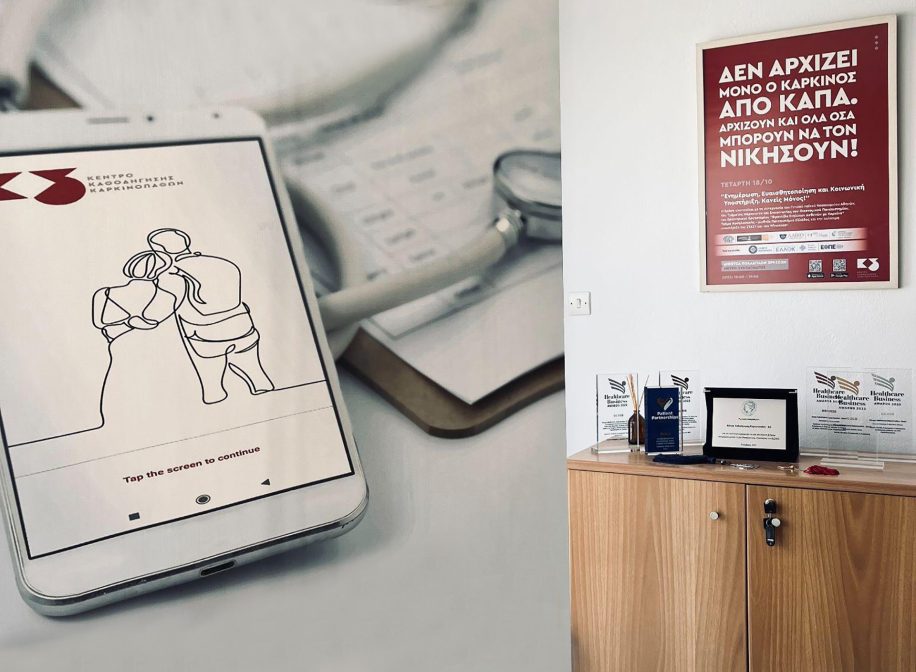
Having completed five years of uninterrupted service in supporting cancer patients through digital guidance, Kapa 3 is entering a new era with the development of the innovative “Myrto” project. This is a pioneering Social Artificial Intelligence (Social AI) initiative in the field of care for cancer patients in Greece. “Myrto” will function as an advanced digital health and rights navigator (Patient Empowerment e-Navigator) for patients, caregivers, and healthcare professionals—a project for which the strategic partnership with SimasiaAi for its co-development was crucial. Finally, the first closed workshop of the MYRTO Al Health Innovation Lab was held for the “Myrto” application, with the support of René Descartes College.

The results of this first half-year clearly demonstrate that Kapa 3 serves as a link connecting innovation, scientific research, and the digital age in the field of oncology care. By combining academic knowledge, European partnerships, and technological development, Kappa 3 transforms every challenge into sustainable, people-centered solutions. Partnerships with leading organizations, investors, and partners who share the same values of social responsibility are also essential to realizing this vision, ensuring that every patient has immediate, reliable, and equitable access to healthcare and their rights.

The KAPA3 team stands steadfastly by patients and caregivers to provide guidance and safeguard their rights. For any information or support, please feel free to contact us.

You can contact the KAPA3 team

13 Kostis Palamas Street, 3rd floor (Hours: 9:00 a.m. – 5:00 p.m.).

Phone Numbers: 210 5221424 & 6906265170.

Email: info@kapa3.gr


Kapa3 in the First Half of March: Actions, Collaborations, and Updates for Oncology Patients

During the first half of March, Kapa3 continued to highlight important topics concerning the oncology patient support, rights, and daily lives  through initiatives, collaborations, and informational activities.

Efforts focused both on strengthening access to information and services, and on promoting practical and digital tools that make patients’ daily lives easier.

In an environment where patients’ needs remain complex and constantly evolving, reliable information, enhanced collaboration among stakeholders, and the promotion of holistic care are especially important.

Below is a summary of the main developments from the month.

Collaborations

Key partnerships were strengthened with the Sarcoma Fighters Patients Association, the Hellenic Federation of Persons with Multiple Sclerosis (HFoPwMS), and Doctor Homie, aiming to enhance information, support, and quality care for patients.

Actions & Presentations

Kapa3 participated in the scientific meeting “Cancer in 2026: Challenges and Breakthroughs,” emphasizing the pivotal role of supportive care for oncology patients, while also presenting recent developments addressing their evolving needs. Kapa3 also attented the event Facing the Challenge of Artificial Intelligenceas we remain focused on supporting dialogue around the opportunities and challenges of A.I.

Patient Rights

Supporting oncology patients remains a central goal of our initiatives. Focus was given to updates on the 2026 constant attendance allowance and improved digital access for patients to their test results.

Digital Health & Research

A new European Commission report highlights the critical role of digital health technologies in transforming healthcare systems, outlining both opportunities and challenges for the future of care.

Awareness

March is Colorectal Cancer Awareness Month, reminding everyone of the importance of prevention and early detection.

Oncology patient support remains our top priority, and we continue to monitor developments — more news will follow.

Ministerial Decision (Government Gazette, FEK 230/B/22.01.2026) on Clinical Trials: Streamlining Research in Greece

The clinical trials regulation in Greece, published in the Government Gazette (ΦΕΚ) 230/B/22.01.2026, establishes a unified and simplified framework for contracts and financial management of clinical trials, non-interventional studies, and other health research projects. This clinical trials regulation in Greece directly affects clinical trials with medicines, studies involving medical devices, and research conducted in hospitals and public health institutions, aiming to reduce bureaucracy, ensure transparency, and protect participating patients.

Clinical trials regulation in Greece

WHY THE NEW DECISION WAS NECESSARY

Until now, procedures for signing contracts for clinical trials and studies were often delayed, complex, and varied between institutions. This slowed down research and discouraged sponsors and research teams. The new Ministerial Decision aims to create a clear, unified framework with common standards, defined responsibilities, and specific timelines.

WHAT CHANGES FOR CLINICAL TRIALS AND STUDIES

Under the new regulation:

  • Standardized contracts for clinical trials and studies are introduced,

  • Clear deadlines for contract signing are established,

  • The use of electronic procedures is promoted,

  • The financial management framework of research projects by responsible institutions is clarified.

These changes aim to reduce administrative burdens and facilitate the daily operations of research teams and health institutions.

WHAT THIS MEANS FOR PATIENTS

Of particular importance is the reaffirmation that participating patients are not financially burdened by their involvement in clinical trials or studies. The costs of examinations, procedures, and services related to the study are covered by the sponsor, ensuring the protection of patients’ rights and safety, and reinforcing trust in the research process.

WHY THIS REGULATION IS AN IMPORTANT STEP FOR RESEARCH IN GREECE

The Ministerial Decision published in the Government Gazette (ΦΕΚ 230/B/22.01.2026) represents a significant step toward improving the research environment in Greece. By creating unified and clear procedures for contract signing and financial management of clinical trials and studies, it reduces long-standing administrative barriers that delayed the implementation of research projects. At the same time, it strengthens institutional security for all stakeholders—researchers, health institutions, and sponsors—while fostering transparency and accountability.

In this context, Greece can become more competitive in research, facilitate participation in international research initiatives, and make more effective use of its scientific knowledge and human resources. In the healthcare field, accelerating and streamlining processes helps align research more closely with clinical practice and patients’ real needs, benefiting society as a whole.

Kapa3 closely monitors institutional developments affecting health research and clinical trials, highlighting their importance for patient protection and the improvement of care quality.

Text/adaptation: Ifiyenia Anastasiou for Kapa3