The experience of cancer is not confined to the hours spent at a medical appointment, receiving treatment or being admitted to hospital. A large part of the patient’s actual cancer journey unfolds at home: where symptoms and side effects are managed, medications and appointments are organised, information is sought, work and family life need to continue and, very often, a relative or friend takes on the role of caregiver.
This is why today’s discussion about the quality of cancer care cannot stop at the hospital door.
International literature is increasingly moving towards models of integrated, person-centred and multidisciplinary care, in which health is connected with everyday life, the family, the social environment and the wider community [1,2].
A recent review of health and social care models across the Mediterranean highlights several key elements: a holistic approach, collaboration among professionals, individual empowerment and stronger connections between healthcare services, social care and support at home.
When Home Becomes Part of the Care Pathway
For a person living with cancer, needs cannot easily be divided into “medical” and “social”.
On the same day, someone may need guidance on managing a side effect, assistance with an administrative procedure, information about a benefit or entitlement, psychological support, or access to a professional who can provide care at home.
Cancer also affects employment and financial life. In a population-based study of women with breast cancer, the burden of treatment was associated with significant absence from work and, in some cases, withdrawal from employment altogether, while access to paid sick leave and flexible working arrangements appeared to have a protective effect [3].
The need for integrated support is therefore not an abstract concept. It concerns a person’s ability to continue their life as safely and independently as possible.
What Kapa3’s Everyday Experience Tells Us
Data from Kapa3 – Cancer Patient Guidance Centre reflect this complexity within the Greek context.
Between 27 January and 30 July 2026, Kapa3 recorded 1,251 telephone contacts — 614 incoming and 637 outgoing calls — as well as 497 emails sent to beneficiaries.
Through email-based counselling interventions, 241 people submitted more than 300 requests, covering 52 different categories of need.
Exemptions and social benefits represented the largest category, followed by disability certification through KEPA, the Greek Disability Certification Centres, as well as matters relating to pensions, appeals, healthcare coverage and transportation.
At the same time, requests also concerned palliative care, psychological support, private-duty nursing, hospital beds, personal assistants, home-help services, rehabilitation centres and caregiver leave.
These data remind us of something fundamental:
A person with cancer does not simply need more information. They need support in understanding which information applies to their own situation and what the appropriate next step should be.
Caregivers Cannot Remain “Invisible”
Scientific evidence is particularly clear regarding the burden experienced by family caregivers.
Caregivers are often required to organise appointments, transportation and medication, assist with everyday and sometimes even clinical needs, while at the same time providing continuous emotional support [4].
This burden can significantly affect mental health and quality of life. Systematic reviews and meta-analyses have reported high levels of depressive symptoms, anxiety and psychological distress among family caregivers [5–7].
In advanced cancer, existential distress, anticipatory grief, loneliness and death anxiety have also been described [8]. These rates should always be interpreted as findings from screening assessments and not automatically as clinical diagnoses.
At the same time, social support appears to have a protective effect. A recent umbrella review associated higher levels of perceived social support with reduced caregiver burden and better psychological well-being [9].
This is why contemporary dyadic interventions increasingly view the patient and caregiver as an interconnected system rather than as two independent individuals [10].
Integrated patient care is therefore difficult to achieve when the person providing care remains without adequate information, education and support.
From Information to Navigation
This is where patient navigation plays a critical role.
Patient navigation was developed specifically to reduce barriers, facilitate coordination and support continuity throughout the cancer care pathway. A recent systematic review highlights the contribution of patient navigation programmes in addressing practical and organisational barriers during cancer treatment [11].
This is also the principle on which the Kapa3 model has been developed:
not to create yet another isolated service, but to help people connect with the services and resources that already exist.
A patient should not be expected to know in advance whether their question belongs to KEPA, a social service, a healthcare professional, a psychological support service or a home-care provider.
What they need is a trusted point from which to begin.
Myrto: When Technology Supports Navigation
It is precisely this need that has also led to the development of Myrto, Kapa3’s digital assistant.
Its philosophy is not to replace professionals, nor to turn a complex human journey into an impersonal digital process.
The goal is to create an accessible point of reference where people can express their needs and be guided towards appropriate, evidence-based information and the next relevant step.
Digital health can offer significant advantages: remote access to support, flexibility, easier access to information, personalisation and better coordination [12,13].
Among caregivers of people with cancer, eHealth interventions have also been studied as tools that may support self-management, provide assistance and help reduce caregiver burden.
However, technology does not automatically create equality.
Age, limited digital health literacy, sensory or functional limitations and difficulties in accessing technology can create new forms of digital exclusion [14].
This is why the real question is not “digital or human?”
What is needed is a hybrid model, in which technology reduces distance while human support remains available whenever it is needed.
The Strength of the Kapa3–Doctorhomie Partnership
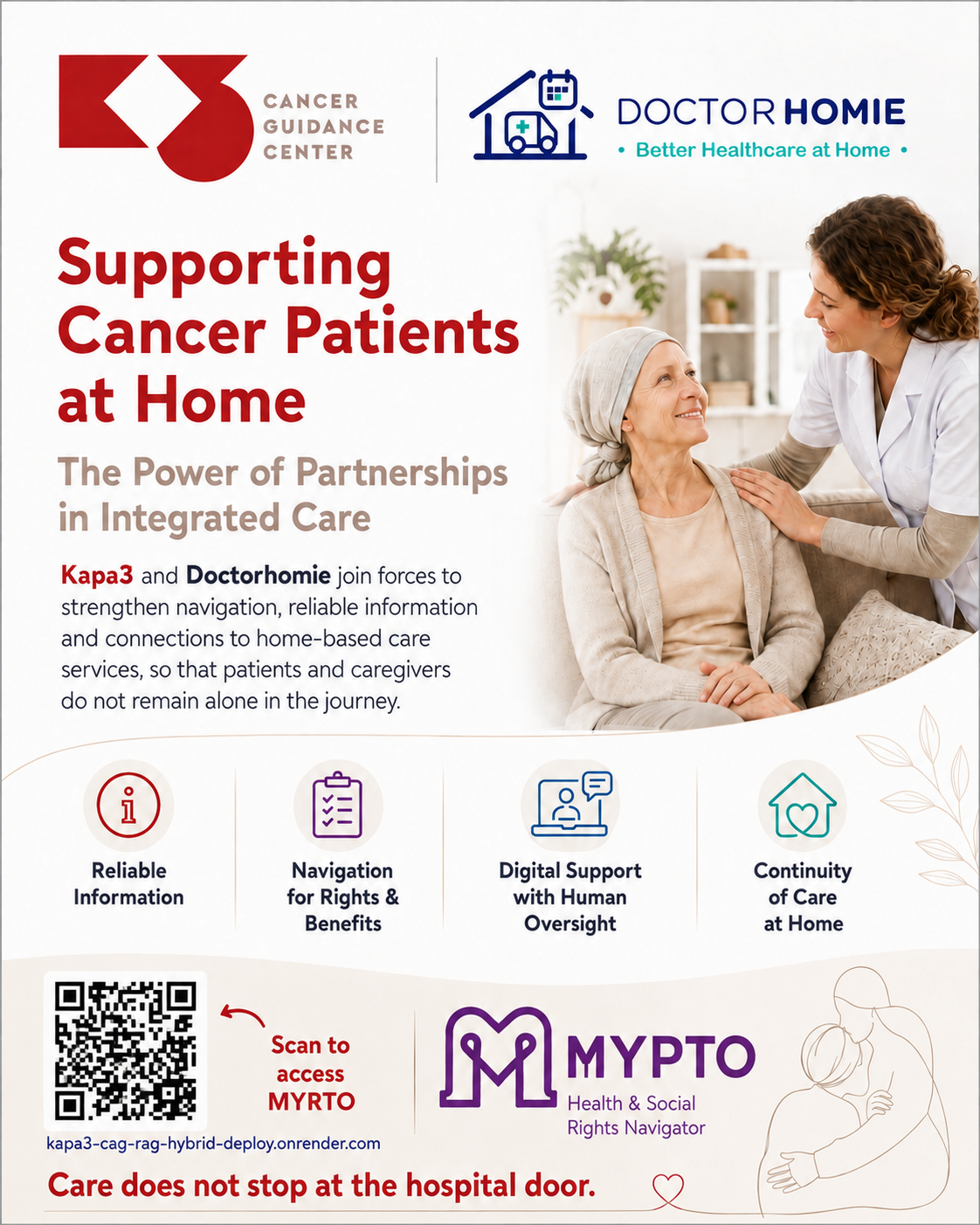
Within this framework, the collaboration between Kapa3 and Doctorhomie, a digital platform for primary and home-based healthcare, takes on a very practical meaning.
The roles of the two organisations are different, yet complementary.
Kapa3 contributes through the identification of needs, reliable information, social guidance and patient navigation.
When an identified need concerns a healthcare service or professional care at home, the ability to connect with an organised home-care platform can become the next important link in the patient’s pathway.
The logic is simple:
identifying the need → reliable information → navigation → appropriate professional or service → support at home → continuity of care
Quality, after all, does not depend solely on whether a service is available.
Studies in primary care highlight reliability, responsiveness, safety and empathy as fundamental dimensions of the patient experience [15].
Building a Network Around the Person
Integrated cancer care does not mean that one organisation must provide everything.
It means that patients should not be left alone to discover who provides what and where they should turn next.
It also means recognising the caregiver, not underestimating the social and psychological dimensions of cancer, using technology to facilitate access rather than create exclusion, and enabling different organisations and professionals to work together around the real needs of each person.
Because the future of cancer care does not lie only in the personalisation of treatment.
It also lies in the personalisation of understanding, navigation and support.
And that care must be able to follow people wherever life continues:
at home, within the family and throughout everyday life.
Learn more about the Kapa3–Doctorhomie collaboration
The collaboration between Kapa3 and Doctorhomie aims to strengthen support for cancer patients and their families through information, research, innovation and improved connections with home-based care services.
Edited by: Evangeli Bista, PhD(c), MBA, MSc, BSc
Co-founder, Kapa3 / Head of Operations and Development
CANCER PATIENT GUIDANCE CENTRE – KAPA3
13 Kosti Palama Street, 11141 Athens, Greece – 3rd Floor
Tel.: +30 210 5221424
Mobile: +30 690 6265170 (09:00–17:00)
Email: info@kapa3.gr
References
- Porcel-Gálvez AM, Allande-Cussó R, Mac Fadden I, Ferentinou E, Zafiropoulou M, Lima-Serrano M. Socio-Healthcare for Older People in the Mediterranean Basin: An Integrative Review and Quality Appraisal. Public Health Nursing. 2024. doi:10.1111/phn.13453.
- Phillips JL, Currow DC. Cancer as a chronic disease. Collegian. 2010;17:47–50.
- Jagsi R, Abrahamse PH, Lee KL, et al. Treatment Decisions and Employment of Breast Cancer Patients: Results of a Population-Based Survey. Cancer. 2017;123:4791–4799. doi:10.1002/cncr.30959.
- National Cancer Institute. Support for Caregivers: When Someone You Love Is Being Treated for Cancer. U.S. Department of Health & Human Services, National Institutes of Health.
- Akter J, Konlan KD, Nesa M, Ispriantari A. Factors influencing cancer patients’ caregivers’ burden and quality of life: An integrative review. Heliyon. 2023;9(11):e21243.
- Pan YC, Lin YS. Systematic review and meta-analysis of prevalence of depression among caregivers of cancer patients. Frontiers in Psychiatry. 2022;13:817936.
- Bedaso A, Dejenu G, Duko B. Depression among caregivers of cancer patients: Updated systematic review and meta-analysis. Psycho-Oncology. 2022;31(11):1809–1820. doi:10.1002/pon.6045.
- Walbaum C, Philipp R, Oechsle K, Ullrich A, Vehling S. Existential distress among family caregivers of patients with advanced cancer: A systematic review and meta-analysis. Psycho-Oncology. 2024;33(1):e6239.
- Cipolletta S, et al. The Role of Social Support in the Experience of Informal Caregivers of Cancer Patients: An Umbrella Review. Psycho-Oncology. 2026. doi:10.1002/pon.70430.
- Li L, Zhu C, Yan Q, Li J, Chen Y, Hu X. Effectiveness of dyadic interventions on quality of life for cancer patients and family caregivers: A systematic review and meta-analysis of randomised controlled trials. Journal of Clinical Nursing. 2025;34(8):3383–3405.
- Chen M, Wu VS, Falk D, Cheatham C, Cullen J, Hoehn R. Patient Navigation in Cancer Treatment: A Systematic Review. Current Oncology Reports. 2024;26(5):504–537. doi:10.1007/s11912-024-01514-9.
- Σκανδαλάκη Ν, Κωνσταντινίδης Θ. Παρεμβάσεις ηλεκτρονικής υγείας για την υποστήριξη φροντιστών ογκολογικών ασθενών. Νοσηλευτική. 2024;63(1):17–26.
- Li Y, Li J, Zhang Y, Ding Y, Hu X. The effectiveness of e-Health interventions on caregiver burden, depression, and quality of life in informal caregivers of patients with cancer: A systematic review and meta-analysis of randomized controlled trials. International Journal of Nursing Studies. 2022;127:104179.
- Τσόλη Ε, Καυγά Α, Δρακοπούλου Μ, Γκοβίνα Ο, Καλεμικεράκης Ι. Η χρήση της ψηφιακής τεχνολογίας υγείας στους ηλικιωμένους. Αρχεία Ελληνικής Ιατρικής. 2024;41(4):477–484.
- Αρμένη ΜΑ, Καυγά Α, Γκοβίνα Ο, Καλεμικεράκης Ι. Αξιολόγηση της ποιότητας των παρεχόμενων υπηρεσιών σε δομές πρωτοβάθμιας φροντίδας υγείας. Αρχεία Ελληνικής Ιατρικής. 2024;41(1):115–121.
- Darley A, Coughlan B, Furlong E. People with cancer and their family caregivers’ personal experience of using supportive eHealth technology: A narrative review. European Journal of Oncology Nursing. 2021;54:102030.
- Verma R, Saldanha C, Ellis U, Sattar S, Haase KR. eHealth literacy among older adults living with cancer and their caregivers: A scoping review. Journal of Geriatric Oncology. 2022;13:555–562.
- Schiess LC, Song LL, Schädelin S, et al. Nonpharmacologic interventions for managing distress, anxiety, and depression for patients with cancer and their family caregivers: A systematic review and meta-analysis. CA: A Cancer Journal for Clinicians. 2026;76(2):e70076. doi:10.3322/caac.70076.
- Su H, Tam KI, Li Y. Factors associated with death anxiety in family caregivers of cancer patients: A systematic review. BMC Palliative Care. 2026;25:175.
- Νικολούδη ΜΕ. Ελληνική εκδοχή του δείκτη ελπίδας Herth σε ογκολογικούς ασθενείς: Ψυχομετρική ανάλυση και μελέτη περίπτωσης. Εθνικό και Καποδιστριακό Πανεπιστήμιο Αθηνών, 2020.