Information about the actions of Kapa3 in Soufli. An initiative of the Branch and the Social Service of the Municipality of Soufli

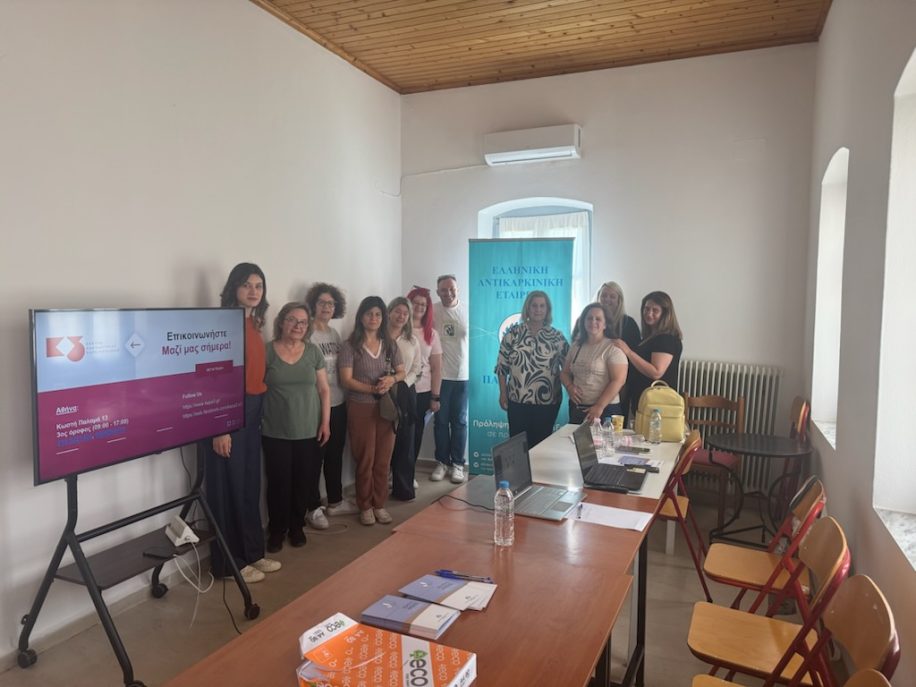
On Friday, May 29, 2026, a working meeting was held at the offices of the Evros Branch of the Hellenic Anti-Cancer Society in Soufli, at the initiative of the Branch and the Social Service of the Municipality of Soufli, with the aim of strengthening the support of oncology patients and the cooperation between local bodies.

The meeting was attended by the President of the Evros Branch of the Hellenic Anti-Cancer Society, Ms. Theodora Rokka, the Head of the Social Service of the Municipality of Soufli, Mr. Marinos Mantziaras, Ms. Aristea Archontidou from KAPA3, social workers of the Municipality of Soufli, as well as health professionals of the Soufli Health Center.

Particularly important was the presence of Ms. Kalliopi Kafetzaki, a social worker at the Day Center for Children, Adolescents and Young Adults with Neoplastic Diseases of the Hellenic Anti-Cancer Society, who presented the services of the Day Center and the hostel in Athens, as well as the challenges faced by oncology patients in the region.

The actions of KAPA3 were also presented, while information was provided on digital tools that can facilitate citizens’ access to health services, such as the Health Insurance Fund, the National Health Insurance Fund and the myHealth application. At the same time, the development of “Myrto”, a digital assistant that will support patients, caregivers and health professionals in searching for information and services, was discussed. During the discussion, issues related to inequalities in access to health services in the region, as well as the difficulties that patients encounter in administrative procedures and social benefits, were highlighted.

The meeting concluded with a joint commitment to continue cooperation and develop initiatives that will strengthen the support of oncology patients and their families in the Evros region. We are particularly happy about the presence of Kappa3 throughout Greece and for the trust of social services in our Organization. We remain faithful to the vision and mission of the Organization. For anything you need, please do not hesitate to contact us. The Kappa3 team is constantly by the patients and caregivers’ side to guide and ensure their rights. For any information or support, you can contact us.

You can contact the Kapa3 team at 13 Kostis Palamas, 3rd floor (Opening hours: 09:00 – 17:00). Contact numbers: 210 5221424 & 6906265170. Email: info@kapa3.gr

June: Cancer Survivors Month

Survival is a victory — but care must continue

June is dedicated to people living with and beyond cancer. It is a month of recognition, hope and respect for every person who has faced a cancer diagnosis, completed treatment, continues treatment, or lives with cancer as a long-term condition.

Cancer survival is a major victory. However, for many people, it is not the end of the story. Life after cancer often brings a new reality: follow-up appointments, fear of recurrence, fatigue, emotional distress, changes in body image, work-related challenges, financial pressure, family adjustments and the need to rebuild everyday life with confidence and dignity.

Cancer Survivors Month reminds us that survivorship is not only about living longer. It is also about living better.

A cancer survivor is not only a person who has completed treatment and is disease-free. The term also includes people receiving maintenance treatment, people living with cancer as a chronic condition, and those who continue to experience the physical, emotional, social or economic consequences of the disease and its treatment.

In recent years, advances in early diagnosis, targeted therapies, immunotherapy, surgery, radiotherapy and supportive care have increased the number of people living many years after a cancer diagnosis. This is a major achievement for medicine, research and public health. At the same time, it creates a new responsibility: to ensure that survivorship care is organised, person-centred and accessible to all.

For many survivors, the end of active treatment is a moment of relief and gratitude. Yet it may also bring uncertainty. Some people feel that everyone around them expects them to “go back to normal”, while they are still trying to understand what has changed in their body, their emotions, their relationships and their daily life.

The fear of recurrence, anxiety before follow-up tests, persistent fatigue, pain, cognitive difficulties, changes in sexuality, emotional vulnerability and social isolation are real experiences for many people after cancer. These needs should not be underestimated. Survivors need space to speak, reliable information, access to professional support when needed, and connection with communities and organisations that understand their journey.

Long-term follow-up is also essential. Survivorship care should not focus only on recurrence. It should also include prevention, early recognition of late effects, management of treatment-related complications, support for mental health, healthy lifestyle guidance and personalised monitoring according to each person’s cancer type, treatment history, age and individual risk factors.

The message is not fear. The message is awareness, prevention and continuity of care.

Life after cancer is also about rights. It is about returning to work, accessing social benefits, understanding available services, managing financial toxicity, supporting caregivers, protecting dignity and ensuring equal access to care. Survivorship must be seen as a social, psychological and practical issue — not only a medical one.

At Kapa3, we see every day that cancer does not always end with the last treatment. It continues in the questions people ask about their rights, their next steps, their follow-up, their access to benefits, psychological support, work, family life and social reintegration.

This is why people living with and beyond cancer need holistic support. They need information, guidance, psychosocial care, access to rights and services, empowerment and continuity of care. No one should feel alone after treatment. No one should be left to navigate bureaucracy, uncertainty or lack of information without support.

Cancer Survivors Month invites us to change the way we talk about survival. We should not ask only: “Did the person survive cancer?” We should also ask:

Are they living with quality of life?
Do they have access to the care they need?
Do they know their rights?
Do they receive psychological and social support?
Can they return to work and daily life with dignity?
Is there a follow-up plan?
Is there someone to guide them when they do not know where to turn?

Cancer survival is a victory. But the real challenge is to turn this victory into a life with quality, safety, rights, support and hope.

At Kapa3, we continue to stand beside every person living with and beyond cancer. Through information, guidance, empowerment and human-centred support, we believe that care does not stop at treatment.

It continues in life.

Kapa3 at the Scientific Meeting “Cancer in 2026: Challenges and Disruptions” – Focusing on Supportive Care and Its Limits

At the scientific meeting “Cancer in 2026: Challenges and Disruptions”, held on March 13–14, 2026 at the Divani Caravel, Kapa3 actively contributed to discussions on supportive care for oncology patients, a critical area for improving quality of life and holistic patient support.

The meeting was organized by the Hellenic Oncology Patient Support Institute, under the chairmanship of Christos Panopoulos, and was held under the auspices of the Hellenic Cancer Society and the Hellenic Society of Medical Oncologists. It has become a recognized annual event for the oncology community, highlighting each year the latest challenges and rapid developments in the field.

Progress in oncology is continuous and impressive, with scientific advances steadily enhancing the possibilities for personalized treatment, while simultaneously improving patients’ quality of life and turning some forms of cancer into manageable chronic conditions.

During the two-day meeting, key developments were presented in critical areas such as precision medicine, immunotherapy, and novel therapeutic strategies, with particular emphasis on the role of artificial intelligence and molecular analysis in modern clinical practice.

Kapa3 participated in the roundtable on supportive care for oncology patients, held on Friday, March 13, represented by Ms. Evangeli Bista. She noted that attending the conference gave her the opportunity to engage with people leading initiatives in patient support and advocacy. The roundtable addressed critical topics such as the role of healthcare professionals, pain management in Greece, and the adequacy of existing care structures.

In the discussion on psychosocial support, Ms. Bista, representing Kapa3 and drawing from her daily experience with oncology patients, emphasized that addressing the challenges arising from the patient journey is particularly demanding, as the high volume of cases and the fragmentation of the healthcare and social support system create exponentially more issues to manage.

When asked whether voluntary work alone is sufficient to meet the growing needs of patients, her response was clear:

…voluntary action is a valuable and essential pillar of social support. The improvement of patients’ quality of life relies heavily on voluntary efforts that take place across the country under challenging conditions. However, it is not sufficient on its own to meet the complex and increasing needs of patients.

As highlighted during the discussion, voluntary contributions are crucial for filling gaps in the system and strengthening social protection. At the same time, a more comprehensive and institutionally supported approach is necessary. This includes:

• adequate and stable funding
• continuous training and empowerment of all stakeholders
• clear and functional legal frameworks
• a shift in mindset among healthcare professionals, patients, and administrators
• and the development of integrated policies in the field of supportive care

Kapa3’s intervention underscored the importance of psychosocial support as an integral part of oncology supportive care, promoting a more holistic, humane, and sustainable approach to patient management. As Ms. Bista noted, participating in the two-day meeting serves as a reminder that the fight to support patients requires all of us on the same side.

World Love Day – 14 December

Love as a foundation of wellbeing, resilience, and human connection

World Love Day, celebrated every year on 14 December, invites us to pause and reflect on the power of love in our everyday lives. Love — in all its forms — strengthens human connection, nurtures compassion, and builds more resilient communities. For people facing illness, caregiving responsibilities or personal hardship, love is not just an emotion; it is presence, support, and protection.

Love and human wellbeing

International evidence highlights that loving relationships and strong social bonds contribute to better mental health, lower stress levels, and greater resilience. Social support — whether from family, friends, or the wider community — is essential during moments of crisis and plays a key role in enhancing overall wellbeing.

Inequalities in access to care, support, and connection

Although love is universal in meaning, it is not universally experienced. Social and economic barriers, loneliness, and lack of supportive networks can limit a person’s access to care and emotional safety. World Love Day is a reminder that social cohesion requires continuous effort — especially for individuals and families living in vulnerable conditions.

The meaning of love in cancer care

For people living with cancer — and for those who care for them — love carries a profound significance. Emotional support has been shown to:

  • reduce anxiety and depression,

  • strengthen adherence to treatment,

  • improve communication with healthcare professionals,

  • and create a much-needed sense of stability and safety.

Love means no one should face illness alone.

The Greek context

In Greece, many patients and caregivers rely heavily on informal networks of support. While this often becomes a powerful source of strength, it can also create pressure when caregivers lack institutional support or face social and economic challenges. Strengthening a culture of care and solidarity is essential so that no family carries the burden by itself.

The role of Kapa3

At Kapa3, love is at the heart of our work. Through awareness activities, psychosocial support, networking opportunities, and advocacy for patients’ rights, we strive to create environments where love translates into care, safety, and dignity. We support families, empower caregivers, and amplify the voices of those who are often unheard.

Become a member or volunteer at Kapa3

Support our work and become part of a community that ensures no patient or caregiver is left alone. By joining Kapa3 as a member or volunteer, you help us build support networks, provide reliable information and psychosocial support, and promote dignity and compassion in practice.

Learn more about volunteering here: https://www.kapa3.gr/prosklisi-ethelonton-gia-to-kentro-kathodigisis-karkinopathon-kapa3/

After all, nothing is stronger than the heart of a volunteer. (Jimmy Doolittle)

If you would like to contribute, you can contact us by phone or email, using the subject line “Volunteering”.

Become a member of Kapa3:
https://www.kapa3.gr/gine-melos/

Contact us here:
https://www.kapa3.gr/epikoinonia/

Learn more about Kapa3 at:
www.kapa3.gr

A call to action

World Love Day invites us to express love openly, through actions and with consistency. It calls on us to support those who need care, to cultivate empathy, and to build a society where compassion and humanity are not exceptions, but core values.

Let’s not forget that love is a choice. It takes time. It requires patience and effort. It means showing up. It is kindness. It is not selfish, and it is not conditional.

Let us remember today — and every day — that love is an action. And that this action has the power to change lives.

After all,

“And now these three remain: faith, hope and love. But the greatest of these is love.”
1 Corinthians 13:13

Text/adaptation: Ifiyenia Anastasiou for Kapa3