Kapa3 joins PERIFORMANCE: From Information to Trust in Cancer Care

Kapa3 – Cancer Guidance Centre is pleased to announce that its proposal, “From Information to Trust: MYRTO Patient & Citizen Lab for Equal Access in Cancer Care,” has been selected for funding under the PERIFORMANCE Open Call for Bottom-Up Stakeholder Engagement Initiatives in Cancer Research & Care.

The initiative places patients, caregivers, healthcare and social care professionals, civil society organisations and local communities at the heart of the process, creating a participatory framework for the ethical, trustworthy and inclusive use of AI-enabled cancer navigation.

Putting patients and citizens at the centre

The project is closely linked to MYRTO, Kapa3’s AI-enabled digital social assistant designed to support people affected by cancer in navigating health, social care, administrative procedures and rights-related information.

PERIFORMANCE funding will not support the core technical development of MYRTO. Instead, the project will focus on building the participatory, educational and ethical layer around the tool, ensuring that its future development is shaped by the real needs, experiences and expectations of the people who will use it.

This approach reflects a key principle for Kapa3: technology should not replace human care. When designed responsibly, however, it can become a powerful tool for improving access, empowerment and equality.

From local communities to a national dialogue

The engagement pathway will include regional listening activities, a thematic focus on vulnerable and underrepresented groups, and a central MYRTO Patient & Citizen Lab in Athens.

Particular attention will be given to caregivers, older patients, migrants, people with disabilities, people with low health or digital literacy, socially vulnerable groups and people living far from specialised oncology services.

The Athens Lab will be integrated into Kapa3’s national conference “Equality in Access”, creating a space for synthesising regional experiences, identifying trust criteria and collecting patient and caregiver perspectives on AI-supported navigation.

What does trust in AI-supported cancer navigation mean?

At the heart of the project lies a fundamental question:

What does a person need in order to trust a digital tool during one of the most sensitive periods of their life?

Through co-creation and stakeholder engagement, the initiative will explore issues such as:

  • reliability and clarity of information,
  • data protection and privacy,
  • accessibility and digital inclusion,
  • responsible use of Artificial Intelligence,
  • prevention of bias and exclusion,
  • human oversight,
  • and clear referral pathways to appropriate professionals when human support is needed.

Bringing together science, civil society and lived experience

Kapa3 will coordinate the initiative and lead its design, implementation, facilitation, patient and community outreach, dissemination and reporting.

The project will be supported by a multidisciplinary academic and scientific collaboration network involving the International Hellenic University – Department of Nursing, University of West Attica – Department of Occupational Therapy, Democritus University of Thrace – Department of Social Work, and University of the Peloponnese – Department of Nursing. simasiaAI will provide technical support for MYRTO-related digital materials and the AI navigation environment.

The project is expected to produce practical resources including a Patient Guidance Toolkit, a Trust & Human Escalation Checklist, a Training and Dissemination Package, and an Engagement & Trust Report.

From information to trust

For Kapa3, participation in PERIFORMANCE marks another step towards ensuring that the patient voice is present not only when new services and technologies are evaluated, but from the very beginning of their design.

With MYRTO, the question is no longer simply:

“How can we provide more information?”

It is increasingly:

“How can we turn information into understanding, trust, safety and real access?”

Because responsible digital health innovation begins with people.
Newsletter Kapa3| June 2026,From survivorship to quality of life — from information to support — from technology to human-centred care.

May was a month of important developments, scientific outreach and service enhancement for Kapa3. From the new European scientific publication of the MELODIC project and educational participation in international networks, to the development of “Myrto”, the creation of a new Psychological Support Team and support through social and corporate initiatives, Kapa3 continues to bring together knowledge, technology, human care and social action.

Our mission remains focused on equal access for cancer patients and their caregivers to information, rights, services and meaningful support.

1. June: Cancer Survivors Month

June is dedicated to people living with and beyond cancer. Survivorship is not only the end of treatment; it is continuity, adaptation, reintegration, psychosocial support, quality of life and the right to care beyond therapy.

EN: https://www.kapa3.gr/en/june-cancer-survivors-month-title-sep-sitename/

2. Kapa3 Introduces Its New Psychological Support Team

On the occasion of Mental Health Awareness Month and Cancer Survivors Month, Kapa3 introduces its new Psychological Support Team: a safe space for listening, support and empowerment for patients, survivors, caregivers and families.

CONTACT US  https://www.kapa3.gr/en/kapa3-introduces-its-new-psychological-support-team/

3. New MELODIC Scientific Publication on the Mental Health of Young Adults with Cancer

Mental health is an integral part of cancer care, particularly for young adults facing the complex challenges of a cancer diagnosis. Kapa3 contributes to the new scientific publication of the European MELODIC project, highlighting the educational needs of healthcare professionals.

READ THE ARTICLE

4. Digital Health and Cancer Survivorship: Kapa3 at the INE-CSC 2026 Conference in Coimbra

Kapa3 participated in the INE-CSC 2026 Conference in Coimbra, contributing to the European dialogue on cancer survivorship, supportive care, digital health and participatory solutions that respond to the real needs of patients and caregivers.

READ THE ARTICL Ehttps://www.kapa3.gr/en/participation-in-ca21152-implementation-network-europe-for-cancer-survivorship-care/

5. Co-creating Myrto: A Digital Health and Rights Navigator for Oncology Patients

Myrto is designed as a digital health and rights navigator — a Patient Empowerment e-Navigator — that goes beyond information provision to guide, support and evolve according to users’ real needs.

READ THE ARTICLE https://www.kapa3.gr/en/myrto-health-navigator-oncology-patients-greece/

6. Learning by Doing: Participation in the European Service Learning 2.0: CoLab Programme

Kapa3 participated in the European programme Service Learning 2.0: CoLab, an initiative connecting academic knowledge with meaningful social action and highlighting collaboration between universities, civil society organisations and community actors.

FIND OUT MOREhttps://www.kapa3.gr/en/learning-by-doing-participation-in-the-european-service-learning-2-0-colab-programme/

7. Alpha Bank and Its Employees Support Kapa3 through the Match for Good Initiative

Through the Match for Good initiative, Alpha Bank and its employees supported Kapa3, strengthening our mission to stand alongside people affected by cancer, their families and caregivers.

FIND OUT MORE https://www.kapa3.gr/en/i-alpha-bank-kai-oi-ergazomenoi-tis-stirizoyn-to-kapa3-kai-tin-isotimi-prosvasi-stin-ypostirixi-ton-ogkologikon-asthenon/

8. 6 Awards for Kapa3 at the 4th Vouliagmeni Summer Crossing: Is There Such a Thing as a “Lonely Race”?

Kapa3 took part in the 4th Vouliagmeni Summer Crossing, sharing a strong message of participation, resilience, empowerment and solidarity. Even when a race seems individual, it does not have to be lonely.

READ MOREhttps://www.kapa3.gr/en/kapa3-6-vraveia-diaplous-vouliagmenis/

Newsletter closing note

If this newsletter reached you through forwarding or another source, subscribe today to receive reliable updates, news and useful information directly in your inbox.

Support our work and help us continue to provide information, guidance and support to patients and their families.

SUBSCRIBE TO NEWSLETTER

SUPPORT US

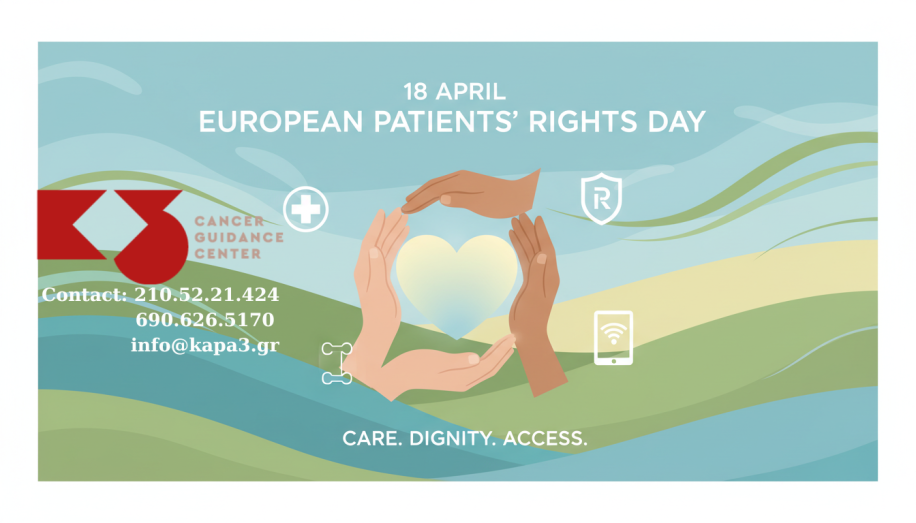
April 18: European Patients’ Rights Day

European Patients’ Rights Day is celebrated every year on April 18 and serves as an important occasion to raise awareness about the fundamental rights of all patients in Europe. The day was established by the Active Citizenship Network, aiming to promote equal access to quality healthcare services and safeguard patients’ dignity.

At the European level, patients’ rights do not stem from a single binding legal framework, but from a combination of principles, European directives, and national legislation. A milestone was the European Charter of Patients’ Rights (2002), which established 14 core rights and has become a reference point for many countries.

Key rights include:

  • The right to access healthcare services
  • The right to prevention
  • The right to timely and accurate diagnosis
  • The right to information and informed consent
  • The right to choose treatment
  • The right to privacy and confidentiality
  • The right to safe and high-quality care
  • The right to respect for the patient’s dignity

Despite legislative progress, the full implementation of these rights remains a challenge. According to international reports, in certain vulnerable groups, unmet healthcare needs can reach particularly high levels due to cost, long waiting times, or geographic barriers. Data from the European Commission also highlight delays in diagnoses and treatments, as well as limited patient awareness of available options.

In Greece, patients’ rights are legally protected through, among others, Law 2071/1992 and subsequent regulations. Furthermore, Patient Rights Protection Offices (Γ.Π.Δ.Λ.Υ.Υ.) implement specific regulations for managing complaints, grievances, and positive feedback, as outlined in a Ministry of Health circular (2024). In recent years, significant steps have been taken to strengthen patients’ position in the healthcare system, including:

  • Strengthening the role of Patient Rights Protection Offices in public hospitals
  • Updating the Charter of Rights, with emphasis on modern needs such as digital health and rare diseases
  • Enhancing cooperation between the State, local authorities, academic community, and patient associations
  • Advancing digital transformation, including electronic prescriptions and applications such as MyHealth app

Despite this progress, major challenges remain, such as ensuring equal access to innovative treatments, reducing inequalities, protecting personal data, and guaranteeing high-quality care for all patients.

If a patient feels that their rights have been violated, they can turn to:

  • The hospital administration or the relevant patient rights office
  • The Greek Ombudsman
  • Patient associations or support organizations
  • Relevant health supervisory authorities

In this context, patient organizations and broader civil society organizations, such as Kapa3, play a crucial role—not only in supporting and guiding patients but also in highlighting issues, promoting policy changes, and shaping a fairer and more accessible healthcare system.

Awareness of one’s rights is the first and most essential step toward protecting them. An informed patient can actively participate in decisions concerning their health, advocate for better care, and contribute to improving the healthcare system itself.

This day reminds us that healthcare is not a privilege but a fundamental human right—and that a fair and patient-centered healthcare system is built every day, with respect, information, and active participation from all.

Sources:

  1. European Charter of Patients’ Rights (2002): https://www.activecitizenship.net/charter-of-rights.html
  2. European Commission data: https://health.ec.europa.eu/publications/patients-rights_en
  3. Ministry of Health – Regulations for managing complaints and grievances through Patient Rights Protection Offices (Γ.Π.Δ.Λ.Υ.Υ.) -greek text

Text/adaptation: Ifiyenia Anastasiou for Kapa3