Adolescents and Young Adults with Cancer (AYAs): When a Diagnosis Comes During the Most Formative Years of Life

The unique psychosocial challenges, the invisible signs of distress, and Kapa3’s holistic response through the European MELODIC project.

A cancer diagnosis during adolescence or young adulthood often comes at a time when life is unfolding through some of its most creative and defining stages. Education, employment, romantic relationships, independence, starting a family, and planning for the future are all taking shape. A cancer diagnosis can abruptly interrupt this journey, creating a reality that is often difficult to comprehend, even for the young people experiencing it.

Adolescents and young adults with cancer, internationally referred to as AYAs (Adolescents and Young Adults), represent a distinct population within oncology. Their needs extend far beyond the treatment of the disease itself. They encompass identity, autonomy, relationships, sexuality, fertility, education, employment, financial security, and, above all, how they perceive their future and themselves.

When Life Is Put on Hold

For a young person, experiencing cancer can create the feeling that their personal life has come to a standstill while their peers continue moving forward. Friends pursue their studies, build careers, travel, develop relationships, and start families, while they may be coping with hospitalisations, treatments, fatigue, and restrictions on everyday activities.

This disruption can significantly affect their psychological well-being. Social isolation, changes in body image, concerns about sexuality and intimate relationships, and fears about potential effects on fertility are issues that may not always be easy to discuss with family members or even with the healthcare team.

At the same time, interruptions to education or employment can create financial uncertainty and undermine a young person’s sense of independence.

The impact of cancer, therefore, is not limited to the physical body. It extends to how young people perceive themselves, their identity, and their place within society.

Psychological Distress Is Not Always Visible: Recognising the Warning Signs

One of the most important challenges in caring for AYA patients is that psychological distress is not always immediately recognisable.

Distress may emerge at different stages of treatment, including after treatment has ended, and can manifest in various ways.

It may be expressed through anger towards the healthcare team, mistrust of treatment or medical recommendations, repeated questioning or, conversely, complete avoidance of questions.

It may also appear as delayed or missed appointments, difficulty adhering to treatment, excessive reliance on information found online, or reluctance to seek support from family members and social networks.

At other times, the signs are even more subtle: withdrawal from friends, reduced participation in activities, feelings of loneliness or hopelessness, or the belief that “no one can understand what I am going through.”

These behaviours should not automatically be interpreted as non-cooperation or lack of motivation. They may reflect emotional distress, uncertainty, fear, or unmet psychosocial needs that require further exploration.

This is why communication is a fundamental component of care.

An open-ended question, a safe and supportive environment, and, above all, a genuine willingness to listen without minimising a young person’s feelings can provide the starting point for identifying needs at an early stage.

Completing Treatment Does Not Always Mean the End of the Struggle

Another important message concerns the period following the completion of cancer treatment.

The end of oncology treatment is often accompanied by relief and optimism. At the same time, however, it can create a new sense of uncertainty or emptiness.

Frequent contact with the hospital and healthcare professionals gradually decreases, while young people are expected to return to everyday life and redefine their identity and future after cancer.

Fear of recurrence, changes in relationships, returning to work or education, and the need to reconsider personal goals may create new psychological challenges.

Psychological recovery, therefore, does not necessarily follow the same timeline as physical recovery.

Importantly, resilience and psychological distress are not mutually exclusive.

A young person may continue moving forward, pursuing their goals and rebuilding their life, while simultaneously experiencing fear, uncertainty, or emotional difficulties.

Recognising this complexity is essential to avoid unrealistic expectations that young people should immediately return to their previous lives or feel consistently positive once treatment has ended.

From Recognition to Meaningful Support and Effective Interventions

Addressing these needs requires an approach that sees the AYA patient as a whole person, not simply as someone undergoing cancer treatment.

Active listening, encouraging emotional expression, strengthening autonomy, and facilitating access to appropriate psychosocial support services are essential elements of comprehensive care.

Support may include psychological and social care, peer-support groups, counselling, and practical assistance related to employment, financial concerns, or social rights.

Individualisation is particularly important.

Not all young people require the same type of support, nor do they experience cancer in the same way.

Age, family circumstances, social environment, personal values, and life goals all contribute to shaping different needs and expectations.

Evidence-Informed Psychotherapeutic Approaches

Several psychotherapeutic approaches may help address the psychological and emotional challenges experienced by adolescents and young adults affected by cancer.

Cognitive Behavioural Therapy (CBT) can help young people identify and reframe unhelpful patterns of thinking, develop more adaptive coping strategies, and regain a sense of control during periods of significant uncertainty.

Acceptance and Commitment Therapy (ACT) emphasises psychological flexibility, the recognition and acceptance of difficult emotions, and engagement with personal values. This approach may be particularly relevant when illness has disrupted a young person’s priorities, identity, or future plans.

In parallel, meaning-centred approaches can support AYA patients in addressing existential concerns, changes in identity, and experiences of loss.

These interventions may help individuals integrate the experience of cancer into their evolving understanding of themselves and their lives, while rediscovering meaning, purpose, and personal direction.

The Importance of Peer Support

Peer support represents another valuable dimension of psychosocial care.

Connecting with people who have experienced similar challenges can reduce feelings of social isolation, strengthen the sense that “I am not alone,” and create opportunities for mutual understanding.

Peer relationships may also provide a supportive environment in which young people feel more comfortable discussing concerns that can be difficult to communicate with family members or healthcare professionals.

These forms of support should be adapted to individual circumstances and preferences.

Psychotherapeutic and psychosocial interventions need to be delivered flexibly, taking into account each person’s developmental stage, cultural and social context, values, and changing needs.

The therapeutic relationship, trust, respect for autonomy, and the active involvement of young people in decisions affecting their care are fundamental components of a genuinely person-centred approach.

MELODIC and the Need for More Human-Centred Cancer Care

This need lies at the heart of the European project MELODIC – Mental Health Support for Young Adults with Cancer, in which Kapa3 – Cancer Guidance Centre participates as a project partner.

MELODIC focuses on the mental health and well-being of young adults affected by cancer, aiming to strengthen the knowledge, skills, and support available to them, their loved ones, and the professionals involved in their care.

The project specifically addresses the needs of young adults aged 18–35 and seeks to promote a more integrated, supportive, and human-centred approach to oncology care.

Within the framework of MELODIC, Kapa3 has actively contributed to the co-development of educational materials, the development of the educational framework, and the pilot educational intervention in Greece.

Through this participation, Kapa3 supports the recognition of psychosocial needs and the development of knowledge and competencies among healthcare professionals working with young people affected by cancer.

This approach is directly aligned with the philosophy of holistic cancer care: mental health is not a separate or secondary concern but an integral part of the overall experience of living with cancer.

MELODIC also highlights the importance of interdisciplinary collaboration and the early identification of psychosocial needs.

By strengthening awareness and professional competencies, healthcare professionals can become better equipped to recognise signs of distress and refer young people to appropriate support services in a timely and coordinated manner.

From Identifying Needs to Developing Supportive Interventions

The MELODIC project promotes an approach that moves beyond identifying psychological challenges towards developing practical, person-centred interventions that respond to the everyday realities of young adults living with cancer.

Its broader framework recognises the value of psychosocial support, social connection, physical activity, and engagement with nature as complementary dimensions of well-being.

For Kapa3, participation in MELODIC reflects a wider commitment to connecting scientific knowledge with practical support and the lived experiences of people affected by cancer.

By contributing to European collaboration, educational activities, and the development of supportive interventions, Kapa3 seeks to help strengthen a model of cancer care that is more responsive to the individual, social, and emotional needs of patients.

This commitment also reflects the organisation’s broader work in patient navigation, health literacy, access to rights, and psychosocial support.

Because meaningful cancer care must extend beyond medical treatment and recognise the person behind the diagnosis.

Why Listening to Young People Matters

Meaningful care begins with a simple but fundamental principle: listening.

Listening to the young person who is afraid, even when they cannot express that fear directly.

Listening to the person who feels angry, withdraws from others, or struggles to follow their treatment plan.

Listening to those who appear to be coping well but may be experiencing greater emotional difficulties than they reveal.

Listening without judgement, without minimising emotions, and without assuming that the needs of all young people affected by cancer are the same.

Behind every diagnosis is a person who continues to have relationships, plans, dreams, ambitions, and a need for independence.

Through its participation in MELODIC, alongside its broader activities supporting people living with cancer, Kapa3contributes to promoting a model of care that does not end with the treatment of the disease.

A model that recognises psychological and social needs, strengthens patient empowerment, and builds bridges towards appropriate support.

A model that understands that recovery is not only about physical health but also about rebuilding confidence, identity, relationships, and the ability to imagine a future.

Because cancer care is not only about helping people recover from illness. It is also about supporting them, with dignity and understanding, as they rebuild the lives they want to live.


Learn More About MELODIC

The European project MELODIC – Mental Health Support for Young Adults with Cancer aims to promote mental health and well-being among young adults affected by cancer through interdisciplinary collaboration, education, and person-centred supportive interventions.

Kapa3 participates in the project, contributing to its activities in Greece and to the broader European effort to strengthen psychosocial cancer care.

For more information about MELODIC, its objectives, activities, and Kapa3’s participation, visit the dedicated section of our website:

https://www.kapa3.gr/melodic/

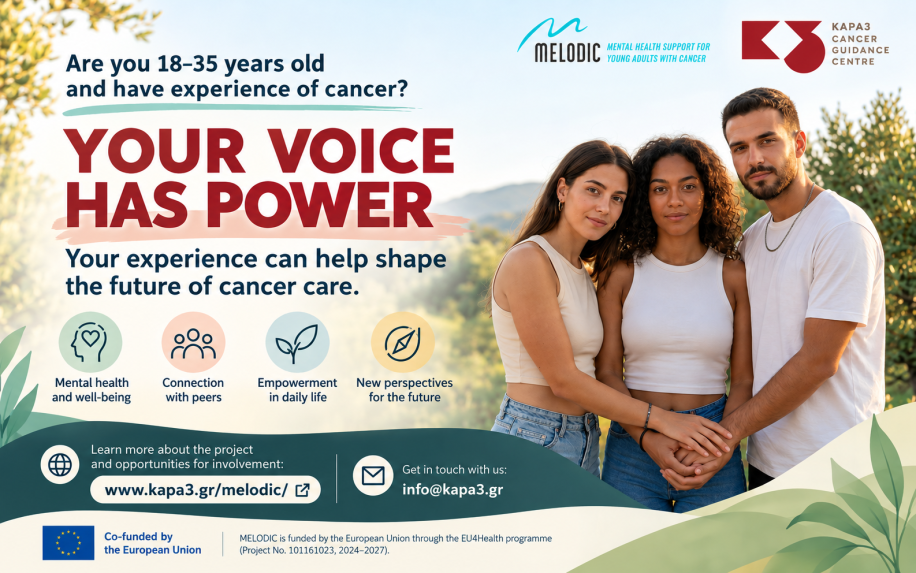
If you are a young adult aged 18–35 with lived experience of cancer and would like to learn more about the project or possible opportunities for involvement, please contact the Kapa3 team.

Kapa3 – Cancer Guidance Centre

Website: https://www.kapa3.gr
Email: info@kapa3.gr
Telephone: +30 210 5221424


Source

Ciampa, D., Mathew, L., Fulginiti, K., & Fortune-Kottis, S. (2026, August 11). Addressing unique psychosocial challenges in adolescent and young adult (AYA) patients with cancer. Oncology Central.

https://www.oncology-central.com/addressing-unique-psychosocial-challenges-in-adolescent-and-young-adult-aya-patients-with-cancer/

Further information:
European MELODIC Project – Kapa3
https://www.kapa3.gr/melodic/


Article edited by:
Elena Panopoulou
Sociologist, Kapa3 Tripoli Team

Email: elenak3team@gmail.com
LinkedIn: https://www.linkedin.com/in/elena-panopoulou-5061aa426
Newsletter Kapa3| June 2026,From survivorship to quality of life — from information to support — from technology to human-centred care.

May was a month of important developments, scientific outreach and service enhancement for Kapa3. From the new European scientific publication of the MELODIC project and educational participation in international networks, to the development of “Myrto”, the creation of a new Psychological Support Team and support through social and corporate initiatives, Kapa3 continues to bring together knowledge, technology, human care and social action.

Our mission remains focused on equal access for cancer patients and their caregivers to information, rights, services and meaningful support.

1. June: Cancer Survivors Month

June is dedicated to people living with and beyond cancer. Survivorship is not only the end of treatment; it is continuity, adaptation, reintegration, psychosocial support, quality of life and the right to care beyond therapy.

▸ EN: https://www.kapa3.gr/en/june-cancer-survivors-month-title-sep-sitename/

2. Kapa3 Introduces Its New Psychological Support Team

On the occasion of Mental Health Awareness Month and Cancer Survivors Month, Kapa3 introduces its new Psychological Support Team: a safe space for listening, support and empowerment for patients, survivors, caregivers and families.

▸ CONTACT US  https://www.kapa3.gr/en/kapa3-introduces-its-new-psychological-support-team/

3. New MELODIC Scientific Publication on the Mental Health of Young Adults with Cancer

Mental health is an integral part of cancer care, particularly for young adults facing the complex challenges of a cancer diagnosis. Kapa3 contributes to the new scientific publication of the European MELODIC project, highlighting the educational needs of healthcare professionals.

▸ READ THE ARTICLE

4. Digital Health and Cancer Survivorship: Kapa3 at the INE-CSC 2026 Conference in Coimbra

Kapa3 participated in the INE-CSC 2026 Conference in Coimbra, contributing to the European dialogue on cancer survivorship, supportive care, digital health and participatory solutions that respond to the real needs of patients and caregivers.

▸ READ THE ARTICL Ehttps://www.kapa3.gr/en/participation-in-ca21152-implementation-network-europe-for-cancer-survivorship-care/

5. Co-creating Myrto: A Digital Health and Rights Navigator for Oncology Patients

Myrto is designed as a digital health and rights navigator — a Patient Empowerment e-Navigator — that goes beyond information provision to guide, support and evolve according to users’ real needs.

▸ READ THE ARTICLE https://www.kapa3.gr/en/myrto-health-navigator-oncology-patients-greece/

6. Learning by Doing: Participation in the European Service Learning 2.0: CoLab Programme

Kapa3 participated in the European programme Service Learning 2.0: CoLab, an initiative connecting academic knowledge with meaningful social action and highlighting collaboration between universities, civil society organisations and community actors.

▸ FIND OUT MOREhttps://www.kapa3.gr/en/learning-by-doing-participation-in-the-european-service-learning-2-0-colab-programme/

7. Alpha Bank and Its Employees Support Kapa3 through the Match for Good Initiative

Through the Match for Good initiative, Alpha Bank and its employees supported Kapa3, strengthening our mission to stand alongside people affected by cancer, their families and caregivers.

▸ FIND OUT MORE https://www.kapa3.gr/en/i-alpha-bank-kai-oi-ergazomenoi-tis-stirizoyn-to-kapa3-kai-tin-isotimi-prosvasi-stin-ypostirixi-ton-ogkologikon-asthenon/

8. 6 Awards for Kapa3 at the 4th Vouliagmeni Summer Crossing: Is There Such a Thing as a “Lonely Race”?

Kapa3 took part in the 4th Vouliagmeni Summer Crossing, sharing a strong message of participation, resilience, empowerment and solidarity. Even when a race seems individual, it does not have to be lonely.

▸ READ MOREhttps://www.kapa3.gr/en/kapa3-6-vraveia-diaplous-vouliagmenis/

Newsletter closing note

If this newsletter reached you through forwarding or another source, subscribe today to receive reliable updates, news and useful information directly in your inbox.

Support our work and help us continue to provide information, guidance and support to patients and their families.

▸ SUBSCRIBE TO NEWSLETTER

▸ SUPPORT US

New MELODIC Scientific Publication on the Mental Health of Young Adults with Cancer

Kapa3 participates in the new scientific publication of the European MELODIC project, entitled:

“Educational Needs Regarding Mental Health of Professionals Working with Young Adults with Cancer: A European Survey.”

The publication addresses a highly important issue in contemporary cancer care: the educational needs of healthcare professionals working with young adults with cancer, particularly in relation to recognising and supporting mental health concerns.

Young adults experiencing cancer often face complex psychosocial challenges. Diagnosis, treatment, changes in daily life, impact on studies, work, relationships, body image and future planning can deeply affect their mental health and quality of life.

The European study, involving 271 healthcare professionals from 21 countries, highlighted an important gap between professionals’ willingness to support patients and the systematic use of validated assessment tools. While approximately half of the participating professionals reported feeling confident in identifying mental health issues, only a small percentage reported using validated screening tools.

This finding is particularly important. It shows that awareness and professional experience are valuable, but they are not enough on their own. Targeted education, appropriate tools, interdisciplinary collaboration and clear support pathways are needed so that the needs of young adults with cancer can be recognised early and addressed in a comprehensive way.

The message of the publication is clear: the education of healthcare professionals can make a meaningful difference in the early recognition, support and care of young adults with cancer.

At Kapa3, this approach is a core principle of our work. Before every intervention and every support action, there is education, information and empowerment of the people who stand beside patients.

Kapa3 professionals and collaborators are trained, informed and actively involved in European projects such as MELODIC, ensuring that the support provided is evidence-informed, human-centred and meaningful.

Kapa3’s active participation in such scientific initiatives strengthens its role as an organisation that connects research with practice, European knowledge with real patient needs, and education with everyday care.

We are proud of our participation in the MELODIC project and of our contribution to a European effort that highlights the importance of mental health, early recognition and targeted education in cancer care.

More information: https://lnkd.in/e9Pw4epy

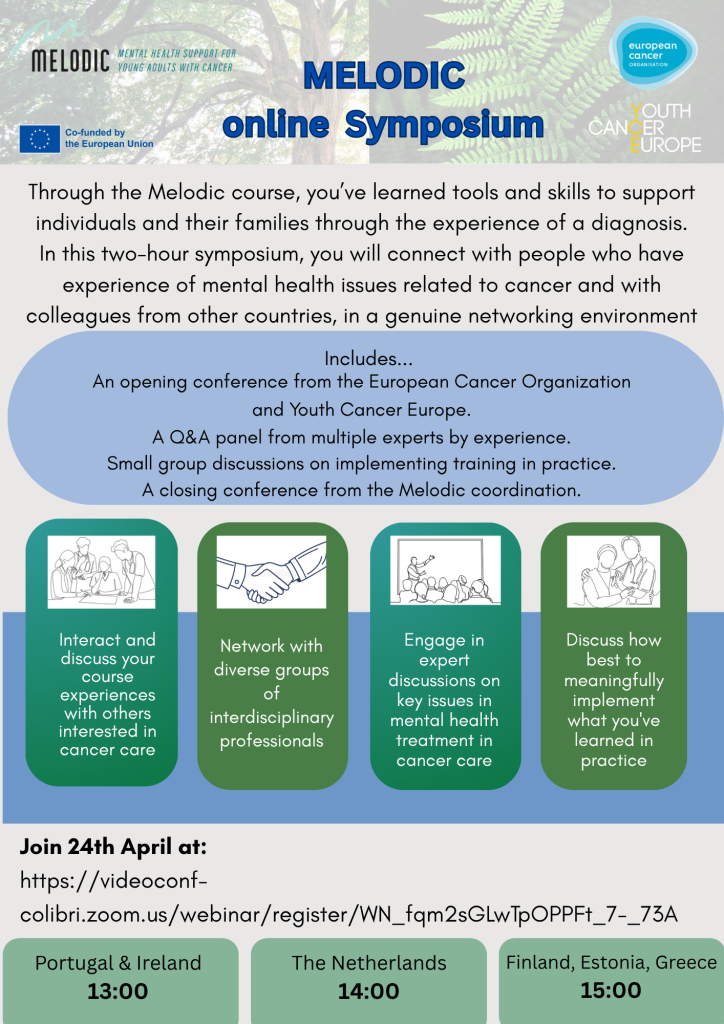
MELODIC Online Symposium: completion of the pilot training phase and strengthening psychosocial cancer care

The European project MELODIC (Mental Health Support for Young Adults with Cancer), in which the Cancer Guidance Center – Kapa3 participates, is being implemented through distinct development phases. The pilot training programme for healthcare professionals is one of its core components, and within this framework, the MELODIC Online Symposium 2026, taking place on 24 April 2026, marks the completion of this educational phase.

The MELODIC project framework

MELODIC is a European project co-funded by the European Union, aiming to strengthen the mental health of young adults living with cancer, as well as to support their families. Through the collaboration of universities, research institutions and healthcare organizations across Europe, the project develops training and support tools for healthcare professionals.

More information about the project and its progress is available on the official Kapa3 website, in the dedicated project section.

The pilot training programme

The pilot training programme focused on enhancing the knowledge and skills of healthcare professionals in providing psychosocial support to young adults with cancer and their families.

As part of the programme, online sessions and contact lessons were delivered, aiming to strengthen interdisciplinary collaboration and support the practical application of tools in everyday clinical practice.

MELODIC Online Symposium 2026

The MELODIC Online Symposium 2026, a two-hour event, brings together participants from all partner countries and includes:

  • opening presentations from the European Cancer Organisation and Youth Cancer Europe
  • an “experts by experience” panel, where individuals share their lived experience
  • a networking panel with healthcare professionals from participating countries
  • discussion on how training can be applied in clinical practice
  • a closing session by the project coordination team

From training to clinical practice

A key objective of the MELODIC training programme is to strengthen the psychosocial dimension of cancer care, with particular focus on young adults.

The exchange of experiences among healthcare professionals contributes to more holistic approaches to care and supports the integration of psychosocial support into daily clinical practice.

The role of Kapa3

Kapa3 actively participates in the European MELODIC consortium, contributing to the implementation of the training activities and the dissemination of results in Greece. Through this involvement, the connection between scientific knowledge and the support of cancer patients is further strengthened, promoting the development of practical approaches to psychosocial care.

The MELODIC Online Symposium 2026 marks the transition from the pilot training phase to the next stage of utilizing its outcomes, reinforcing the link between education and real-world application in cancer care.

The Press Release here: PRESS-RELEASE-MELODIC SYMPOSIUM

Text/adaptation: Ifiyenia Anastasiou for Kapa3

Launch of Free MELODIC Training Programme – Greece

We are pleased to announce the launch of the free eight-week online training programme implemented in Greece within the framework of the European project MELODIC, in which Kapa3 participates as one of 13 partner organisations from 6 European countries.

The programme is addressed to doctors, nurses, other health professionals, and social care professionals working in oncology.

MELODIC is an international collaboration aimed at strengthening mental health support for young adults with cancer and their families, promoting high-quality, holistic oncology care.

Through the programme, participants will have the opportunity to develop skills in:

  • Assessing mental health needs using validated and evidence-based tools

  • Supporting families and caregivers

  • Delivering high-quality psychosocial care

  • Interprofessional collaboration

  • Sustaining personal and professional wellbeing

The programme is divided into an asynchronous part (on the Moodle platform), which participants can complete at their own pace, and four contact lessons, constituting the synchronous part via Zoom. Upon completion, participants will receive 5 ECTS credits and a certificate of completion.

Sessions will take place from March to April 2026.

The contribution of health professionals is crucial for the accurate assessment of mental health needs of young adults with cancer and their families, as well as for delivering high-quality, person-centred care. The MELODIC programme strengthens their skills, promoting collaboration, responsibility, and sustainable professional practice in oncology.

For further information, please contact:
Ifiyenia Anastasiou
email: ifi.k3team@gmail.com | phone: 690.62.65.170

January 24 – International Day of Education

January 24 has been designated by the United Nations as the International Day of Education, recognizing education as a fundamental human right and a key pillar of social cohesion, equality, and sustainable development. Access to knowledge is not only a means of professional growth but also a decisive factor in psychological resilience, personal identity, and hope for the future.

EDUCATION AND ILLNESS: WHEN LEARNING BECOMES SUPPORT

For children living with cancer or other serious illnesses, education takes on a special significance. International initiatives, such as hospital schools, have highlighted the role of learning in maintaining continuity of life during treatment. According to the World Health Organization, education for hospitalized children is not just about curriculum but also serves as a source of joy, normalcy, and psychological empowerment. Participation in lessons, interaction with teachers, and pursuing personal interests help children retain goals and envision their future, even under the strain of serious illness.

YOUNG ADULTS WITH CANCER: STUDIES, INTERRUPTIONS, AND RETURNS

Education is also a critical issue for young adults living with cancer, an age group often engaged in higher education, vocational training, or early career stages. International research shows that a cancer diagnosis during this period can lead to study interruptions, delayed completion, shifts in educational direction, and increased psychological burden. Studies from Europe and the United States report higher levels of anxiety, social isolation, and uncertainty about the future, while also highlighting that flexible educational structures and supportive policies significantly increase the likelihood of returning to and completing studies.

Yet there are also those who, through their experience with illness, redefine their priorities: pursuing new fields of knowledge, changing direction, or discovering previously untapped skills.

DATA IN GREECE

In Greece, there are no official data tracking continuation or interruption of studies for young adults living with cancer — such as how many students drop out, how many return after treatment, or the overall impact on their educational trajectory. However, it is estimated that the incidence of cancer in young adults is approximately 7.4 new cases per 100,000 inhabitants per year, highlighting the unique psychosocial and developmental challenges this group faces. The lack of systematic data on educational outcomes underscores the need for further research and for policies that support young people in continuing or completing their studies when and how they wish.

Education at any age can serve as a tool for hope and life reorientation. Many individuals who have experienced cancer choose to return to learning, acquire new skills, change career paths, or invest in postponed dreams. Knowledge does not erase the challenges of illness, but it can provide meaning, perspective, and a sense of control during uncertain times.

At KAPA3, we recognize the importance of education as an integral part of psychosocial support. Through our participation in European projects, such as MELODIC, which focuses on the mental health of young adults with cancer, we highlight the need for holistic approaches that consider life, studies, and personal plans beyond the diagnosis.

The International Day of Education serves as a reminder that knowledge does not stop in the face of illness. With support, understanding, and appropriate structures, education can remain alive — acting as a bridge to the future and a reminder that life continues.

Sources:

Text/Adaptation: Ifiyenia Anastasiou for Kapa3

MELODIC: Advancing Mental Health Support for Young Adults with Cancer

The MELODIC project, a European programme focused on the mental health of young adults with lived experience of cancer, launched in September 2024 with the aim of strengthening the mental wellbeing of people aged 18–35, as well as their families. Through collaboration among six European countries, MELODIC combines research, educational activities, and the development of future interventions, promoting a more supportive and personalised approach to care.

MELODIC has already delivered significant outcomes, including outputs related to project management, needs assessment, interview-based research, and the training of healthcare professionals, while preparing upcoming intervention actions and communication and policy strategies.

KEY DELIVERABLES – WHAT HAS BEEN COMPLETED SO FAR

WP1 – Project Management & Quality Assurance

Deliverable 1.1 – Project Implementation Manual:
A management and quality monitoring guide defining implementation requirements, organisational structures, and partner roles.

Deliverable 1.2 – Quality Report:
A quality assurance report outlining procedures to ensure clarity, consistency, and timely delivery of project outputs.

WP2 – Needs Assessment

Deliverable 2.1 – Data Management Plan:
Assessment of the mental health and educational needs of young adults and healthcare professionals, in full compliance with data protection requirements.

Deliverable 2.3 – Interview Study Report:
A comprehensive interview-based study involving young adults, family members, and healthcare professionals across six countries, conducted with ethical approval and presenting key findings.

WP3 – Co-design Guide & Training

Deliverable 3.1 – MELODIC Curriculum:
A training programme for healthcare professionals at EQF level 7, focusing on the identification and support of the psychosocial and mental health needs of young adults with cancer. The curriculum includes learning objectives, training materials, assessment methods, and certification.

WHAT’S NEXT – UPCOMING DELIVERABLES AND ACTIONS

WP4 – Intervention Study

Deliverable D4.1 – Ethical Review:
Ethical approval for the intervention study aiming to improve the mental health and wellbeing of young adults with cancer and their families. The intervention will combine physical activity in natural environments with psychoeducation and informational support.

WP5 – Communication & Policy

Deliverable 5.1 – Communication Strategy:
A communication strategy outlining channels, target audiences, and publication plans for the internal and external dissemination of project results.

Deliverable 5.2 – Policy Outreach Strategy:
A policy engagement strategy at European and national level, including policy and stakeholder mapping and three intervention pillars (European, National, and Project-specific). The aim is to integrate MELODIC training into curricula and to enhance the project’s visibility at European level.

OUR PARTICIPATION IN MELODIC

As part of our active involvement, we have contributed to the production of key deliverables, particularly in data collection through interviews and in the development of the training curriculum for healthcare professionals. Our engagement ensures that the voices of young adults with lived experience of cancer and their families are taken into account at every stage of the project.

For more information and full access to MELODIC deliverables, please visit the project’s official website here.

Text/adaptation: Ifiyenia Anastasiou for Kapa3

2025 – Moving Forward with Vision

The Kapa3 Annual Review 2025 reflects a year of determination and vision, as Kapa3 strengthened its impact through initiatives and collaborations focused on holistic cancer care.During the first half of the year alone, we managed more than 400 individual requests, with support for the process of Disability Certification standing out as a key service—confirming that personalized, hands-on support remains at the core of our mission.

A milestone moment in 2025 was Kapa3’s participation, alongside 13 European partners, in the EU4Health programme MELODIC, which focuses on improving mental health support for young adult cancer patients (18–39 years old). Through research mapping the training needs of healthcare professionals, the project highlights the urgent need for better detection and management of psychological distress among young patients—many of whom still lack access to adequate psychosocial care.

MELODIC promotes innovative wellbeing interventions, such as physical activity in green and blue spaces combined with psychosocial support, emphasizing the healing power of nature and community in mental health recovery. As an active partner, Kapa3 works to ensure that these actions reach patients directly, fostering community engagement and equitable access to quality care.

At the same time, our participation in the second cycle of the SmartHEALTH programme, supported by CERTH, strengthened the digital integration of healthcare services and empowered patients through smart technologies, improving efficiency, accessibility, and transparency.

Our collaboration with FairLife within the BREATH programme for lung cancer patients highlighted the importance of holistic and interdisciplinary care. In parallel, our presence at conferences and scientific events—such as COST Action INECSC CA21125 and the 7th conference “Caregivers and Depression”—consistently brought attention to the needs of caregivers and the empowerment of patients.

At both national and international levels, Kapa3 presented its work at the Lazord International Conference, the Pan-Macedonian Scientific Nursing Conference, and the ESMO World Congress in Berlin. We also participated in major events such as the Patients Summit, Morning Health Talks by EIT Health, and the 18th Panhellenic Conference on Nutrition & Dietetics.

A particularly important moment was our action in the Municipality of Megara, where a new Cancer Patient Guidance and Counselling Station was established, offering direct and personalized support to patients and their families.

Prevention and awareness remain fundamental pillars of our work. Breast self-examination initiatives, participation in the Action4Obesity network, presence at the Thessaloniki Disability Festival, and the launch of new nutrition-related sections on our website all contribute to improving the quality of life of patients and caregivers—combining scientific guidance with lived experience.

Awards 2025

In 2025, Kapa3 received significant recognition for the digital platform Cancer Care Connect, winning a Gold Award at the Diversity, Equity & Inclusion Awards, as well as the Gold Award for “NGO of the Year – Health and Social Care” at the Hellenic Responsible Business Awards 2025.
In addition, our collaboration with the University of Peloponnese received a Silver Award at the Healthcare Business Awards 2025 for the programme “Community co-design and implementation of holistic educational practices for nutrition and mental health.”

Every initiative, every partnership, and every participation brings us closer to our vision: holistic, human-centred care where the voices of patients and caregivers truly matter.

To explore our full journey from the foundation of Kapa3 through the end of 2025, you can view our comprehensive activity report here.

The Kapa3 Annual Review 2025 reaffirms our commitment to holistic, human-centred care, where the voices of patients and caregivers truly matter.

As we step into the new year, we move forward with enthusiasm, commitment, and optimism—to continue supporting patients and caregivers, investing in innovation and education, and strengthening care and participation across all our actions.

We wish everyone a year filled with health, strength, and inspiration.

The Kapa3 Team

Kapa3 participation in the MELODIC consortium meeting in Lisbon

We are delighted to announce that Kapa3 had the opportunity to take part in the recent MELODIC consortium meeting, which was held in Lisbon. Although our participation was online, it was in real time, and our team contributed actively to the discussions, which focused on the development of the training program for healthcare professionals and the design of the intervention study, both aiming to support the mental health of young adults living with cancer.

The MELODIC project, funded by the EU4HEALTH program with a total budget of €1.8 million, addresses a critical yet often overlooked issue: the mental health of young adults aged 18–35 living with cancer.

During the meeting, partners exchanged experiences and findings from European research and interviews with healthcare professionals, families, and young adults with cancer. These insights strengthened collaboration and the formulation of strategies for timely psychosocial support.

Next spring, the project will launch the intervention phase, focusing on social prescribing and the use of green and blue spaces—harnessing the power of nature and community to promote well-being.

Kapa3 continues to work closely with its European partners to ensure a meaningful impact on the lives of young adults facing cancer.

Read more on the Melodic project here