The unique psychosocial challenges, the invisible signs of distress, and Kapa3’s holistic response through the European MELODIC project.
A cancer diagnosis during adolescence or young adulthood often comes at a time when life is unfolding through some of its most creative and defining stages. Education, employment, romantic relationships, independence, starting a family, and planning for the future are all taking shape. A cancer diagnosis can abruptly interrupt this journey, creating a reality that is often difficult to comprehend, even for the young people experiencing it.
Adolescents and young adults with cancer, internationally referred to as AYAs (Adolescents and Young Adults), represent a distinct population within oncology. Their needs extend far beyond the treatment of the disease itself. They encompass identity, autonomy, relationships, sexuality, fertility, education, employment, financial security, and, above all, how they perceive their future and themselves.
When Life Is Put on Hold
For a young person, experiencing cancer can create the feeling that their personal life has come to a standstill while their peers continue moving forward. Friends pursue their studies, build careers, travel, develop relationships, and start families, while they may be coping with hospitalisations, treatments, fatigue, and restrictions on everyday activities.
This disruption can significantly affect their psychological well-being. Social isolation, changes in body image, concerns about sexuality and intimate relationships, and fears about potential effects on fertility are issues that may not always be easy to discuss with family members or even with the healthcare team.
At the same time, interruptions to education or employment can create financial uncertainty and undermine a young person’s sense of independence.
The impact of cancer, therefore, is not limited to the physical body. It extends to how young people perceive themselves, their identity, and their place within society.
Psychological Distress Is Not Always Visible: Recognising the Warning Signs
One of the most important challenges in caring for AYA patients is that psychological distress is not always immediately recognisable.
Distress may emerge at different stages of treatment, including after treatment has ended, and can manifest in various ways.
It may be expressed through anger towards the healthcare team, mistrust of treatment or medical recommendations, repeated questioning or, conversely, complete avoidance of questions.
It may also appear as delayed or missed appointments, difficulty adhering to treatment, excessive reliance on information found online, or reluctance to seek support from family members and social networks.
At other times, the signs are even more subtle: withdrawal from friends, reduced participation in activities, feelings of loneliness or hopelessness, or the belief that “no one can understand what I am going through.”
These behaviours should not automatically be interpreted as non-cooperation or lack of motivation. They may reflect emotional distress, uncertainty, fear, or unmet psychosocial needs that require further exploration.
This is why communication is a fundamental component of care.
An open-ended question, a safe and supportive environment, and, above all, a genuine willingness to listen without minimising a young person’s feelings can provide the starting point for identifying needs at an early stage.
Completing Treatment Does Not Always Mean the End of the Struggle
Another important message concerns the period following the completion of cancer treatment.
The end of oncology treatment is often accompanied by relief and optimism. At the same time, however, it can create a new sense of uncertainty or emptiness.
Frequent contact with the hospital and healthcare professionals gradually decreases, while young people are expected to return to everyday life and redefine their identity and future after cancer.
Fear of recurrence, changes in relationships, returning to work or education, and the need to reconsider personal goals may create new psychological challenges.
Psychological recovery, therefore, does not necessarily follow the same timeline as physical recovery.
Importantly, resilience and psychological distress are not mutually exclusive.
A young person may continue moving forward, pursuing their goals and rebuilding their life, while simultaneously experiencing fear, uncertainty, or emotional difficulties.
Recognising this complexity is essential to avoid unrealistic expectations that young people should immediately return to their previous lives or feel consistently positive once treatment has ended.
From Recognition to Meaningful Support and Effective Interventions
Addressing these needs requires an approach that sees the AYA patient as a whole person, not simply as someone undergoing cancer treatment.
Active listening, encouraging emotional expression, strengthening autonomy, and facilitating access to appropriate psychosocial support services are essential elements of comprehensive care.
Support may include psychological and social care, peer-support groups, counselling, and practical assistance related to employment, financial concerns, or social rights.
Individualisation is particularly important.
Not all young people require the same type of support, nor do they experience cancer in the same way.
Age, family circumstances, social environment, personal values, and life goals all contribute to shaping different needs and expectations.
Evidence-Informed Psychotherapeutic Approaches
Several psychotherapeutic approaches may help address the psychological and emotional challenges experienced by adolescents and young adults affected by cancer.
Cognitive Behavioural Therapy (CBT) can help young people identify and reframe unhelpful patterns of thinking, develop more adaptive coping strategies, and regain a sense of control during periods of significant uncertainty.
Acceptance and Commitment Therapy (ACT) emphasises psychological flexibility, the recognition and acceptance of difficult emotions, and engagement with personal values. This approach may be particularly relevant when illness has disrupted a young person’s priorities, identity, or future plans.
In parallel, meaning-centred approaches can support AYA patients in addressing existential concerns, changes in identity, and experiences of loss.
These interventions may help individuals integrate the experience of cancer into their evolving understanding of themselves and their lives, while rediscovering meaning, purpose, and personal direction.
The Importance of Peer Support
Peer support represents another valuable dimension of psychosocial care.
Connecting with people who have experienced similar challenges can reduce feelings of social isolation, strengthen the sense that “I am not alone,” and create opportunities for mutual understanding.
Peer relationships may also provide a supportive environment in which young people feel more comfortable discussing concerns that can be difficult to communicate with family members or healthcare professionals.
These forms of support should be adapted to individual circumstances and preferences.
Psychotherapeutic and psychosocial interventions need to be delivered flexibly, taking into account each person’s developmental stage, cultural and social context, values, and changing needs.
The therapeutic relationship, trust, respect for autonomy, and the active involvement of young people in decisions affecting their care are fundamental components of a genuinely person-centred approach.
MELODIC and the Need for More Human-Centred Cancer Care
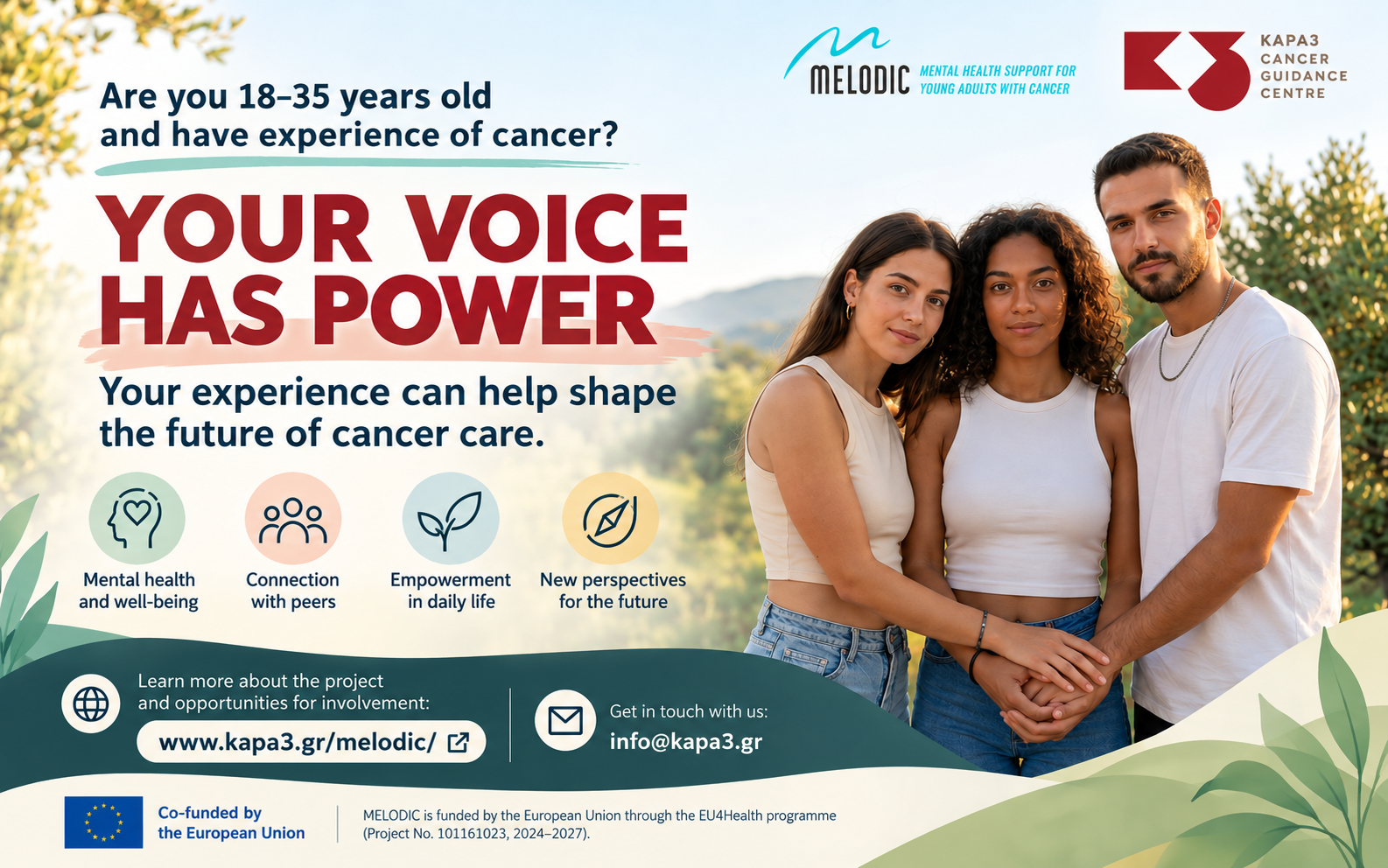
This need lies at the heart of the European project MELODIC – Mental Health Support for Young Adults with Cancer, in which Kapa3 – Cancer Guidance Centre participates as a project partner.
MELODIC focuses on the mental health and well-being of young adults affected by cancer, aiming to strengthen the knowledge, skills, and support available to them, their loved ones, and the professionals involved in their care.
The project specifically addresses the needs of young adults aged 18–35 and seeks to promote a more integrated, supportive, and human-centred approach to oncology care.
Within the framework of MELODIC, Kapa3 has actively contributed to the co-development of educational materials, the development of the educational framework, and the pilot educational intervention in Greece.
Through this participation, Kapa3 supports the recognition of psychosocial needs and the development of knowledge and competencies among healthcare professionals working with young people affected by cancer.
This approach is directly aligned with the philosophy of holistic cancer care: mental health is not a separate or secondary concern but an integral part of the overall experience of living with cancer.
MELODIC also highlights the importance of interdisciplinary collaboration and the early identification of psychosocial needs.
By strengthening awareness and professional competencies, healthcare professionals can become better equipped to recognise signs of distress and refer young people to appropriate support services in a timely and coordinated manner.
From Identifying Needs to Developing Supportive Interventions
The MELODIC project promotes an approach that moves beyond identifying psychological challenges towards developing practical, person-centred interventions that respond to the everyday realities of young adults living with cancer.
Its broader framework recognises the value of psychosocial support, social connection, physical activity, and engagement with nature as complementary dimensions of well-being.
For Kapa3, participation in MELODIC reflects a wider commitment to connecting scientific knowledge with practical support and the lived experiences of people affected by cancer.
By contributing to European collaboration, educational activities, and the development of supportive interventions, Kapa3 seeks to help strengthen a model of cancer care that is more responsive to the individual, social, and emotional needs of patients.
This commitment also reflects the organisation’s broader work in patient navigation, health literacy, access to rights, and psychosocial support.
Because meaningful cancer care must extend beyond medical treatment and recognise the person behind the diagnosis.
Why Listening to Young People Matters
Meaningful care begins with a simple but fundamental principle: listening.
Listening to the young person who is afraid, even when they cannot express that fear directly.
Listening to the person who feels angry, withdraws from others, or struggles to follow their treatment plan.
Listening to those who appear to be coping well but may be experiencing greater emotional difficulties than they reveal.
Listening without judgement, without minimising emotions, and without assuming that the needs of all young people affected by cancer are the same.
Behind every diagnosis is a person who continues to have relationships, plans, dreams, ambitions, and a need for independence.
Through its participation in MELODIC, alongside its broader activities supporting people living with cancer, Kapa3contributes to promoting a model of care that does not end with the treatment of the disease.
A model that recognises psychological and social needs, strengthens patient empowerment, and builds bridges towards appropriate support.
A model that understands that recovery is not only about physical health but also about rebuilding confidence, identity, relationships, and the ability to imagine a future.
Because cancer care is not only about helping people recover from illness. It is also about supporting them, with dignity and understanding, as they rebuild the lives they want to live.
Learn More About MELODIC
The European project MELODIC – Mental Health Support for Young Adults with Cancer aims to promote mental health and well-being among young adults affected by cancer through interdisciplinary collaboration, education, and person-centred supportive interventions.
Kapa3 participates in the project, contributing to its activities in Greece and to the broader European effort to strengthen psychosocial cancer care.
For more information about MELODIC, its objectives, activities, and Kapa3’s participation, visit the dedicated section of our website:
If you are a young adult aged 18–35 with lived experience of cancer and would like to learn more about the project or possible opportunities for involvement, please contact the Kapa3 team.
Kapa3 – Cancer Guidance Centre
Website: https://www.kapa3.gr
Email: info@kapa3.gr
Telephone: +30 210 5221424
Source
Ciampa, D., Mathew, L., Fulginiti, K., & Fortune-Kottis, S. (2026, August 11). Addressing unique psychosocial challenges in adolescent and young adult (AYA) patients with cancer. Oncology Central.
Further information:
European MELODIC Project – Kapa3
https://www.kapa3.gr/melodic/
Article edited by:
Elena Panopoulou
Sociologist, Kapa3 Tripoli Team
Email: elenak3team@gmail.com
LinkedIn: https://www.linkedin.com/in/elena-panopoulou-5061aa426