
There is an urgent need for psychological support for cancer patients. The KAPA3 team explains and advocates for this

There is an urgent need for psychological support for cancer patients. The KAPA3 team explains and advocates for this

Every day, healthcare professionals are called upon to communicate with, assess, and, above all, support people who are going through cancer.

Does cancer affect only physical health, or does it also have a profound impact on a person’s psychological, social, and emotional life? The needs that arise during the course of the illness are many and are often accompanied by the question: “What does the disease really bring to a person’s life?” A cancer diagnosis brings about significant changes in daily life, relationships, social roles, and the way a person perceives themselves and their future.

A cancer diagnosis is an extremely stressful event, often accompanied by feelings of fear, uncertainty, anxiety, and grief. At the same time, patients are called upon to cope with the effects of treatments such as chemotherapy, radiation therapy, and surgery. Changes in physical appearance, fatigue, pain, and limitations in daily functioning can significantly affect their self-esteem and quality of life (Pitman et al., 2018).

Uncertainty regarding the course of the disease and the likelihood of relapse are significant sources of psychological distress. The extent of this phenomenon is reflected in the meta-analysis by Mitchell et al. (2011), which included 94 studies and more than 14,000 cancer patients. According to the results, 16.3% of patients met the diagnostic criteria for major depressive disorder, 10.3% for anxiety disorder, and 19.2% for adjustment disorder.

These data highlight that a significant proportion of cancer patients experience severe psychological distress, a fact that underscores the need for specialized psychological support.

Furthermore, cancer often affects an individual’s family and social relationships. The patient may be forced to limit or abandon professional and social roles, while the family is called upon to adapt to new demands and responsibilities, experiencing significant psychological strain of their own (Northouse et al., 2010).

Cancer patients have an increased need for psychological support, as the disease significantly affects their psychological, social, and emotional functioning. Fear of the disease’s progression, uncertainty about the future, the side effects of treatments, and the possibility of recurrence are major sources of psychological distress. At the same time, the experience of cancer is often accompanied by feelings of loss of control, fear, and emotional distress. The contemporary psycho-oncology literature recognizes that the early identification of psychosocial needs and the provision of appropriate interventions are an integral part of holistic oncology care (Caruso & Breitbart, 2020; Mehnert-Theuerkauf et al., 2023).

Within this context, psychological support is a key component of holistic care for cancer patients. Holistic care refers to a comprehensive approach that takes into account not only the patient’s physical needs but also the psychological, social, and spiritual dimensions of their health. Counseling, psychotherapy, and support groups provide a safe space for expressing emotions and building psychological resilience (National Comprehensive Cancer Network [NCCN], 2024).

At the same time, they help improve adherence to treatment, strengthen cooperation with healthcare professionals, and maintain quality of life. As Holland and Weiss (2008) argue, psychosocial care is an integral part of high-quality oncology care, from diagnosis through the survival phase.

In conclusion, the experience of cancer is a complex and multidimensional process that affects every aspect of a person’s life. Managing the disease is not limited solely to physical treatment but requires the recognition and addressing of the psychological and social needs that arise at every stage. Providing timely and systematic psychological support can empower the patient, improve their ability to adapt to the demands of treatment, and contribute significantly to maintaining their dignity, hope, and quality of life. Psychological care should be regarded as a fundamental right of every cancer patient and as an integral part of modern oncology practice.

Coordination of Psychological and Social Services within the Framework of Psychosocial Care

The care of cancer patients is not limited to treating the disease and its physical effects. The needs that arise during treatment are often multifaceted and concern both the individual’s psychological well-being and practical, social, or financial issues that affect their daily life.

For this reason, effective support requires close collaboration among different healthcare professionals within a shared framework of psychosocial care. Within this framework, the Social Services and Psychological Services operate in a complementary manner, with the shared goal of enhancing the individual’s quality of life and overall adjustment to the experience of illness.

A client’s contact with the service can begin either through the Social Services Department or the Psychological Services Department. During the initial contact, an assessment of the client’s needs is conducted, and information is provided about all available support services.

Regardless of the initial request, the beneficiary is informed about the option of receiving psychological support, as the experience of cancer is often accompanied by heightened psycho-emotional needs that are not always apparent from the first contact. With their consent, an internal referral can be made to the Psychological Services Department for further evaluation and support.

The Psychological Services Department is responsible for the initial assessment, obtaining informed consent, and creating an individual support file. A structured series of sessions is then provided, tailored to the beneficiary’s needs. During this process, issues may arise related to social benefits, employment challenges, financial burdens, disability certification procedures, or other practical needs that significantly impact the daily functioning of the individual and their family. In such cases, and always with the beneficiary’s consent, cooperation with Social Services is initiated, and Social Services assumes responsibility for managing the relevant social and administrative matters.

The collaboration between the two services enables the timely identification of new needs and ensures continuity of care. Social Services focuses on the practical, social, and administrative aspects of support, while Psychological Services focuses on psychological resilience, emotional processing of the experience of the disease, and adaptation to the changes it brings about. The collaboration between the two services allows for a more comprehensive response to the needs of the cancer patient. In this way, a unified framework of psychosocial care is established that provides substantial support to the patient and their support network at all stages of their journey with the disease.

At the same time, regular communication and coordination between the two services allow for the timely identification of new needs and ensure continuity of care. The Social Services Department focuses on the practical, social, and administrative aspects of support, while the Psychological Services Department focuses on psychological resilience, emotional processing of the experience of the disease, and adaptation to the changes it brings about. The collaboration between the two services enables a more comprehensive response to the needs of cancer patients. In this way, a unified framework of psychosocial care is established that provides substantial support to the patient and their support network at all stages of their journey with the disease.


Kapa3 – Cancer Patient Guidance Center

Together, with knowledge, care, and a human touch.

Contact us:

https://www.kapa3.gr/epikoinonia/ by typing “Psychological Support” in the Message box

OR CALL

2105221424 – info@kapa3.gr

Athens: 13 Kostis Palamas Street, 3rd floor, (9:00 AM – 5:00 PM) 6982003282

Alpha Bank and Its Employees Support Kapa3 through the Match for Good Initiative

The Cancer Guidance Center – Kapa3 warmly thanks Alpha Bank and its employees for their meaningful support through the Match for Good initiative, through which Alpha Bank doubled the contribution of its employees.

Through this initiative, six non-profit organisations from across Greece received financial support during a special event held at Alpha Bank’s headquarters, in the presence of representatives of the organisations. The event was hosted by the Chairman of Alpha Bank’s Board of Directors, Mr. Dimitris Tsitsiragos, and the Chief Human Resources Officer, Ms. Fragiski Melissa.

Mr. Dimitris Tsitsiragos highlighted that the Match for Good initiative puts into practice Alpha Bank’s commitment to consistently support organisations that create a positive social impact. He underlined that when the individual contribution of employees is combined with the Bank’s support, it becomes a collective force with tangible results.

Ms. Fragiski Melissa noted that Match for Good reflects the Bank’s new culture in practice, giving employees an active role in selecting, participating in and supporting initiatives with social value.

Kapa3 was represented by Ms. Evangeli Bista, co-founder of the Organisation, and Ms. Despoina Chrysostomidou, collaborating psychologist. During the event, they had the opportunity to present Kapa3’s work and discuss the social impact that can be created when corporate responsibility meets the active participation of employees.

For all of us at Kapa3, this support is particularly meaningful. It strengthens our daily effort to stand beside people with lived experience of cancer, as well as their families and caregivers, offering guidance, information, support in accessing rights and services, and practical empowerment tools.

Kapa3 acts as a navigation and support organisation for cancer patients, bridging the gap between need and information, between rights and real access. For many people, especially those living outside major urban centres, the challenge is not only the disease itself. It is uncertainty, bureaucracy, lack of information about available rights, financial burden, transportation difficulties, psychosocial pressure and the need for a reliable companion.

Through initiatives like this, social contribution gains multiplying power and becomes real support for those who need it. The support of Alpha Bank and its employees strengthens Kapa3’s mission: ensuring that no person is left alone when facing cancer, searching for information, navigating procedures or claiming a right they are entitled to.

Health is not only a medical act. It is access, information, dignity, social care and meaningful presence. Every contribution to Kapa3 becomes more guidance, more information, more empowerment and more care for people and families going through a difficult and demanding journey.

We warmly thank Alpha Bank and its employees for their trust, choice and support of Kapa3’s work.

Because when giving becomes collective, it can meaningfully change people’s everyday lives.


20260310 Match For Good Programme Part2 Alpha Bank Via Solid Havas / Thalia Galanopoulou

Match for Good – Alpha Bank (1)

MELODIC Online Symposium: completion of the pilot training phase and strengthening psychosocial cancer care

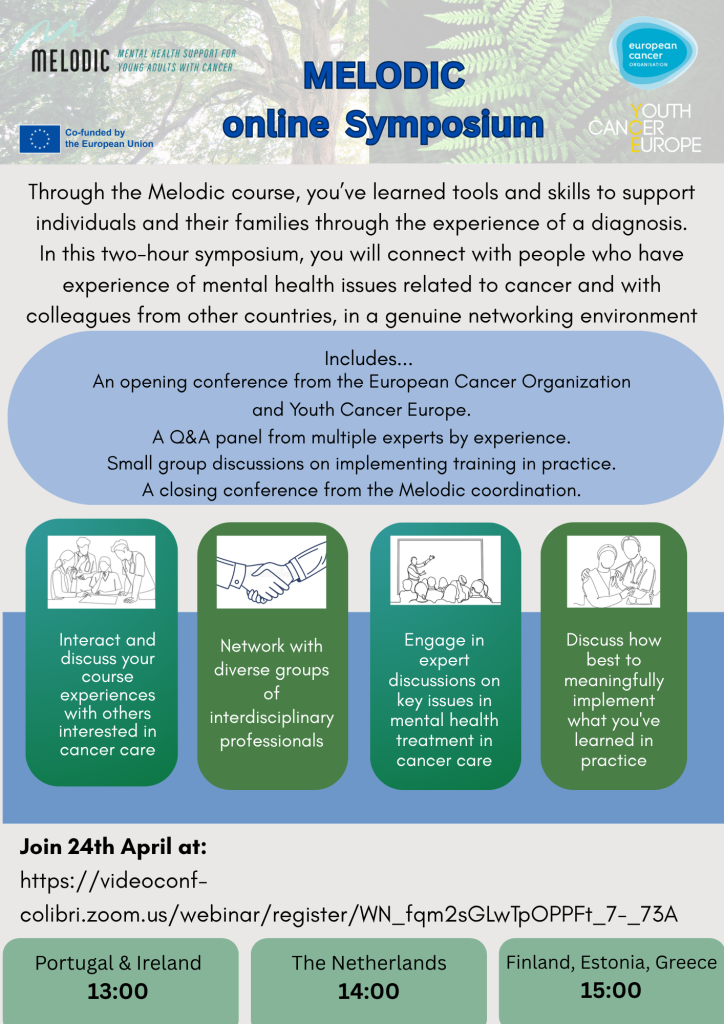
The European project MELODIC (Mental Health Support for Young Adults with Cancer), in which the Cancer Guidance Center – Kapa3 participates, is being implemented through distinct development phases. The pilot training programme for healthcare professionals is one of its core components, and within this framework, the MELODIC Online Symposium 2026, taking place on 24 April 2026, marks the completion of this educational phase.

The MELODIC project framework

MELODIC is a European project co-funded by the European Union, aiming to strengthen the mental health of young adults living with cancer, as well as to support their families. Through the collaboration of universities, research institutions and healthcare organizations across Europe, the project develops training and support tools for healthcare professionals.

More information about the project and its progress is available on the official Kapa3 website, in the dedicated project section.

The pilot training programme

The pilot training programme focused on enhancing the knowledge and skills of healthcare professionals in providing psychosocial support to young adults with cancer and their families.

As part of the programme, online sessions and contact lessons were delivered, aiming to strengthen interdisciplinary collaboration and support the practical application of tools in everyday clinical practice.

MELODIC Online Symposium 2026

The MELODIC Online Symposium 2026, a two-hour event, brings together participants from all partner countries and includes:

  • opening presentations from the European Cancer Organisation and Youth Cancer Europe
  • an “experts by experience” panel, where individuals share their lived experience
  • a networking panel with healthcare professionals from participating countries
  • discussion on how training can be applied in clinical practice
  • a closing session by the project coordination team

From training to clinical practice

A key objective of the MELODIC training programme is to strengthen the psychosocial dimension of cancer care, with particular focus on young adults.

The exchange of experiences among healthcare professionals contributes to more holistic approaches to care and supports the integration of psychosocial support into daily clinical practice.

The role of Kapa3

Kapa3 actively participates in the European MELODIC consortium, contributing to the implementation of the training activities and the dissemination of results in Greece. Through this involvement, the connection between scientific knowledge and the support of cancer patients is further strengthened, promoting the development of practical approaches to psychosocial care.

The MELODIC Online Symposium 2026 marks the transition from the pilot training phase to the next stage of utilizing its outcomes, reinforcing the link between education and real-world application in cancer care.

The Press Release here: PRESS-RELEASE-MELODIC SYMPOSIUM

Text/adaptation: Ifiyenia Anastasiou for Kapa3

Kapa3 and Karkinaki join forces to support children, adolescents, and families living with cancer

The Cancer Guidance Center – Kapa3 announces its new collaboration with the non-profit organization “Karkinaki”, aiming to strengthen information, psychosocial support, and awareness around childhood and adolescent cancer, as well as to support families experiencing the disease.

Karkinaki is a specialized organization working in the field of childhood and adolescent cancer, focusing on reliable information, empowering parents and caregivers, and fostering a supportive environment around children and teenagers affected by cancer. Through community-based actions and awareness initiatives, it seeks to reduce the sense of isolation that often accompanies diagnosis, while also enhancing understanding, social awareness, and access to available support resources for families.

Within the framework of this collaboration, the two organizations will develop joint initiatives focused on information and awareness-raising, with an emphasis on actions addressing both families and healthcare and support professionals. The partnership will also include the co-organization of informational events, the exchange of good practices, and the exploration of participation in national and European programs that promote a holistic approach to patient care, with an emphasis on continuity of support across all stages of the disease experience.

The Cancer Guidance Center – Kapa3 is dedicated to informing, guiding, and empowering people affected by cancer, providing practical support and access to reliable information and services. At the same time, it develops initiatives that strengthen patients’ active participation in managing their health and promotes a more accessible and human-centered model of care.

In this context, Kapa3 is also involved in European collaborations focusing on the psychosocial dimension of cancer across different stages of life, such as the MELODIC project, which addresses the mental health of young adults with lived experience of cancer. This work further enhances the organization’s ability to recognize needs that emerge throughout the cancer journey, from childhood to adulthood.

This collaboration with Karkinaki reflects the shared vision of both organizations to strengthen a support network that goes beyond medical treatment, extending into families’ daily lives, information access, and psychosocial empowerment, with the aim of providing a more stable and meaningful presence for those who need it most.

Our Press Release here: KARKINAKI PRESS RELEASE

Text: Ifiyenia Anastasiou for Kapa3

Kapa3 and Doctorhomie: Joining Forces to Support Cancer Patients

Kapa3 is pleased to announce the signing of a memorandum of cooperation with the digital home-care platform Doctorhomie. The Kapa3–Doctorhomie collaboration aims to strengthen support for cancer patients and their families across Greece.

Since its establishment, the Cancer Guidance Center – Kapa3 has been actively working to provide meaningful guidance to people living with cancer and their caregivers, with a strong focus on access to benefits and services, information about patients’ rights, and psychosocial support. Through Mobile Units, digital tools and educational initiatives, the organization promotes patient-centred care, creates channels of communication with beneficiaries and strengthens their participation in decisions concerning their health. Kapa3’s philosophy is grounded in building partnerships, leveraging technology and fostering collaborations with organizations that share the same vision.

Doctorhomie, on the other hand, is redefining home-based care in Greece by offering an integrated digital platform that connects patients with physicians, nurses, psychologists, physiotherapists and caregivers. Through tools that enhance monitoring and management of care at home, Doctorhomie contributes to strengthening Primary Health Care, promoting prevention, supporting families and improving both the safety and quality of care.

The new collaboration between Kapa3 and Doctorhomie opens opportunities for joint initiatives at multiple levels, including:

  • the organization of workshops, conferences and webinars aimed at informing patients, promoting quality of care and strengthening trust between patients and their treating physicians, particularly within the context of home-based care and Primary Health Care,

  • awareness and information campaigns focusing on prevention, the fight against myths and stigma, and a better understanding of patients’ symptoms and needs,

  • participation and collaboration in national and European programmes that promote innovation in oncology care and strengthen digital tools for patients and caregivers,

  • joint research initiatives on topics of shared interest, with the aim of supporting scientific evidence, disseminating knowledge and contributing to health policy development at both national and European level.

This partnership is founded on the shared belief that patient care begins with information and support, is strengthened through education and collaboration, and evolves through the combined use of technology and patient-centred practices.

Kapa3 and Doctorhomie are committed to making the most of this collaboration in order to strengthen patients’ participation in decisions regarding their health, reduce inequalities and provide timely and effective support to those who need it.

With a shared vision of quality and accessible care, Kapa3 and Doctorhomie are opening a new chapter of cooperation in support of cancer patients in Greece.

Download our Press Release in pdf or word

Artificial Intelligence (AI) is transforming the fight against cancer.The European Cancer Organisation’s “Harnessing AI for Cancer Care in Europe” report

Artificial Intelligence (AI) is transforming the fight against cancer, enabling machines to learn, reason, and assist humans in detecting, diagnosing and treating the disease more accurately and efficiently. It works by analysing vast amounts of data, learning patterns, and making predictions or recommendations to support human decision-making.

Cancer care is rapidly transforming with the use of AI, which serves as a powerful tool in prevention, detection, treatment and research of the disease. The European Cancer Organisation’s “Harnessing AI for Cancer Care in Europe” report states that AI has the potential to transform every stage of the cancer pathway. Simultaneously, the report emphasises the need for AI to be used responsibly, by protecting patients, upholding ethical standards, and aligning with European values, to ensure its benefits are delivered fairly and effectively across healthcare systems.

The Promise of AI in Cancer Care

The report highlights several ways AI can improve cancer outcomes across the care pathway. In primary prevention, AI can analyse genetic, environmental, and lifestyle data to identify high-risk patients and guide preventive strategies before symptoms appear. For early detection, AI can dramatically speed up screening, reducing test interpretation from days to hours, improving accuracy, and lowering missed diagnoses. In diagnostics, deep-learning models trained on large datasets can detect even the smallest lesions, prioritise urgent cases, and support more precise diagnoses. AI also enables personalised treatment by integrating tumour genomics, imaging data, and real-world outcomes to help clinicians select the most effective therapies for individual patients. Finally, in drug development, AI can identify promising compounds and targets, shortening traditional development cycles and discovering new uses for existing medicines.

Challenges That Cannot Be Ignored

However, the report also highlights significant risks associated with AI in cancer care. Key concerns include regulatory gaps as AI tools advance faster than current rules, making it challenging to ensure they remain safe, accurate, and accountable. Many promising AI systems require further validation in real-world clinical settings, as untested tools could lead to misdiagnoses or unsafe decisions. Bias and inequity are also risks, since AI trained on unrepresentative data may produce less accurate recommendations for specific patient groups. Implementation barriers, such as limited infrastructure, funding, and trained staff, can hinder the integration of AI into everyday healthcare. Finally, trust issues may arise, as both patients and clinicians need to understand and have confidence in AI systems for them to be effectively adopted.

Policy Recommendations: A Roadmap for Safe and Effective Use

To tackle these challenges, the report puts forward four key recommendations. First, it calls for national standards and validation frameworks, including speciality-specific rules and post-market monitoring of AI tools. Second, it emphasises the importance of training and literacy, proposing pan-European AI education to ensure that at least 50% of oncology professionals are confident in using AI by 2030. Third, the report urges robust regulatory guidance and oversight, including EU-wide support for data protection under GDPR, implementation of the AI Act, and strong patient engagement to ensure clinical accountability. Finally, it highlights the need for investment in data infrastructure, leveraging the European Health Data Space to harmonise systems, modernise cancer registries, and build representative datasets that support safe and effective AI deployment.

Why This Matters for Kapa3

Building on these advancements, K3 is preparing to launch its digital assistant, “Myrto”, in 2026. Designed to harness the power of AI, “Myrto” will support patients and healthcare professionals across the cancer care pathway. By integrating cutting-edge AI capabilities with user-friendly guidance, “Myrto” exemplifies K3’s commitment to improving outcomes, streamlining workflows, and empowering both patients and clinicians in Europe’s rapidly evolving healthcare landscape.

To see the full article, please click here.

https://www.europeancancer.org/resources/publications/harnessing-ai-for-cancer-care-in-europe.html

This Year’s Good-Luck Charm (2026): A Symbol of Self-Care

The Good Luck Charm of the Year (2026) for Kapa3: The Crown

A Symbol of Self-Care

This year’s good luck charm is dedicated to self-care — a small, daily reminder of the deep importance of tending to ourselves with gentleness, respect, and consistency.
In a time when everyday life becomes increasingly demanding, this charm reminds us that self-care is not a luxury, but a necessity.

It symbolizes all those small acts that keep us standing: the pause, the breath, the moment of rest; the warm embrace we offer ourselves. The choice to listen to our bodies, to acknowledge our limits, and to prioritize our health, joy, and inner balance.

And it is precisely this “pause” that led us to our good-luck charm for 2026: the Crown — a symbol that carries far more than what meets the eye.

In music, the crown (fermata) is the pause held by the performer —
the moment of emphasis before the melody continues.
So it is with every struggle: it requires breaths, pauses, small breaks — not to stop, but to continue.

A crown is also a circle. And a circle means you are not alone; around you are people, care, support — a circle that holds you.

If there were a title of honor for those who fight cancer, it would be a crown. Not as a symbol of power, but as a recognition of dignity.

Cancer can sometimes feel like a thorny wreath — heavy, painful, relentless.
And yet, depending on how we choose to face it, it can transform into a wreath of victory: the victory of persistence, endurance, return — and above all, the victory of effort.

Because behind every crown lies a story: of a parent, a friend, a child, a partner, someone who is fighting or supporting someone who fights.

That is why the crown is not just a piece of jewelry — it is a message of strength:

It is not what happens to us that defines us —
but how we choose to face it.

It reminds us that when we care for ourselves, we can truly care for others. That strength, well-being, and kindness begin within us.

May this year’s charm be a small talisman accompanying us each day, inspiring us to make space for what nourishes us, to embrace our vulnerability, and to celebrate our worth.

For a year filled with more care, more peace, and more love — beginning with ourselves.

Let’s fill our days with small acts that make a difference.
Let’s uplift one another.
Let’s turn self-care into a habit.

And for all of us at Kapa3, the invitation is simple: To weave self-care into our everyday lives.

Join the #kapa3gouri Self-Care Challenge

Inspired by this year’s charm — dedicated to self-care — we invite you to join the #kapa3gouri Self-Care Challenge, a collective action that brings us together through moments of care, calm, and mindfulness.

How the challenge works:
  1. Take one small self-care action during your day.
    It can be something simple: a walk, a breathing break, a warm cup of tea, a few minutes away from screens, journaling your thoughts, a hug you needed.

  2. Capture a photo or write a few words that reflect that moment.

  3. Share it on Instagram or Facebook using the hashtag #kapa3gouri.

  4. Tag two friends to keep the chain of self-care going.

Our goal is not the “perfect” image — but the daily reminder that we deserve time, space, and care. Each post becomes a small mosaic of tenderness toward ourselves.
A collective message that wellbeing begins within.

For 2026, choose the Crown — as a symbol of hope, strength, and dignity.
Wear it. Offer it. Share its power.

Thank you for being part of this journey.


The Kapa3 Team


Parenting in Childhood Cancer: The Importance of Psychological Support

One of the hardest challenges for parents of children with cancer —emotionally and practically—is to see your child in pain and distress, especially when facing cancer. Unfortunately, according to the World Health Organization, around 400,000 children and adolescents are diagnosed with cancer every year, most commonly with leukemia, brain tumors, or lymphomas. Parents play a crucial role in improving their child’s quality of life, and their emotional well-being is the cornerstone for coping with this demanding situation. (World Health Organization, 2025)

Parenting and Childhood Cancer

Cancer can cause major upheavals and imbalances within a family. Parents in particular play a multifaceted and decisive role, often experiencing intense distress, stress, anxiety, depression, or even post-traumatic stress symptoms. According to the study by Kearney, Salley, and Muriel, parental distress negatively affects the child’s quality of life as well as family and marital relationships.
Because parents are the primary caregivers, they strive to support their children throughout all stages of treatment. Building psychological resilience against fear and stress is essential to achieving that goal. Without parental self-care, there can be no real care for the child. (Kearney et al., 2015)

The Importance of Psychological Support

Most parents develop resilience, creating a new sense of normalcy. However, additional support through psychotherapy—particularly cognitive-behavioral and family-based approaches (CBT)—can greatly help manage emotions and reduce anxiety.
Problem-Solving Skills Training (PSST), which helps individuals identify and correct unhelpful patterns of thinking and behavior, has proven effective: more than 800 mothers of children with cancer reported reduced negative emotions and distress.
Beyond professional psychological support, parents’ own outlook and access to emotional support play a significant role in how they cope. (Kearney et al., 2015)
In every case, childhood cancer places a heavy burden on parents, demanding enormous strength and dedication. Yet with self-care, they can create the foundation to better support their children.

At Kapa3, we strongly believe that psychological empowerment and emotional support for parents and caregivers of children with cancer are vital. Through awareness actions, support programs, and collaborations with mental health professionals, we aim to strengthen not only the patients but also those who stand by them every single day.

Sources: Kearney, J. A., Salley, C. G., & Muriel, A. C. (2015). Standards of psychosocial care for parents of children with cancer. Pediatric Blood & Cancer, 62(S5), S632–S683. Read more here

Read more here

Original text by Anastasia Dania for Kapa3
English translation and adaptation by Ifiyenia Anastasiou for Kapa3