
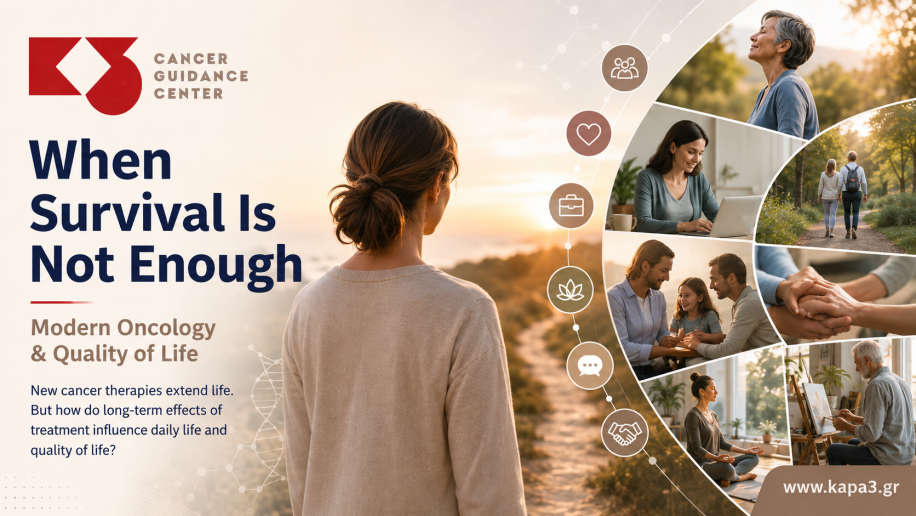
Modern Oncology: When Survival Is Not Enough

New therapies, “hidden” effects and the need to assess not only how long patients live, but how they live

Modern Oncology: When Survival Is Not Enough

New therapies, “hidden” effects and the need to assess not only how long patients live, but how they live

Modern oncology is changing at an unprecedented pace. Immunotherapies, antibody–drug conjugates (ADCs), bispecific antibodies and new targeted therapies are creating treatment opportunities that would have been unimaginable only a few years ago.

Cancer treatment is becoming increasingly personalised and tailored to the biological and molecular characteristics of each tumour, while overall survival is being extended for many people living with cancer.

Yet alongside this remarkable scientific progress, a critical question is emerging:

What does it really mean to live longer after — or with — cancer?

A recent Nature Medicine editorial, entitled “Oncology must confront hidden side effects”, highlights precisely this challenge. While cancer drug development is advancing at remarkable speed, the approaches used to record, assess and manage long-term treatment-related toxicities — and their impact on patients’ quality of life — have not evolved at the same pace.

When a “mild” side effect becomes a major burden

Therapeutic success can create a new reality: people are living longer, but some must also manage treatment-related adverse effects for months, years or even for the rest of their lives.

An adverse event classified clinically as low-grade is not necessarily insignificant to the person experiencing it.

A persistent rash, diarrhoea, stomatitis or other symptoms may substantially affect daily functioning, psychological wellbeing and social life when they continue over long periods.

Similarly, some immune-related adverse events associated with immune checkpoint inhibitors can become chronic, persist for years or even be irreversible.

This highlights an important limitation of the Common Terminology Criteria for Adverse Events (CTCAE), which are widely used to classify and grade treatment-related adverse events.

The duration of adverse events is not adequately reflected, while functional and psychological consequences may also remain outside traditional toxicity assessment.

As a result, what may be considered “manageable” according to conventional clinical criteria can feel very different to the patient living with it every day.

Quality of life cannot be an afterthought

A second important issue is the timing of quality-of-life evidence.

In some cases, quality-of-life findings are reported considerably later than the primary results of a clinical trial, and sometimes after a new drug has already been approved.

This means that patients making treatment decisions during the early years of a new therapy may not yet have a complete picture of how it could affect their daily functioning, emotional wellbeing and overall quality of life.

At the same time, the questionnaires and tools used to assess quality of life need to evolve continuously.

And this cannot happen without the direct involvement of patients themselves.

The experiences and priorities of people receiving treatment should form part of how treatment impact is assessed, rather than being treated as information that is added later.

The example of daraxonrasib

The Nature Medicine editorial highlights the pan-RAS inhibitor daraxonrasib as a telling example. The therapy has shown important survival benefits for patients with aggressive RAS-driven advanced pancreatic cancer, a setting in which treatment options have historically been limited.

At the same time, most patients experienced acneiform rash, with diarrhoea and stomatitis also reported as lower-grade treatment-related adverse events.

Full quality-of-life data — including information on daily functioning and emotional wellbeing — were not yet available because follow-up remained relatively short.

This example illustrates a much wider issue.

If we know that a therapy can significantly extend life, but we do not yet fully understand what that life will be like, an essential part of the information is missing from the conversation between patients and their healthcare teams.

This also has direct implications for informed consent.

Whenever evidence is available, patients need information not only about response rates and survival but also about the potential short- and long-term consequences of treatment for their everyday lives.

The same treatment is not experienced in the same way by everyone

The toxicity profile of a treatment is not identical for every patient.

It may vary according to the drug’s mechanism of action, a person’s physical condition, co-existing long-term conditions, genetic background and other individual characteristics.

Particular attention is needed for populations that have historically been excluded from, or underrepresented in, clinical trials, as their experiences of treatment-related toxicity may differ.

The editorial points, for example, to sex-related differences in adverse events associated with immunotherapy and racial disparities in adverse events observed with CAR-T cell therapy.

This makes real-world data particularly important.

Clinical trials remain fundamental to establishing the safety and efficacy of new treatments. However, broader use in everyday clinical practice may reveal treatment effects that were not fully captured in the populations included in initial studies.

One example is the bispecific antibody amivantamab in lung cancer, where the full extent and severity of some skin toxicities became clearer after a broader patient population was exposed to the treatment.

Moving beyond clinical silos

This changing landscape also demands a different approach to the organisation of cancer care.

The adverse effects of modern cancer therapies do not always fit within a single organ system or medical specialty.

Traditional clinical and disciplinary silos can limit the transfer of knowledge needed to identify, monitor and manage emerging toxicities effectively.

The response therefore needs to be interdisciplinary.

Collaborative networks, updated guidance, systematic reporting, dedicated registries and effective knowledge exchange are increasingly important so that new or rare adverse effects can be recognised early and managed appropriately.

Above all, the patient voice must be heard

Perhaps the most important change concerns how we define treatment success itself.

Survival remains a fundamental goal of oncology.

But it cannot be the only one.

We also need to understand whether people can work, move, sleep, eat, participate in family and social life, maintain as much independence as possible and manage the effects of treatment on their everyday lives.

In other words, we need to know not only how much time a treatment adds to life, but also what that time means to the person living it.

Patients should therefore not enter the process only at the end, as recipients of treatment.

Their perspectives need to be incorporated from the design of clinical trials and assessment tools through to post-approval monitoring and the real-world use of new cancer therapies.

From survival to living after — and with — cancer

Progress in oncology is undeniable, and it brings genuine hope.

The next challenge is to ensure that longer survival is accompanied by quality of life, functioning, meaningful information, participation and dignity.

Modern cancer care therefore needs to move beyond asking only:

“How much longer can this patient live?”

and give equal importance to another question:

“How will this person live during that additional time?”

For Kapa3, this discussion goes to the heart of truly person-centred cancer care: care that sees not only the disease and the treatment, but the person, their everyday life, their needs, their choices and the life that continues during and after cancer.

Source and references

Main source:
Nature Medicine. “Oncology must confront hidden side effects.” Volume 32, July 2026. Published online 8 July 2026. DOI: 10.1038/s41591-026-04554-9.

  1. Barron CC et al. Journal for ImmunoTherapy of Cancer. 2023;11.
  2. Gyawali B et al. Lancet Oncology. 2025;26–e89.
  3. O’Reilly EM et al. New England Journal of Medicine. 2026. DOI: 10.1056/NEJMoa2605555.
  4. Unger JM et al. Journal of Clinical Oncology. 2022;40:1474–1486.
  5. Rayapureddy AK et al. Journal of Clinical Oncology. 2026;44.
  6. Hines MR et al. Transplantation and Cellular Therapy. 2023;29:438.e1–438.e16.

find more s41591-026-04554-9

Κapa3 at IEEE CBMS 2026 | AI for Equitable Oncology Information

Kapa3 at IEEE CBMS 2026: Artificial Intelligence in Support of Equitable Patient Information in Oncology Care

New scientific publication in the Proceedings of the 39th IEEE International Symposium on Computer-Based Medical Systems

The voice and lived experience of patients must remain at the centre of the emerging era of Artificial Intelligence in healthcare.

Kapa3 – Cancer Guidance Centre contributes to a new scientific publication presented in the Proceedings of the 2026 IEEE 39th International Symposium on Computer-Based Medical Systems (CBMS), focusing on how Artificial Intelligence and Retrieval-Augmented Generation can support more equitable, reliable and patient-centred access to information in oncology.

The paper, entitled:

“Informed, Empowered, and Heard: AI and Retrieval-Augmented Generation as Tools for Equitable Patient Information in Oncology”

is authored by Lars Münter, Evangeli Bista, Maria Lavdaniti and Christos Frantzidis, with Evangeli Bista representing Kapa3 as Co-founder.

From access to information to meaningful patient empowerment

A cancer diagnosis creates an immediate need for information that is reliable, understandable and relevant to the individual patient.

At the same time, patients and their families are often expected to understand complex medical terminology, treatment options, prognosis discussions and administrative procedures at a moment of intense psychological and emotional pressure.

The paper highlights that acute stress associated with a serious diagnosis can affect working memory, attention and the ability to process new information. This means that patient information cannot be designed for an ideal, fully attentive reader; it must respond to the real cognitive and emotional conditions experienced by people facing cancer.

The key question is therefore not simply:

“How much information do we provide?”

but rather:

“Are we providing the right information, at the right time, in a form that people can understand and act upon?”

AI and Retrieval-Augmented Generation: towards trustworthy and evidence-grounded information

The publication places particular emphasis on Retrieval-Augmented Generation (RAG).

RAG architectures combine the generative capabilities of large language models with the retrieval of information from curated and verified knowledge sources. In a healthcare setting, this can include clinical guidelines, validated patient information resources, regulatory documents and peer-reviewed literature.

This approach offers an important advantage over purely generative AI systems: responses can be grounded in identifiable sources, supporting greater transparency and enabling patients and healthcare professionals to verify where information comes from.

In oncology, this is especially important.

A patient does not simply need a quick answer. They need information that is:

accurate, current, understandable, accessible and appropriate to their individual situation.

Artificial Intelligence as a tool for equity

One of the central themes of the paper is inequality in access to high-quality oncology information.

Geography, language, socioeconomic circumstances, health literacy, digital literacy and access to specialised healthcare services can significantly influence a person’s ability to understand their diagnosis, treatment options and rights.

The publication pays particular attention to the Greek context, where patients living in large urban centres may experience a very different information environment from those living in rural, remote or island communities.

When equity is treated as a core design principle, AI-RAG systems can potentially support:

  • multilingual access to health information,
  • different levels of language and information complexity,
  • voice-based interfaces,
  • shorter and more manageable units of information,
  • low-bandwidth or offline-capable solutions,
  • and opportunities for patients to return to information when they are ready to process it.

Technology alone, however, does not create equity.

The way technology is designed determines whether it reduces existing inequalities or reproduces them.

Designed with patients, for patient needs

The paper calls for an important shift in the way digital health systems are developed.

Many traditional health information systems are designed primarily around institutional or clinical workflows, with patient-facing communication added later.

For patient-centred AI, this logic must be reversed.

Systems should be designed with patients and around patient needs, with patients and informal carers actively involved in shaping the knowledge base, the questions the system is expected to answer and the ways information is presented.

This also means moving beyond systems that simply respond to individual questions.

A meaningful AI-supported information environment could help patients prepare for clinical consultations, organise their questions, understand the next steps in their care and become more aware of their rights.

The paper highlights applications such as consultation preparation guides, question prompts before appointments and post-consultation summaries as examples of how technology can support patients before, during and after important healthcare interactions.

AI should strengthen, not replace, human relationships

Perhaps the most important message of the publication is that the transformative potential of AI in oncology is not primarily technical. It is relational.

Artificial Intelligence should not create distance between patients and healthcare professionals.

It should help strengthen their communication.

A better-informed patient can arrive at a clinical consultation more prepared, identify questions and concerns more clearly, participate more actively in shared decision-making and communicate more effectively with the healthcare team.

The same applies to informal carers, who often carry a significant part of the informational and emotional burden of cancer care.

For this reason, the paper argues that AI-RAG systems should be designed to strengthen the relationship between patients, carers and healthcare professionals, rather than to replace any part of this human network of care.

For healthcare professionals, trustworthy information systems may also reduce the time required for basic information provision, allowing more of the clinical encounter to focus on nuanced discussions, decision-making and the human aspects of care that technology cannot replicate.

From information to trust

This scientific contribution adds to an increasingly important discussion about the future of healthcare:

How can Artificial Intelligence be developed and used in ways that genuinely respond to human needs?

The answer does not lie only in more powerful AI models or larger volumes of data.

It also lies in evidence, transparency, accessibility, co-design, equity and respect for patient rights.

As the paper concludes, people affected by cancer in Greece and across Europe deserve access to information that is accurate, personalised, accessible and respectful of their rights, regardless of where they live, the language they speak or the socioeconomic resources available to them.

For Kapa3, participating in this scientific discussion also reflects a broader commitment: ensuring that real patient needs, lived experience and equitable access are represented in the design and evaluation of the next generation of digital health and AI-supported tools.

Publication details

Title: Informed, Empowered, and Heard: AI and Retrieval-Augmented Generation as Tools for Equitable Patient Information in Oncology

Authors: Lars Münter, Evangeli Bista, Maria Lavdaniti, Christos Frantzidis

Published in: 2026 IEEE 39th International Symposium on Computer-Based Medical Systems (CBMS)

DOI: 10.1109/CBMS69103.2026.00302

find more 499901b523

Mapping the efficiency of cancer care in Greece: findings from the All.Can Greece report

Cancer care efficiency in Greece remains one of the most complex and pressing challenges for the Greek health system — not only in terms of its clinical burden, but also in how care is organized around the patient.

With approximately 63,000 new cancer cases diagnosed annually and more than 32,000 cancer-related deaths each year, Greece faces a steadily increasing oncological burden. Projections suggest that cancer incidence will rise by around 23% by 2040, further intensifying pressure on health services.

Against this backdrop, All.Can Greece has published a landmark report titled “Mapping the Efficiency of Cancer Care in Greece”, based on the pilot implementation of the All.Can Action Guide for Efficient Cancer Care.

Rather than simply describing the current situation, the report aims to measure it — identifying where efficiency is lost across the cancer care pathway and where targeted reforms could make the greatest impact.

Cancer care efficiency in Greece: delays in care delivery

One of the most critical findings of the report relates to delays in the patient journey.

Despite the existence of modern infrastructure and highly specialized oncology centres, significant delays persist between initial suspicion, diagnosis, and the start of treatment.

These delays are not the result of a single bottleneck, but of systemic fragmentation:

  • fragmented referral pathways,
  • limited coordination between levels of care,
  • and the absence of standardized clinical protocols.

A key structural weakness is the lack of systematic monitoring of waiting times and time-to-treatment indicators. As a result, inefficiencies remain partially invisible to the system itself, limiting the ability to implement targeted improvements.

Fragmentation across the care continuum

The report highlights a broader issue of fragmentation in cancer care delivery.

The patient journey from primary care to specialist oncology services is often not clearly structured or consistently coordinated. Referral pathways depend heavily on individual practice rather than standardized national protocols.

A major gap is the absence of structured patient navigation services. In practice, this means that patients and families are often left to navigate a complex system on their own, increasing delays and adding unnecessary psychological burden.

At the same time, multidisciplinary tumor boards represent a positive development, supporting collaborative clinical decision-making across specialties. However, systematic monitoring of their performance remains limited.

The development of Comprehensive Cancer Centers is identified as a promising step forward, although further regulatory strengthening and clearer governance structures are still needed to maximize their impact.

Patient-centered care: progress with remaining gaps

Greece has made notable progress in collecting Patient-Reported Outcome Measures (PROMs) and Patient-Reported Experience Measures (PREMs), reflecting a growing commitment to integrating patient perspectives into care delivery.

However, patients’ access to their own clinical data remains limited, restricting their ability to actively participate in decision-making processes.

In addition, patient education and shared decision-making are not yet systematically embedded across the health system.

Another important gap concerns survivorship care. As cancer survival rates improve, the lack of structured long-term follow-up pathways leaves many patients without continuous support after active treatment ends.

Key policy directions

The report outlines several strategic priorities for improving cancer care efficiency in Greece:

  • Development of a comprehensive national cancer strategy with clear targets and governance mechanisms
  • Strengthening coordination across all levels of care
  • Implementation of standardized clinical pathways with defined time-to-treatment and quality indicators
  • Investment in oncology workforce capacity, particularly in shortage specialties
  • Establishment of structured patient navigation programmes
  • Acceleration of Comprehensive Cancer Center development
  • Systematic use of health data for monitoring performance and accountability
  • Greater patient engagement through PROMs, PREMs, and shared decision-making

Conclusion: a system with strong foundations but limited integration

Greece has many of the essential building blocks for a high-performing cancer care system — including infrastructure, clinical expertise, and emerging digital health capabilities.

However, the key challenge lies not in the existence of these components, but in their integration.

The All.Can Greece report highlights a system that is still operating in silos: strong individual elements that do not yet function as a fully connected care pathway.

In oncology, this lack of integration is not merely an organizational issue. It directly affects timeliness, patient experience, and ultimately outcomes.

The opportunity now lies in moving from fragmented capacity to coordinated care — where patients no longer have to bridge the gaps between system components themselves.

Source: Mapping-the-Efficiency-of-Cancer-Care-in-Greece-FINAL

Text/adaptation: Ifiyenia Anastasiou for Kapa3

January 21 – International Hug Day

January 21 has been internationally recognized as International Hug Day, a day dedicated to the power of human touch, emotional connection, and care. Established in 1986, this day serves as a reminder that simple, human gestures can have a meaningful impact on our mental and emotional wellbeing.

Hugs are not merely spontaneous expressions of affection. Various scientific studies have shown that physical contact, such as hugging, is linked to reduced stress levels and increased oxytocin, the so-called “bonding hormone,” which is associated with feelings of safety, trust, and emotional closeness. Physical touch has also been correlated with improvements in psychological wellbeing and emotional regulation, particularly during periods of heightened stress or emotional strain.

For people living with cancer or other serious illnesses, as well as their caregivers, emotional support and human connection are essential elements of care. A hug can act as a silent affirmation that someone is not alone, without the need for words or explanations. While it does not replace medical or psychological support, it can offer relief, comfort, and a sense of companionship.

The need for human connection has also been expressed through social initiatives such as the “Free Hugs” movement, which emerged in the 2000s to symbolically highlight the importance of physical touch in public spaces. Although not a scientific intervention, such actions reflected the collective human desire for closeness, understanding, and emotional contact.

At the same time, it is important to acknowledge that physical touch is not experienced in the same way by everyone. For some individuals, hugs or any form of physical contact may be difficult or unwanted due to personal boundaries, past experiences, or psychological state. International Hug Day is not about imposing closeness, but about reminding us of the importance of respect, consent, and empathy. Care can be expressed in many ways: through presence, conversation, or acts of understanding – and when a hug is welcomed, it can serve as a powerful symbol of support.

In an era where loneliness, isolation, and mental strain are growing challenges, the value of human connection is more relevant than ever. Hugs, as symbols of closeness and care, remind us that even small, simple gestures can carry significant meaning.

At KAPA3, we believe in the power of meaningful support and empathy at every stage of illness and caregiving. We stand alongside individuals who need understanding, respect, and genuine care, promoting emotional empowerment and solidarity.

International Hug Day is an opportunity to remember that, with respect, empathy, and meaningful connection, we can make a real difference.

Sources:

Text/Adaptation: Ifiyenia Anastasiou for Kapa3