Digital Health Technologies in Europe: New European Commission Report Highlights Opportunities and Challenges

Digital health technologies in Europe are a key pillar in transforming care systems, as highlighted in the new European Commission report (published in 2026), titled “Observatory for Digital Health Technologies in Europe”. The report, prepared for the Directorate-General CONNECT (DG CNECT) by Capgemini Invent and IDC, provides a comprehensive overview of the EU27 digital health market, analyzing both the technology ecosystem and its economic impact.

The report is structured in three main sections. The first focuses on the creation of the Digital Health Technologies Observatory, a strategic tool for monitoring adoption, innovation, and investment in the sector. The second part presents the economic analysis of five selected technologies, while the third contains conclusions and policy recommendations.

The analysis draws on extensive data, including pan-European surveys of healthcare providers and technology companies, expert interviews, mapping of hundreds of providers, and analysis of tens of thousands of investment records. The findings depict a rapidly growing yet fragmented digital health market in Europe.

Artificial intelligence plays a central role in this transformation, with 94% of healthcare providers already adopting or planning to integrate it. Technologies such as Clinical Decision Support Systems (CDSS), automated medical imaging analysis, and digital mental health platforms are highlighted as particularly important for improving care quality and enhancing health system efficiency.

The economic benefits are substantial. CDSS are estimated to enable savings of up to €252 billion over a decade, while automated medical imaging analysis could save up to €192 billion. Similarly, digital mental health platforms support early intervention and reduce the burden on healthcare services, providing significant social and economic benefits.

The report also identifies critical challenges, such as market fragmentation, interoperability issues, and dependence on non-EU providers in strategic areas. Additionally, issues related to digital skills, regulatory frameworks, and equitable access continue to affect the widespread adoption of these technologies.

To address these challenges, the report recommends measures such as strengthening interoperability, supporting small and medium-sized enterprises, promoting innovation in cutting-edge fields (such as AI and genomics), and integrating principles of sustainability, accessibility, and equity.

The positioning of digital health technologies in Europe as a key pillar for the future of care systems is closely linked with initiatives developed at the national level. In this context, Kapa3 invests in digital tools that enhance information, accessibility, and empowerment of oncology patients, such as the “Myrto” Health Navigator. You can read more about it here.

As Europe seeks to build a more resilient and inclusive health system, leveraging digital technologies emerges as a decisive factor in improving patient quality of life and the effectiveness of healthcare services.

Sources:

Text/Adaptation: Ifiyenia Anastasiou for Kapa3

Launch of Free MELODIC Training Programme – Greece

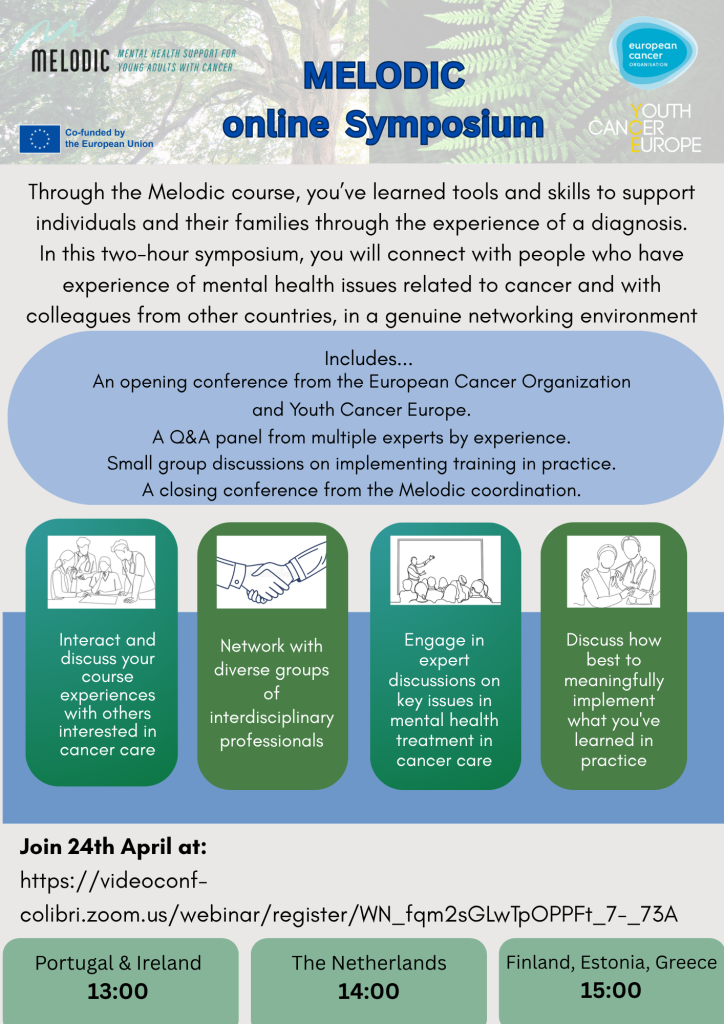
We are pleased to announce the launch of the free eight-week online training programme implemented in Greece within the framework of the European project MELODIC, in which Kapa3 participates as one of 13 partner organisations from 6 European countries.

The programme is addressed to doctors, nurses, other health professionals, and social care professionals working in oncology.

MELODIC is an international collaboration aimed at strengthening mental health support for young adults with cancer and their families, promoting high-quality, holistic oncology care.

Through the programme, participants will have the opportunity to develop skills in:

  • Assessing mental health needs using validated and evidence-based tools

  • Supporting families and caregivers

  • Delivering high-quality psychosocial care

  • Interprofessional collaboration

  • Sustaining personal and professional wellbeing

The programme is divided into an asynchronous part (on the Moodle platform), which participants can complete at their own pace, and four contact lessons, constituting the synchronous part via Zoom. Upon completion, participants will receive 5 ECTS credits and a certificate of completion.

Sessions will take place from March to April 2026.

The contribution of health professionals is crucial for the accurate assessment of mental health needs of young adults with cancer and their families, as well as for delivering high-quality, person-centred care. The MELODIC programme strengthens their skills, promoting collaboration, responsibility, and sustainable professional practice in oncology.

For further information, please contact:
Ifiyenia Anastasiou
email: ifi.k3team@gmail.com | phone: 690.62.65.170

28 January – Data Protection Day: privacy, health and trust

European Data Protection Day, observed every year on 28 January, was established by the Council of Europe and is linked to Convention 108, the first legally binding international instrument on the protection of personal data. The day serves as a reminder that the right to privacy is a fundamental human right — especially in a time when personal information is increasingly collected, stored and processed digitally.

Personal data are not merely technical entries in databases and systems. They are fragments of people’s lives. They include health information, personal experiences, vulnerable moments and deeply private aspects of identity. When individuals share such information, they do so with the expectation that it will be handled with care, confidentiality and respect.

For organisations such as Kapa3, which work closely with patients and people in vulnerable situations, data protection goes far beyond legal compliance. It is a matter of dignity and trust. Health data — including information related to both physical and mental health — belong to the most sensitive categories of personal data. Inadequate protection or misuse can lead to stigma, discrimination and a profound sense of insecurity.

Within the European Union, the General Data Protection Regulation (GDPR) provides a common framework to ensure that individuals retain control over their personal information. Rights such as informed consent, access to data and the ability to request deletion are not administrative formalities. They are essential safeguards that protect human integrity, particularly in the context of healthcare and social support.

According to the World Health Organization (WHO), confidentiality and ethical governance of health data are fundamental to the provision of safe and high-quality care. Trust between patients and healthcare or support organisations is strengthened when personal information is managed transparently, responsibly and within clearly defined limits.

European Data Protection Day is not only an occasion to reflect on legal obligations or technical safeguards. It is an opportunity to consider how we approach privacy as a core element of respectful and ethical care. Protecting personal data is ultimately not about technology — it is about protecting the people behind the data and the trust that underpins every meaningful human relationship.

Sources:

Text/adaptation: Ifiyenia Anastasiou for Kapa3
2025 – Moving Forward with Vision

The Kapa3 Annual Review 2025 reflects a year of determination and vision, as Kapa3 strengthened its impact through initiatives and collaborations focused on holistic cancer care.During the first half of the year alone, we managed more than 400 individual requests, with support for the process of Disability Certification standing out as a key service—confirming that personalized, hands-on support remains at the core of our mission.

A milestone moment in 2025 was Kapa3’s participation, alongside 13 European partners, in the EU4Health programme MELODIC, which focuses on improving mental health support for young adult cancer patients (18–39 years old). Through research mapping the training needs of healthcare professionals, the project highlights the urgent need for better detection and management of psychological distress among young patients—many of whom still lack access to adequate psychosocial care.

MELODIC promotes innovative wellbeing interventions, such as physical activity in green and blue spaces combined with psychosocial support, emphasizing the healing power of nature and community in mental health recovery. As an active partner, Kapa3 works to ensure that these actions reach patients directly, fostering community engagement and equitable access to quality care.

At the same time, our participation in the second cycle of the SmartHEALTH programme, supported by CERTH, strengthened the digital integration of healthcare services and empowered patients through smart technologies, improving efficiency, accessibility, and transparency.

Our collaboration with FairLife within the BREATH programme for lung cancer patients highlighted the importance of holistic and interdisciplinary care. In parallel, our presence at conferences and scientific events—such as COST Action INECSC CA21125 and the 7th conference “Caregivers and Depression”—consistently brought attention to the needs of caregivers and the empowerment of patients.

At both national and international levels, Kapa3 presented its work at the Lazord International Conference, the Pan-Macedonian Scientific Nursing Conference, and the ESMO World Congress in Berlin. We also participated in major events such as the Patients Summit, Morning Health Talks by EIT Health, and the 18th Panhellenic Conference on Nutrition & Dietetics.

A particularly important moment was our action in the Municipality of Megara, where a new Cancer Patient Guidance and Counselling Station was established, offering direct and personalized support to patients and their families.

Prevention and awareness remain fundamental pillars of our work. Breast self-examination initiatives, participation in the Action4Obesity network, presence at the Thessaloniki Disability Festival, and the launch of new nutrition-related sections on our website all contribute to improving the quality of life of patients and caregivers—combining scientific guidance with lived experience.

Awards 2025

In 2025, Kapa3 received significant recognition for the digital platform Cancer Care Connect, winning a Gold Award at the Diversity, Equity & Inclusion Awards, as well as the Gold Award for “NGO of the Year – Health and Social Care at the Hellenic Responsible Business Awards 2025.
In addition, our collaboration with the University of Peloponnese received a Silver Award at the Healthcare Business Awards 2025 for the programme “Community co-design and implementation of holistic educational practices for nutrition and mental health.”

Every initiative, every partnership, and every participation brings us closer to our vision: holistic, human-centred care where the voices of patients and caregivers truly matter.

To explore our full journey from the foundation of Kapa3 through the end of 2025, you can view our comprehensive activity report here.

The Kapa3 Annual Review 2025 reaffirms our commitment to holistic, human-centred care, where the voices of patients and caregivers truly matter.

As we step into the new year, we move forward with enthusiasm, commitment, and optimism—to continue supporting patients and caregivers, investing in innovation and education, and strengthening care and participation across all our actions.

We wish everyone a year filled with health, strength, and inspiration.

The Kapa3 Team

The Impact of the Kapa3 Internship Programme: 30 Young Professionals in Our First 5 Years of Operation

The Impact of the Kapa3 Internship Programme: 30 Young Professionals in Our First 5 Years of Operation

In the five years since our establishment, thirty young people have had the opportunity to learn and grow through the Kapa3 Internship Programme.

International scientific literature highlights that internships are far more than a first work experience. They serve as a fundamental mechanism of experiential learning, enabling students to connect theoretical knowledge with real-world professional contexts.

Through their involvement in a civil society organisation like Kapa3, interns developed reflective and critical thinking skills—core elements of modern professional education. By engaging with real needs and challenges, students strengthened their professional identity and gained a deeper understanding of their role as future practitioners in health and social services. In many cases, the internship at Kapa3 played a significant role in supporting their transition from university to the labour market, enhancing their confidence, social skills, and clarity of professional direction.

Furthermore, the structured field experiences offered opportunities to build professional networks, a key factor in long-term career development.

At Kapa3, the value of internships is evident across all aspects of our work. We strive to create an environment where students can deepen their academic knowledge, apply their skills to real cases, and map out the next steps of their careers with realism and self-awareness.

The result is a community of young professionals who are both socially conscious and scientifically equipped to contribute meaningfully to health and social care. We are proud to be at the forefront of education and warmly thank our partner universities for their trust and collaboration.


Rethinking Solidarity in Health – A European Perspective

Health Systems Under Pressure in Europe

Across Europe, health systems face mounting pressures. Workforce shortages, uneven access, and entrenched inequalities leave many citizens underserved, and public trust in institutions is eroding. The pandemic briefly rekindled a sense of shared responsibility, yet shifting geopolitical tensions and economic priorities have since drawn attention away from collective well-being. This context raises a vital question: what does solidarity in health mean in Europe today? This context was highlighted at the European Health Forum Gastein (EHFG) 2025, where policymakers, civil society representatives, and health experts discussed the challenges and opportunities for solidarity in health across Europe.

Health is not merely a commodity; it is the foundation for social cohesion and long-term resilience. Investing in preventive care, mental health, and social support is not a trade-off with economic competitiveness — it is a prerequisite. In the European Union alone, premature deaths in 2022 accounted for 2.4 million lost work-years, highlighting the societal and economic consequences of insufficient early action. Across member states, access to care remains uneven, chronic diseases are on the rise, and innovations are not uniformly available, leaving vulnerable populations facing overlapping disadvantages.

The Role of Preventive Care and Mental Health

Solidarity in health demands action at every level. Primary and community care serve as the first line of defense, with multidisciplinary teams — including doctors, nurses, psychologists, and social workers — partnering with civil society organisations to reach underserved groups. Examples from Andalusia, Portugal, and Estonia’s e-consultation payment model show how coordinated, person-centred approaches build trust, improve access, and empower citizens. Prevention, early detection, and health literacy must complement innovation, ensuring no one is left behind. In the EU, the average diagnostic delay for asthma is 4.5 years, underlining the need for timely, equitable care.

Digital Health Innovation and Equity

Digital transformation presents both promise and challenge. AI, big data, and digital health tools can enhance early detection and patient monitoring. They also improve system efficiency. However, they risk amplifying bias and mistrust if governance is weak.. Europe’s task is to combine innovation with ethical oversight, embedding transparency, accountability, and accessibility into every design decision. Initiatives like the European Health Data Space (EHDS) aim to unify interoperability, research, and patient empowerment under one framework, giving citizens control over their health data while supporting innovation and equity.

Health systems also intersect with broader social and environmental challenges. Climate change, rising social inequalities, and ageing populations disproportionately affect vulnerable groups, while end-of-life care and rare diseases expose gaps in equity, research, and policy. Across Europe, collaborative solutions — from shared patient pathways to cross-border networks — are essential. Health contributes approximately 10% of EU GDP and 9% of employment, demonstrating its central role in both social and economic stability. Public funding, strategic investment in long-term care, and multi-sector collaboration strengthen resilience and uphold solidarity. Notably, €170 million has been allocated to the EU’s Strategic Research and Innovation Agenda on Health and Climate Change, ensuring vulnerable populations are included in solutions.

Examples of Person-Centred Care in the EU

Ultimately, solidarity in health is not merely about funding or policies; it is a commitment to fairness, inclusivity, and collective responsibility. From innovative care models like Karolinska University Hospital’s “hospital at home” programme to Estonia’s digital solutions, Europe has examples of what works when equity and person-centred design guide decisions. Rebuilding trust and strengthening solidarity requires transparency, engagement with civil society, and measures that demonstrate care in action.

Europe’s social contract in health can be renewed, balancing competitiveness with care. When investments, innovation, and policies are guided by solidarity, the continent can ensure that health becomes the common ground on which trust is restored — measured not in slogans or speeches, but in the well-being of every citizen.

Read the EHFG report here

Text/adaptation: Ifiyenia Anastasiou for Kapa3