A Calm Summer Begins with Proper Preparation Proactive Care Planning, Mental Decompression and Digital Support

Proactive Care Planning, Mental Decompression and Digital Support

Summer is a valuable opportunity for rest, renewal and quality time with the people we love. For people living with or after a cancer diagnosis, as well as for their caregivers, the possibility of enjoying a few days away from everyday life can contribute meaningfully to physical and mental well-being.

When a person’s health condition allows it, and with the agreement of the treating physician, even a short break can have a beneficial effect, enhancing quality of life and supporting the sense of returning to everyday life (Lim et al., 2022).

The quality of life of people living with or after a cancer diagnosis does not depend solely on medical treatment. Mental well-being, social support, optimism and resilience are equally important factors that facilitate adaptation to the disease and contribute to patients’ overall well-being (Ruiz-Rodríguez et al., 2022). At the same time, current guidelines underline the importance of integrated and personalised care, as well as continuous support for people living with or after cancer at every stage of their journey (Hart et al., 2024).

However, the peace of mind associated with holidays does not begin on the day of departure. It begins much earlier, through proper preparation. Practical pending issues, administrative procedures or concerns about unexpected events during the holidays can increase stress and reduce the feeling of safety. By contrast, proactive care planning allows patients to organise what is needed in advance, so that they can devote their time to rest rather than obligations.

Timely renewal of medical certificates, ensuring an adequate supply of medication for the entire period of absence, communicating with the treating physician when necessary, and keeping essential medical documents in an easily accessible format are simple but important steps of preparation. In this way, continuity of care is safeguarded, while the uncertainty that often accompanies travel is reduced.

Reliable information and timely support are key pillars of modern oncology care. When people know where they can turn and have easy access to trustworthy information, they feel safer, their autonomy is strengthened and the management of daily life becomes easier (Ruiz-Rodríguez et al., 2022; Hart et al., 2024).

In today’s world, digital tools can complement support services by facilitating access to reliable information wherever the patient may be. In this direction, Kapa3 is moving forward with the development of Myrto, the digital social navigator, designed to provide direct access to information on social rights, available services and useful guidance. In this way, it facilitates access to the organisation’s services and reliable information, contributing to better preparation before and during holidays.

For all of us at Kapa3, technology does not replace human care; it complements it. It is another means of facilitating access to trustworthy information and available services, while the Social Service and Psychological Support Service of Kapa3 remain the core pillar of holistic support for people living with cancer and their families.

Let us remember that care does not stop when holidays begin. It continues through small but meaningful acts of preparation, proper information and timely planning. Because, many times, the greatest luxury of a holiday is not the destination itself, but the feeling that we can enjoy our moments with calmness, safety and trust.

The Social Service and Psychological Support Service of Kapa3 wish everyone a safe, peaceful and refreshing summer, with health, strength and beautiful moments.

Before Leaving for Your Holidays…

✔️ Make sure you have an adequate supply of your medication for the entire period of your absence.

✔️ Check whether there are any medical certificates, prescriptions or other administrative pending issues that need to be settled in time.

✔️ Discuss with your treating physician any special instructions related to travel or movement.

✔️ Keep with you the necessary medical documents and important contact details.

✔️ Find out about available support services and make use of the Kapa3 App, so that you have easy access to useful information wherever you are.


References

Hart, N. H., Nekhlyudov, L., Smith, T. J., Yee, J., Fitch, M. I., Crawford, G. B., et al. (2024). Survivorship Care for People Affected by Advanced or Metastatic Cancer: MASCC-ASCO Standards and Practice Recommendations. JCO Oncology Practice, 20(9), 1160–1172. https://doi.org/10.1200/OP.23.00716

Lim, J. H. C., Keenan, C., & Flaherty, G. T. (2022). All My Life to Live: Travel Health Benefits and Risks for Cancer Survivors. Journal of Travel Medicine, 29(5), taac069. https://doi.org/10.1093/jtm/taac069

National Comprehensive Cancer Network. (2024). NCCN Clinical Practice Guidelines in Oncology (NCCN Guidelines®): Survivorship. Version 2.2024. Plymouth Meeting, PA: National Comprehensive Cancer Network.

Ruiz-Rodríguez, I., Hombrados-Mendieta, I., Melguizo-Garín, A., & Martos-Méndez, M. J. (2022). The Importance of Social Support, Optimism and Resilience on the Quality of Life of Cancer Patients. Frontiers in Psychology, 13, 833176. https://doi.org/10.3389/fpsyg.2022.833176

World Health Organization. (2022). World Mental Health Report: Transforming Mental Health for All. Geneva: World Health Organization.


Official Access Links

Hart et al., 2024 — MASCC-ASCO Standards:
https://ascopubs.org/doi/10.1200/OP.23.00716

Lim et al., 2022:
https://doi.org/10.1093/jtm/taac069

NCCN Clinical Practice Guidelines in Oncology: Survivorship:
https://www.nccn.org/professionals/physician_gls/pdf/survivorship.pdf

Ruiz-Rodríguez et al., 2022:
https://doi.org/10.3389/fpsyg.2022.833176

WHO World Mental Health Report:
https://www.who.int/publications/i/item/9789240049338


Marilia Barka
Psychology Student
Kapa3 Volunteer

www.linkedin.com/in/maria-garyfalia-marilia-barka-03825a409

The Active Role of Patient Organizations in Shaping Public Policy: How Our Health Advocacy Ef orts Are Put into Action

At the Cancer Patient Guidance Center, we believe that the voices of patients, their families, and the organizations that represent them must be heard loud and clear where decisions are made.

Improving the quality of life for cancer patients, ensuring access to new treatments, and meeting the needs of caregivers are not just requests but rights that are asserted through organized advocacy. To make this a reality, the right tools are needed.

The new “Guide to Mapping Public Consultation Tools”

As part of the “ENERGO – Toward an Open State” project, HIGGS has created a practical guide that maps the available mechanisms for participation at the local, national, and European levels.

This guide serves as a roadmap for Civil Society Organizations (CSOs), providing a detailed overview of:
• How institutional consultation tools function
• The opportunities for organizations to actively participate in policy-making
• The requirements for accessing these mechanisms
• The challenges and limitations, so that our interventions are well-informed and effective

Why might this be of interest to the beneficiaries of our Center?

Participation in shaping public policy is not an abstract concept. In cancer care, it translates into very specific changes:
1. Equal access to care: advocating for better infrastructure, shorter wait times, and free access to innovative medications.
2. Support for caregivers: establishing leave policies, benefits, and support systems for the people who stand by their side
3. Rights in the workplace: protecting cancer patients from discrimination in the workplace during and after treatment.

Summary & Structure of the Public Consultation Tools Guide

The “Public Consultation Tools Guide” was developed as part of the project “ENERGO – Toward an Open State” (implemented by HIGGS and co-funded by the European Union, the Bodossaki Foundation, and the NGO Support Centre). It is a practical reference tool designed to empower civil society organizations (CSOs) by strengthening their capacity for meaningful, evidence-based participation in public policy-making and strategic advocacy.

The guide is organized into the following sections:

1. Introduction & Institutional Landscape: This section presents the framework for the guide’s development, which was based on research and experiential tools involving dozens of civil society organizations. It analyzes the challenges of the institutional landscape, noting that the main obstacle for organizations is not the absence of tools, but rather the fragmentation, lack of visibility, and complexity of existing mechanisms,

2. National Tools for Public Consultation & Participation: maps and presents in detail the tools available in Greece, such as OpenGov, the KEDE & LocalWatch consultation platform, Vouliwatch, the YPEN Participation Platform, the National Register of Procedures (“Mitos”), Open Council & Crowd Participation, as well as Diafania & POTHEN.

3. European Public Consultation & Participation Tools: presents mechanisms for engagement at the European Union level, such as Have Your Say, the European Citizens’ Initiative (ECI), Consul Democracy, Loomio & Decidim, and others.

4. Tool Selection Guide & Conclusions: Provides consistent evaluation criteria (purpose, implementing body, prerequisites, limitations) so that each organization can select the most appropriate tool based on the objective of its engagement.

About the “ENERGO” Project & the PLATO Program

The “ENERGO: Toward an Open State – Participation, Advocacy, and Empowerment of Civil
Society Organizations” project is being implemented as part of the PLATO program, with HIGGS serving as the implementing partner. The PLATO program (“Protecting democracy, human rights, and the rule of law through an open civic space”) aims to strengthen the fundamental rights and values of the EU in both Greece and Cyprus. It is co-funded by the European Union through the Citizens, Equality, Rights and Values (CERV) program, the Bodossaki Foundation, and the NGO Support Center. The Bodossaki
Foundation serves as the coordinator in partnership with the NGO Support Center.

View and download the guiderZT9sW-Οδηγός Εργαλείων Δημόσιας Διαβούλευσης.


Participation in CA21152 – Implementation Network Europe for Cancer Survivorship Care

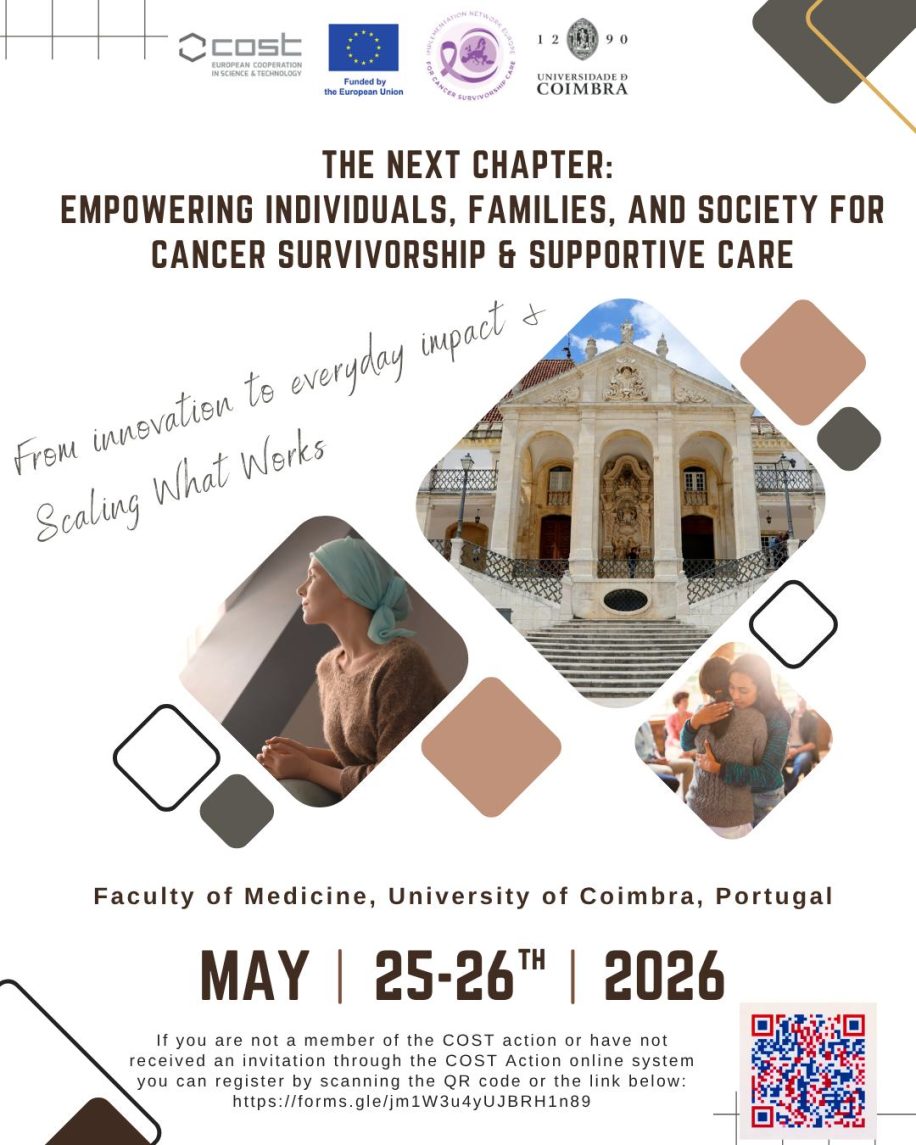
Digital Health and Cancer Survivorship: Kapa3 at the INE-CSC 2026 Conference in Coimbra

The Cancer Guidance Center – Kapa3 participated in the INE-CSC 2026 Conference, part of CA21152 – Implementation Network Europe for Cancer Survivorship Care (INE-CSC), held on 25–26 May 2026 at the Faculty of Medicine (Polo III), University of Coimbra, in Coimbra, Portugal.

The conference was held under the theme “The Next Chapter – Empowering Individuals, Families, and Society for Cancer Survivorship & Supportive Care”, highlighting the need for new approaches to cancer survivorship, supportive care and the translation of innovation into real-world impact for people living with and beyond cancer, their families and society.

Kapa3’s presence in Coimbra represents another important step in its European engagement and in its ongoing effort to connect everyday experience in supporting cancer patients in Greece with European knowledge, research, digital innovation and health policy.

A key highlight was the participation in a round table discussion on facilitators and barriers to the implementation of digital health tools in oncology. The discussion was co-organised by Aristea Kyriaki Ladas and Christos Frantzidis and brought together voices from different European countries and organisations, including representatives from Kapa3, Acreditar Portugal, Liga Portuguesa Contra o Cancro, ORCO / Madrid Regional Ministry of Health, as well as participants from Poland, Latvia and the United Kingdom.

Among the participants in the round table were Yannis Kontogiorgis and Despoina Pistiolis from Kapa3, Greece, contributing to the European dialogue on digital health, oncology navigation and the participatory development of solutions that respond to the real needs of patients and caregivers.

One of the key messages of the discussion was that digital innovation in oncology is not only a technological challenge. It is also a matter of policy, implementation, equity, trust and accessibility.

For digital tools to make a meaningful difference in cancer care and survivorship, they cannot remain isolated applications or pilot projects. They need to become part of real care pathways, be supported by appropriate policy environments, connect with interdisciplinary practice and be evaluated in terms of effectiveness, implementation readiness, accessibility, equity, sustainability and value.

The discussion also highlighted that digital tools must be designed around the real needs of patients and survivors, not only around technical possibilities. Accessibility across countries, languages, healthcare systems and levels of digital and health literacy must be built in from the beginning.

The role of patient organisations and cancer support communities was also identified as essential. These organisations can act as a bridge between technological innovation and the everyday reality of people affected by cancer. They understand the questions, barriers, fears and needs that are often not fully captured by formal care systems.

For Kapa3, this participation is directly linked to the development of Myrto, its digital health and rights navigator, designed as a tool for empowerment, guidance and support for cancer patients and their caregivers.

Myrto is not approached as a simple information tool. It is being designed as a participatory intervention built around the real needs of people with lived experience of cancer. It is connected to access to rights, social benefits, services, practical guidance and human escalation whenever needed.

The Coimbra experience strengthened the view that digital health must be human-centred, accessible, trustworthy and integrated into a broader ecosystem of care. Technology can meaningfully support cancer care only when it is designed with participation, trust, clear purpose and an equity-oriented approach.

Cancer survivorship is not only about completing treatment. It is about quality of life, mental health, social reintegration, work, family, everyday life, access to services and the feeling that no person is left alone after diagnosis or treatment.

Through its participation in European networks such as INE-CSC, Kapa3 continues to contribute to the dialogue on more equitable, participatory and person-centred cancer care. Care that uses technology without losing sight of the human being at its centre.

The future of cancer support will not depend only on better digital tools, but on better collaboration between patients, caregivers, healthcare professionals, researchers, technology partners, patient organisations and policymakers.

For Kapa3, this is at the heart of its mission: transforming knowledge into action, technology into support, and the voice of patients into services that respond to their real needs.

More information: INE-CSC – Implementation Network Europe for Cancer Survivorship Care.More information:
https://inecancersurvivorship.com

This Year’s Good-Luck Charm (2026): A Symbol of Self-Care

The Good Luck Charm of the Year (2026) for Kapa3: The Crown

A Symbol of Self-Care

This year’s good luck charm is dedicated to self-care — a small, daily reminder of the deep importance of tending to ourselves with gentleness, respect, and consistency.
In a time when everyday life becomes increasingly demanding, this charm reminds us that self-care is not a luxury, but a necessity.

It symbolizes all those small acts that keep us standing: the pause, the breath, the moment of rest; the warm embrace we offer ourselves. The choice to listen to our bodies, to acknowledge our limits, and to prioritize our health, joy, and inner balance.

And it is precisely this “pause” that led us to our good-luck charm for 2026: the Crown — a symbol that carries far more than what meets the eye.

In music, the crown (fermata) is the pause held by the performer —
the moment of emphasis before the melody continues.
So it is with every struggle: it requires breaths, pauses, small breaks — not to stop, but to continue.

A crown is also a circle. And a circle means you are not alone; around you are people, care, support — a circle that holds you.

If there were a title of honor for those who fight cancer, it would be a crown. Not as a symbol of power, but as a recognition of dignity.

Cancer can sometimes feel like a thorny wreath — heavy, painful, relentless.
And yet, depending on how we choose to face it, it can transform into a wreath of victory: the victory of persistence, endurance, return — and above all, the victory of effort.

Because behind every crown lies a story: of a parent, a friend, a child, a partner, someone who is fighting or supporting someone who fights.

That is why the crown is not just a piece of jewelry — it is a message of strength:

It is not what happens to us that defines us —
but how we choose to face it.

It reminds us that when we care for ourselves, we can truly care for others. That strength, well-being, and kindness begin within us.

May this year’s charm be a small talisman accompanying us each day, inspiring us to make space for what nourishes us, to embrace our vulnerability, and to celebrate our worth.

For a year filled with more care, more peace, and more love — beginning with ourselves.

Let’s fill our days with small acts that make a difference.
Let’s uplift one another.
Let’s turn self-care into a habit.

And for all of us at Kapa3, the invitation is simple: To weave self-care into our everyday lives.

Join the #kapa3gouri Self-Care Challenge

Inspired by this year’s charm — dedicated to self-care — we invite you to join the #kapa3gouri Self-Care Challenge, a collective action that brings us together through moments of care, calm, and mindfulness.

How the challenge works:
  1. Take one small self-care action during your day.
    It can be something simple: a walk, a breathing break, a warm cup of tea, a few minutes away from screens, journaling your thoughts, a hug you needed.

  2. Capture a photo or write a few words that reflect that moment.

  3. Share it on Instagram or Facebook using the hashtag #kapa3gouri.

  4. Tag two friends to keep the chain of self-care going.

Our goal is not the “perfect” image — but the daily reminder that we deserve time, space, and care. Each post becomes a small mosaic of tenderness toward ourselves.
A collective message that wellbeing begins within.

For 2026, choose the Crown — as a symbol of hope, strength, and dignity.
Wear it. Offer it. Share its power.

Thank you for being part of this journey.


The Kapa3 Team


World Pancreatic Cancer Day – 13 November

Every November, World Pancreatic Cancer Day reminds us that behind every statistic there is a life—a life often challenged by one of the most silent yet aggressive forms of cancer.

According to the latest data from the World Health Organization and GLOBOCAN 2022, pancreatic cancer accounts for over 510,000 new cases and 467,000 deaths every year globally.
In Greece, the disease now ranks among the top five cancers in women and the top seven in men, with incidence steadily increasing in recent decades.

Early detection remains a major challenge, as symptoms—such as persistent abdominal or back pain, unexplained weight loss, or jaundice—often emerge only in advanced stages. Yet prevention can make a difference: avoiding smoking, maintaining a healthy weight, eating a balanced diet, and having regular medical check‑ups are all key steps in protecting pancreatic health.

The disease may also present with digestive changes or the sudden onset of diabetes without obvious cause—signals that warrant prompt attention.

Today is not just about raising awareness—it’s also about supporting patients and their families. With more knowledge, open communication with doctors, and access to specialized care, we can make a difference.

At KAPA3, we join the global community to emphasise that every story matters, and that prevention and early diagnosis can save lives.

Sources:

Text/adaptation: Ifiyenia Anastasiou for KAPA3