Mapping the efficiency of cancer care in Greece: findings from the All.Can Greece report

Cancer care efficiency in Greece remains one of the most complex and pressing challenges for the Greek health system — not only in terms of its clinical burden, but also in how care is organized around the patient.

With approximately 63,000 new cancer cases diagnosed annually and more than 32,000 cancer-related deaths each year, Greece faces a steadily increasing oncological burden. Projections suggest that cancer incidence will rise by around 23% by 2040, further intensifying pressure on health services.

Against this backdrop, All.Can Greece has published a landmark report titled “Mapping the Efficiency of Cancer Care in Greece”, based on the pilot implementation of the All.Can Action Guide for Efficient Cancer Care.

Rather than simply describing the current situation, the report aims to measure it — identifying where efficiency is lost across the cancer care pathway and where targeted reforms could make the greatest impact.

Cancer care efficiency in Greece: delays in care delivery

One of the most critical findings of the report relates to delays in the patient journey.

Despite the existence of modern infrastructure and highly specialized oncology centres, significant delays persist between initial suspicion, diagnosis, and the start of treatment.

These delays are not the result of a single bottleneck, but of systemic fragmentation:

  • fragmented referral pathways,
  • limited coordination between levels of care,
  • and the absence of standardized clinical protocols.

A key structural weakness is the lack of systematic monitoring of waiting times and time-to-treatment indicators. As a result, inefficiencies remain partially invisible to the system itself, limiting the ability to implement targeted improvements.

Fragmentation across the care continuum

The report highlights a broader issue of fragmentation in cancer care delivery.

The patient journey from primary care to specialist oncology services is often not clearly structured or consistently coordinated. Referral pathways depend heavily on individual practice rather than standardized national protocols.

A major gap is the absence of structured patient navigation services. In practice, this means that patients and families are often left to navigate a complex system on their own, increasing delays and adding unnecessary psychological burden.

At the same time, multidisciplinary tumor boards represent a positive development, supporting collaborative clinical decision-making across specialties. However, systematic monitoring of their performance remains limited.

The development of Comprehensive Cancer Centers is identified as a promising step forward, although further regulatory strengthening and clearer governance structures are still needed to maximize their impact.

Patient-centered care: progress with remaining gaps

Greece has made notable progress in collecting Patient-Reported Outcome Measures (PROMs) and Patient-Reported Experience Measures (PREMs), reflecting a growing commitment to integrating patient perspectives into care delivery.

However, patients’ access to their own clinical data remains limited, restricting their ability to actively participate in decision-making processes.

In addition, patient education and shared decision-making are not yet systematically embedded across the health system.

Another important gap concerns survivorship care. As cancer survival rates improve, the lack of structured long-term follow-up pathways leaves many patients without continuous support after active treatment ends.

Key policy directions

The report outlines several strategic priorities for improving cancer care efficiency in Greece:

  • Development of a comprehensive national cancer strategy with clear targets and governance mechanisms
  • Strengthening coordination across all levels of care
  • Implementation of standardized clinical pathways with defined time-to-treatment and quality indicators
  • Investment in oncology workforce capacity, particularly in shortage specialties
  • Establishment of structured patient navigation programmes
  • Acceleration of Comprehensive Cancer Center development
  • Systematic use of health data for monitoring performance and accountability
  • Greater patient engagement through PROMs, PREMs, and shared decision-making

Conclusion: a system with strong foundations but limited integration

Greece has many of the essential building blocks for a high-performing cancer care system — including infrastructure, clinical expertise, and emerging digital health capabilities.

However, the key challenge lies not in the existence of these components, but in their integration.

The All.Can Greece report highlights a system that is still operating in silos: strong individual elements that do not yet function as a fully connected care pathway.

In oncology, this lack of integration is not merely an organizational issue. It directly affects timeliness, patient experience, and ultimately outcomes.

The opportunity now lies in moving from fragmented capacity to coordinated care — where patients no longer have to bridge the gaps between system components themselves.

Source: Mapping-the-Efficiency-of-Cancer-Care-in-Greece-FINAL

Text/adaptation: Ifiyenia Anastasiou for Kapa3
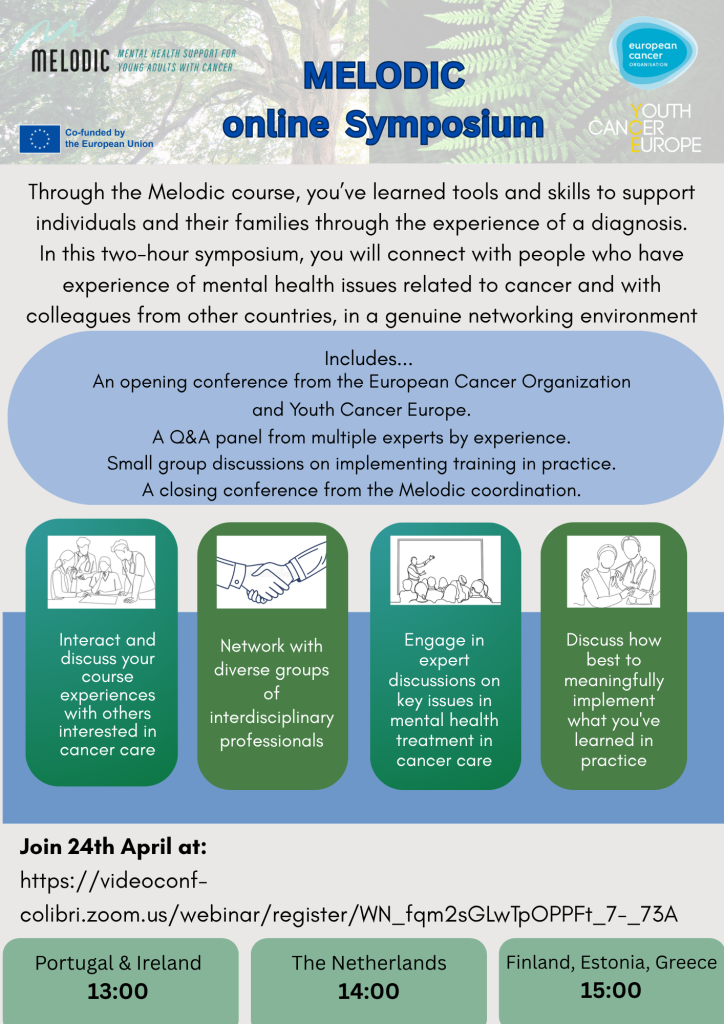
MELODIC Online Symposium: completion of the pilot training phase and strengthening psychosocial cancer care

The European project MELODIC (Mental Health Support for Young Adults with Cancer), in which the Cancer Guidance Center – Kapa3 participates, is being implemented through distinct development phases. The pilot training programme for healthcare professionals is one of its core components, and within this framework, the MELODIC Online Symposium 2026, taking place on 24 April 2026, marks the completion of this educational phase.

The MELODIC project framework

MELODIC is a European project co-funded by the European Union, aiming to strengthen the mental health of young adults living with cancer, as well as to support their families. Through the collaboration of universities, research institutions and healthcare organizations across Europe, the project develops training and support tools for healthcare professionals.

More information about the project and its progress is available on the official Kapa3 website, in the dedicated project section.

The pilot training programme

The pilot training programme focused on enhancing the knowledge and skills of healthcare professionals in providing psychosocial support to young adults with cancer and their families.

As part of the programme, online sessions and contact lessons were delivered, aiming to strengthen interdisciplinary collaboration and support the practical application of tools in everyday clinical practice.

MELODIC Online Symposium 2026

The MELODIC Online Symposium 2026, a two-hour event, brings together participants from all partner countries and includes:

  • opening presentations from the European Cancer Organisation and Youth Cancer Europe
  • an “experts by experience” panel, where individuals share their lived experience
  • a networking panel with healthcare professionals from participating countries
  • discussion on how training can be applied in clinical practice
  • a closing session by the project coordination team

From training to clinical practice

A key objective of the MELODIC training programme is to strengthen the psychosocial dimension of cancer care, with particular focus on young adults.

The exchange of experiences among healthcare professionals contributes to more holistic approaches to care and supports the integration of psychosocial support into daily clinical practice.

The role of Kapa3

Kapa3 actively participates in the European MELODIC consortium, contributing to the implementation of the training activities and the dissemination of results in Greece. Through this involvement, the connection between scientific knowledge and the support of cancer patients is further strengthened, promoting the development of practical approaches to psychosocial care.

The MELODIC Online Symposium 2026 marks the transition from the pilot training phase to the next stage of utilizing its outcomes, reinforcing the link between education and real-world application in cancer care.

The Press Release here: PRESS-RELEASE-MELODIC SYMPOSIUM

Text/adaptation: Ifiyenia Anastasiou for Kapa3

Kapa3 and Karkinaki join forces to support children, adolescents, and families living with cancer

The Cancer Guidance Center – Kapa3 announces its new collaboration with the non-profit organization “Karkinaki”, aiming to strengthen information, psychosocial support, and awareness around childhood and adolescent cancer, as well as to support families experiencing the disease.

Karkinaki is a specialized organization working in the field of childhood and adolescent cancer, focusing on reliable information, empowering parents and caregivers, and fostering a supportive environment around children and teenagers affected by cancer. Through community-based actions and awareness initiatives, it seeks to reduce the sense of isolation that often accompanies diagnosis, while also enhancing understanding, social awareness, and access to available support resources for families.

Within the framework of this collaboration, the two organizations will develop joint initiatives focused on information and awareness-raising, with an emphasis on actions addressing both families and healthcare and support professionals. The partnership will also include the co-organization of informational events, the exchange of good practices, and the exploration of participation in national and European programs that promote a holistic approach to patient care, with an emphasis on continuity of support across all stages of the disease experience.

The Cancer Guidance Center – Kapa3 is dedicated to informing, guiding, and empowering people affected by cancer, providing practical support and access to reliable information and services. At the same time, it develops initiatives that strengthen patients’ active participation in managing their health and promotes a more accessible and human-centered model of care.

In this context, Kapa3 is also involved in European collaborations focusing on the psychosocial dimension of cancer across different stages of life, such as the MELODIC project, which addresses the mental health of young adults with lived experience of cancer. This work further enhances the organization’s ability to recognize needs that emerge throughout the cancer journey, from childhood to adulthood.

This collaboration with Karkinaki reflects the shared vision of both organizations to strengthen a support network that goes beyond medical treatment, extending into families’ daily lives, information access, and psychosocial empowerment, with the aim of providing a more stable and meaningful presence for those who need it most.

Our Press Release here: KARKINAKI PRESS RELEASE

Text: Ifiyenia Anastasiou for Kapa3

The MELODIC Consortium met in Athens to promote the mental health of young adults with cancer

We were delighted to welcome the European partners of the MELODIC Consortium in Athens, during the two-day consortium meeting held on 19–20 January 2026, at the facilities of the School of Public Health, University of West Attica (UNIWA).

Representatives from all participating countries – Finland, Estonia, the Netherlands, Portugal, and Ireland – attended in person, while there was also significant active online participation. The excellent organization and warm hospitality created a collaborative and open communication environment, boosting optimism around the successful progress of the project.

On the first day, discussions focused on the progress of WP2 and WP3, including publication planning, needs assessment, and the development of the educational curriculum for healthcare professionals, aiming to support the mental well-being of young adults with cancer experience and their families.

In this context, the importance of approaches linking physical activity, natural environments, and mental health was highlighted, recognizing nature as a space for recovery and meaningful experiences for young people who have undergone demanding treatments.

During the short breaks, participants had the opportunity to meet and exchange views on the challenges and best practices in the field of mental health for young adults with cancer.

Later in the afternoon, participants enjoyed a lovely dinner at Iamvos Restaurant, located in the historic neoclassical building “Kostis Palamas” of the National and Kapodistrian University of Athens, in a welcoming atmosphere that encouraged networking and human interaction.

On the second day, the work continued with the further development and evaluation of the MELODIC intervention (WP4), with particular emphasis on the blue and green spaces as a key component of its design, followed by discussions on the communication, dissemination, and sustainability strategy (WP5), as well as project management and quality assurance (WP1).

Partners actively participated, exchanging knowledge and experiences, and planning the next steps of the collaboration, while later braving the chilly weather for the optional visit to the Stavros Niarchos Foundation Cultural Center, where they admired the National Library, the National Opera, and the blue and green spaces of the foundation, combining nature with inspiration.

Kapa3’s participation in the MELODIC Consortium ensures that the voices of young adults with cancer experience and their families are considered at every stage of the project.

We look forward to continuing our close collaboration with our European partners, preparing the next phase of the project and disseminating its results, aiming to enhance the mental health and overall well-being of young adults with cancer across Europe.

More information about the project can be found here.

Download our Press Release in pdf or word

Text/adaptation: Ifiyenia Anastasiou for Kapa3
MELODIC: Advancing Mental Health Support for Young Adults with Cancer

The MELODIC project, a European programme focused on the mental health of young adults with lived experience of cancer, launched in September 2024 with the aim of strengthening the mental wellbeing of people aged 18–35, as well as their families. Through collaboration among six European countries, MELODIC combines research, educational activities, and the development of future interventions, promoting a more supportive and personalised approach to care.

MELODIC has already delivered significant outcomes, including outputs related to project management, needs assessment, interview-based research, and the training of healthcare professionals, while preparing upcoming intervention actions and communication and policy strategies.

KEY DELIVERABLES – WHAT HAS BEEN COMPLETED SO FAR

WP1 – Project Management & Quality Assurance

Deliverable 1.1 – Project Implementation Manual:
A management and quality monitoring guide defining implementation requirements, organisational structures, and partner roles.

Deliverable 1.2 – Quality Report:
A quality assurance report outlining procedures to ensure clarity, consistency, and timely delivery of project outputs.

WP2 – Needs Assessment

Deliverable 2.1 – Data Management Plan:
Assessment of the mental health and educational needs of young adults and healthcare professionals, in full compliance with data protection requirements.

Deliverable 2.3 – Interview Study Report:
A comprehensive interview-based study involving young adults, family members, and healthcare professionals across six countries, conducted with ethical approval and presenting key findings.

WP3 – Co-design Guide & Training

Deliverable 3.1 – MELODIC Curriculum:
A training programme for healthcare professionals at EQF level 7, focusing on the identification and support of the psychosocial and mental health needs of young adults with cancer. The curriculum includes learning objectives, training materials, assessment methods, and certification.

WHAT’S NEXT – UPCOMING DELIVERABLES AND ACTIONS

WP4 – Intervention Study

Deliverable D4.1 – Ethical Review:
Ethical approval for the intervention study aiming to improve the mental health and wellbeing of young adults with cancer and their families. The intervention will combine physical activity in natural environments with psychoeducation and informational support.

WP5 – Communication & Policy

Deliverable 5.1 – Communication Strategy:
A communication strategy outlining channels, target audiences, and publication plans for the internal and external dissemination of project results.

Deliverable 5.2 – Policy Outreach Strategy:
A policy engagement strategy at European and national level, including policy and stakeholder mapping and three intervention pillars (European, National, and Project-specific). The aim is to integrate MELODIC training into curricula and to enhance the project’s visibility at European level.

OUR PARTICIPATION IN MELODIC

As part of our active involvement, we have contributed to the production of key deliverables, particularly in data collection through interviews and in the development of the training curriculum for healthcare professionals. Our engagement ensures that the voices of young adults with lived experience of cancer and their families are taken into account at every stage of the project.

For more information and full access to MELODIC deliverables, please visit the project’s official website here.

Text/adaptation: Ifiyenia Anastasiou for Kapa3