New Joint Ministerial Decision on the 2026 Aerotherapy Allowance: A Detailed Guide for KAPA3 Beneficiaries

At the Cancer Patient Guidance Center—KAPA3, we remain committed to providing accurate and timely information to cancer patients and their families regarding the rights and social benefits to which they are entitled. With the aim of making your daily life easier and ensuring you have full access to beneficial legislative provisions, we present a comprehensive guide to the granting of the air therapy allowance, in accordance with the recent Joint Ministerial Decision (No. 89399 EX 2026) published in the Government Gazette, Issue B, No. 3295, dated June 11, 2026.

The air therapy allowance applies to the summer season of 2026.

The amount is set at 250.00 euros and will be paid as a lump sum to the beneficiaries’ bank accounts on July 10, 2026.

The amount is unseizable and fully exempt from any tax or withholding.

  1. Who Are the Beneficiaries

The benefit is granted to disabled retirees of the State and the e-EFKA. Specifically, beneficiaries are those who fall into the following categories:

a) Pensioners referred to in subparagraphs (a) and (b) of paragraph 1 of Article 6 of Legislative Decree 4605/1966.

b) Pensioners under subparagraph (c) of the aforementioned paragraph 1 of Article 6 of Legislative Decree 4605/1966, who, according to 

the opinion of the competent Health Committee for the years 2020 through 2026, have been deemed to be in need of this allowance and belong to the following categories of retirees:

  1. Disabled officers under Law No. 2588/1921 and Law No. 875/1979 on military retirement.
  2. Disabled officers under Law No. 362/1943.

iii. Disabled enlisted personnel under Article 1 of Legislative Decree 1044/1971, as amended by Article 1 of 

Law 1043/1980.

Disabled members of the former Municipal Police who were subject to Legislative Decree 330/1947.

Disabled members of the Security Forces under Law 1579/1950 and those disabled members of the Coast Guard,

the Fire Department, and the Agricultural Police who are treated as equivalent to them.

Disabled members of the National Resistance under Provisional Act 1855/1951, Legislative Decree 412/1970, and Law 1543/1985.

vii. Persons with disabilities under Law 1370/1944 (who sustained their disabilities during peacetime while in service and as a result thereof, and 

receive a disability pension).

viii. Persons with disabilities from the anti-dictatorship struggle under Law 1543/1985.

Disabled civilians under Law 812/1943.

Disabled civilians under Law 1863/1989.

c) Civilian retirees who sustained disabilities as a result of their service (Decision of the Ministry of Labor and Social Security No. 

754.6/117/3912/March 24, 1969) and

d) OSE retirees who left the service and are receiving a pension due to tuberculosis.

3. Who Is Exempt from Payment

According to the Government Gazette, the following categories are not eligible for the air therapy allowance:

Recipients of other benefits: Those who have received or are set to receive a corresponding air therapy allowance from any other source (such as public entities, private entities, public benefit organizations, etc.).

Spa Therapy Beneficiaries: Those who have been deemed eligible for spa therapy for the year 2026 by the Directorate for Reserve Combatants, Veterans, War Victims, and War Disabled (DEPATHA).

New Pensioners: Citizens whose pension is payable after September 30, 2026, or whose order for registration in the Pensioner Registers is issued after October 31, 2026.

  1. What to Do in Case of Non-Payment

If you are eligible but the benefit does not appear in your account by the scheduled date of July 10, 2026, the law entitles you to file a retroactive claim.

You may submit a request by December 31, 2026, at the latest, to the following agencies (depending on your category):

To Section E of the Income Policy Directorate of the General Accounting Office (p. 2) .

To the General Directorate of Public Sector Pensions of e-EFKA (p. 2).

You can contact the Kapa3 team 

13 Kostis Palamas Street, 3rd floor (Hours: 9:00 a.m. – 5:00 p.m.).

Contact Numbers: 210 5221424 & 6906265170.

Email: info@kapa3.gr

Disability Card: Everything KAPA3 beneficiaries need to know about its use and their rights

The Cancer Patient Guidance Center (KAPA3) informs beneficiaries and their caregivers about Clarification Circular No. 12757 issued by the Ministry of Social Cohesion and Family. This circular clarifies the framework for the operation, recognition, and mandatory acceptance of the Disability Card by all relevant agencies.

The Disability Card is the official government document that verifies the holder’s identity and status as a person with a disability. The primary purpose of issuing the card is to protect sensitive personal data, as it does not contain any information regarding the nature of the condition or disability.

Below is a detailed summary of all provisions under the law:

  1. Obligations of Entities and Rights to Service

Mandatory Acceptance: The Card must be accepted by all public and private sector entities, as well as by individuals and legal entities 

Priority Service: All entities are required to give priority service to Cardholders in procedures requiring in-person presence and to provide accessibility accommodations.

  1. The Three Forms of the Card (Equal Evidential Value)

Customer service staff are required to accept the Disability Card in whichever of the following forms the citizen chooses.

Printed form: A document with a digital signature from the online portal karta.epan.gov.gr.

Digital form: Via the Gov.gr Wallet app on a mobile device.

Plastic card: A printed form with a standardized design.

  1. Disability Levels and Right to an Attendant

The Card indicates the total disability percentage across three levels, in order to grant the corresponding rights:

Level I: Disability of 50%–66%.

Level II: Disability of 67%–79%.

Level III: Disability of 80% or higher.

“S” Marking (Right to a Companion): If the Card bears the “S” marking, all benefits, rights, and accommodations provided to the cardholder automatically extend to their companion during the period of accompaniment.

  1. What is the status of existing disability certificates?

Please note that disability certificates issued by the competent health committees (KEPAs, ASYE, etc.) remain valid as usual. Citizens who present these certificates instead of the Disability Card will be served as usual in accordance with the provisions applicable to each benefit.

The KAPA3 team stands firmly by patients and caregivers to provide guidance and ensure their rights are protected. For any information or support regarding the use of the Disability Card, please contact us.


Newsletter Kapa3| June 2026,From survivorship to quality of life — from information to support — from technology to human-centred care.

May was a month of important developments, scientific outreach and service enhancement for Kapa3. From the new European scientific publication of the MELODIC project and educational participation in international networks, to the development of “Myrto”, the creation of a new Psychological Support Team and support through social and corporate initiatives, Kapa3 continues to bring together knowledge, technology, human care and social action.

Our mission remains focused on equal access for cancer patients and their caregivers to information, rights, services and meaningful support.

1. June: Cancer Survivors Month

June is dedicated to people living with and beyond cancer. Survivorship is not only the end of treatment; it is continuity, adaptation, reintegration, psychosocial support, quality of life and the right to care beyond therapy.

EN: https://www.kapa3.gr/en/june-cancer-survivors-month-title-sep-sitename/

2. Kapa3 Introduces Its New Psychological Support Team

On the occasion of Mental Health Awareness Month and Cancer Survivors Month, Kapa3 introduces its new Psychological Support Team: a safe space for listening, support and empowerment for patients, survivors, caregivers and families.

CONTACT US  https://www.kapa3.gr/en/kapa3-introduces-its-new-psychological-support-team/

3. New MELODIC Scientific Publication on the Mental Health of Young Adults with Cancer

Mental health is an integral part of cancer care, particularly for young adults facing the complex challenges of a cancer diagnosis. Kapa3 contributes to the new scientific publication of the European MELODIC project, highlighting the educational needs of healthcare professionals.

READ THE ARTICLE

4. Digital Health and Cancer Survivorship: Kapa3 at the INE-CSC 2026 Conference in Coimbra

Kapa3 participated in the INE-CSC 2026 Conference in Coimbra, contributing to the European dialogue on cancer survivorship, supportive care, digital health and participatory solutions that respond to the real needs of patients and caregivers.

READ THE ARTICL Ehttps://www.kapa3.gr/en/participation-in-ca21152-implementation-network-europe-for-cancer-survivorship-care/

5. Co-creating Myrto: A Digital Health and Rights Navigator for Oncology Patients

Myrto is designed as a digital health and rights navigator — a Patient Empowerment e-Navigator — that goes beyond information provision to guide, support and evolve according to users’ real needs.

READ THE ARTICLE https://www.kapa3.gr/en/myrto-health-navigator-oncology-patients-greece/

6. Learning by Doing: Participation in the European Service Learning 2.0: CoLab Programme

Kapa3 participated in the European programme Service Learning 2.0: CoLab, an initiative connecting academic knowledge with meaningful social action and highlighting collaboration between universities, civil society organisations and community actors.

FIND OUT MOREhttps://www.kapa3.gr/en/learning-by-doing-participation-in-the-european-service-learning-2-0-colab-programme/

7. Alpha Bank and Its Employees Support Kapa3 through the Match for Good Initiative

Through the Match for Good initiative, Alpha Bank and its employees supported Kapa3, strengthening our mission to stand alongside people affected by cancer, their families and caregivers.

FIND OUT MORE https://www.kapa3.gr/en/i-alpha-bank-kai-oi-ergazomenoi-tis-stirizoyn-to-kapa3-kai-tin-isotimi-prosvasi-stin-ypostirixi-ton-ogkologikon-asthenon/

8. 6 Awards for Kapa3 at the 4th Vouliagmeni Summer Crossing: Is There Such a Thing as a “Lonely Race”?

Kapa3 took part in the 4th Vouliagmeni Summer Crossing, sharing a strong message of participation, resilience, empowerment and solidarity. Even when a race seems individual, it does not have to be lonely.

READ MOREhttps://www.kapa3.gr/en/kapa3-6-vraveia-diaplous-vouliagmenis/

Newsletter closing note

If this newsletter reached you through forwarding or another source, subscribe today to receive reliable updates, news and useful information directly in your inbox.

Support our work and help us continue to provide information, guidance and support to patients and their families.

SUBSCRIBE TO NEWSLETTER

SUPPORT US

Kapa3 Introduces Its New Psychological Support Team

On the occasion of May, Mental Health Awareness Month, and June, a month dedicated to cancer survivors, Kapa3 introduces its new Psychological Support Team.

The experience of cancer does not affect only the body. It deeply touches a person’s emotional world, daily life, relationships, family, work and sense of safety. From the moment of diagnosis, throughout treatment, and also in life after treatment, patients and their loved ones are often called to cope with fear, uncertainty, change, loss, exhaustion and, at times, a profound sense of loneliness.

At Kapa3, we know that supporting people affected by cancer requires a holistic approach. Information about rights, benefits and procedures is essential. Guidance through the health and social care system is equally important. But people also need a safe space where they can speak, be heard, express what weighs on them and receive support with respect, discretion and professionalism.

Kapa3’s new Psychological Support Team has been created for this purpose: to provide counselling and psychosocial support to people experiencing cancer, as well as to caregivers and family members.

The aim of the service is to empower, support and improve the quality of life of beneficiaries. Through psychological support, individuals may better recognise what they are experiencing, manage anxiety and uncertainty, strengthen their emotional resilience and feel that they are not alone in their journey.

The service is addressed to adult cancer patients, survivors, caregivers and family members. Support may relate to different stages of the cancer experience, including a new diagnosis, active treatment, the post-treatment period, recurrence, long-term follow-up or the daily challenges faced by caregivers.

Support is provided through a cycle of up to eight individual sessions, scheduled in consultation with the beneficiary and according to the availability of the service. Sessions may take place either in person or online, depending on the needs of the beneficiary and the operational framework of the service.

Confidentiality, professional ethics and the protection of personal data are central to the service. Participation is based on informed consent, and the information shared by the beneficiary remains confidential. Any exchange of information between Kapa3’s Psychological and Social Services is limited strictly to what is necessary in order to provide appropriate support.

The new team is part of Kapa3’s broader philosophy of interdisciplinary, person-centred and responsible care. Psychological support is connected with social guidance, information on rights and benefits, referral needs and the overall empowerment of the beneficiary.

At the same time, the service operates within clear boundaries. It has a supportive and counselling character and does not replace psychiatric monitoring, emergency psychiatric intervention or long-term psychotherapy. When needed, beneficiaries may be guided towards appropriate services or specialised mental health professionals.

At Kapa3, we believe that no one should have to face cancer alone. Psychological support is not a luxury. It is part of care. It is a space for listening, acceptance and empowerment.

Asking for help is not a weakness.
It is an act of care.
It is an act of self-awareness.
It is an act of strength.

Kapa3 – Cancer Guidance Centre
Together, with knowledge, care and human presence.


June: Cancer Survivors Month

Survival is a victory — but care must continue

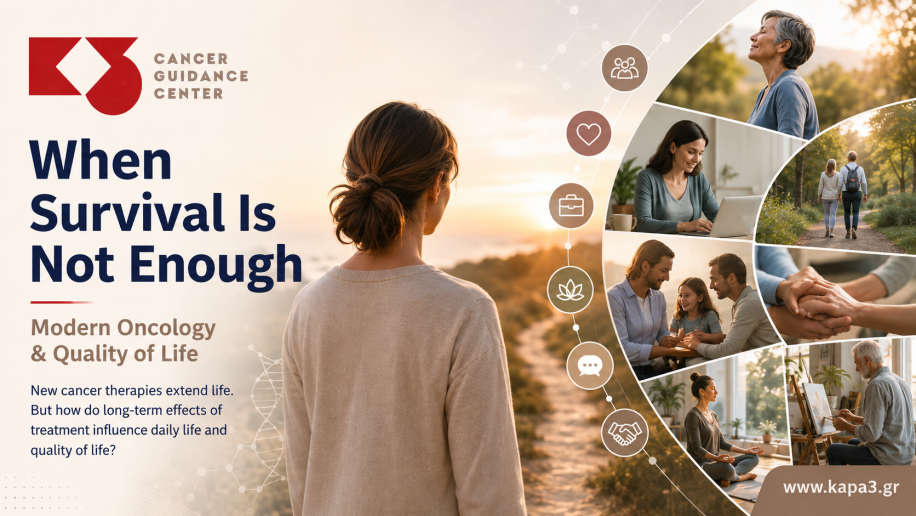
June is dedicated to people living with and beyond cancer. It is a month of recognition, hope and respect for every person who has faced a cancer diagnosis, completed treatment, continues treatment, or lives with cancer as a long-term condition.

Cancer survival is a major victory. However, for many people, it is not the end of the story. Life after cancer often brings a new reality: follow-up appointments, fear of recurrence, fatigue, emotional distress, changes in body image, work-related challenges, financial pressure, family adjustments and the need to rebuild everyday life with confidence and dignity.

Cancer Survivors Month reminds us that survivorship is not only about living longer. It is also about living better.

A cancer survivor is not only a person who has completed treatment and is disease-free. The term also includes people receiving maintenance treatment, people living with cancer as a chronic condition, and those who continue to experience the physical, emotional, social or economic consequences of the disease and its treatment.

In recent years, advances in early diagnosis, targeted therapies, immunotherapy, surgery, radiotherapy and supportive care have increased the number of people living many years after a cancer diagnosis. This is a major achievement for medicine, research and public health. At the same time, it creates a new responsibility: to ensure that survivorship care is organised, person-centred and accessible to all.

For many survivors, the end of active treatment is a moment of relief and gratitude. Yet it may also bring uncertainty. Some people feel that everyone around them expects them to “go back to normal”, while they are still trying to understand what has changed in their body, their emotions, their relationships and their daily life.

The fear of recurrence, anxiety before follow-up tests, persistent fatigue, pain, cognitive difficulties, changes in sexuality, emotional vulnerability and social isolation are real experiences for many people after cancer. These needs should not be underestimated. Survivors need space to speak, reliable information, access to professional support when needed, and connection with communities and organisations that understand their journey.

Long-term follow-up is also essential. Survivorship care should not focus only on recurrence. It should also include prevention, early recognition of late effects, management of treatment-related complications, support for mental health, healthy lifestyle guidance and personalised monitoring according to each person’s cancer type, treatment history, age and individual risk factors.

The message is not fear. The message is awareness, prevention and continuity of care.

Life after cancer is also about rights. It is about returning to work, accessing social benefits, understanding available services, managing financial toxicity, supporting caregivers, protecting dignity and ensuring equal access to care. Survivorship must be seen as a social, psychological and practical issue — not only a medical one.

At Kapa3, we see every day that cancer does not always end with the last treatment. It continues in the questions people ask about their rights, their next steps, their follow-up, their access to benefits, psychological support, work, family life and social reintegration.

This is why people living with and beyond cancer need holistic support. They need information, guidance, psychosocial care, access to rights and services, empowerment and continuity of care. No one should feel alone after treatment. No one should be left to navigate bureaucracy, uncertainty or lack of information without support.

Cancer Survivors Month invites us to change the way we talk about survival. We should not ask only: “Did the person survive cancer?” We should also ask:

Are they living with quality of life?
Do they have access to the care they need?
Do they know their rights?
Do they receive psychological and social support?
Can they return to work and daily life with dignity?
Is there a follow-up plan?
Is there someone to guide them when they do not know where to turn?

Cancer survival is a victory. But the real challenge is to turn this victory into a life with quality, safety, rights, support and hope.

At Kapa3, we continue to stand beside every person living with and beyond cancer. Through information, guidance, empowerment and human-centred support, we believe that care does not stop at treatment.

It continues in life.

Co-Creating Myrto: A Digital Health and Rights Navigator for Cancer Patients

After five years of continuous work supporting cancer patients through digital guidance, the Cancer Guidance Center – Kapa3 is developing a new pioneering project: Myrto.

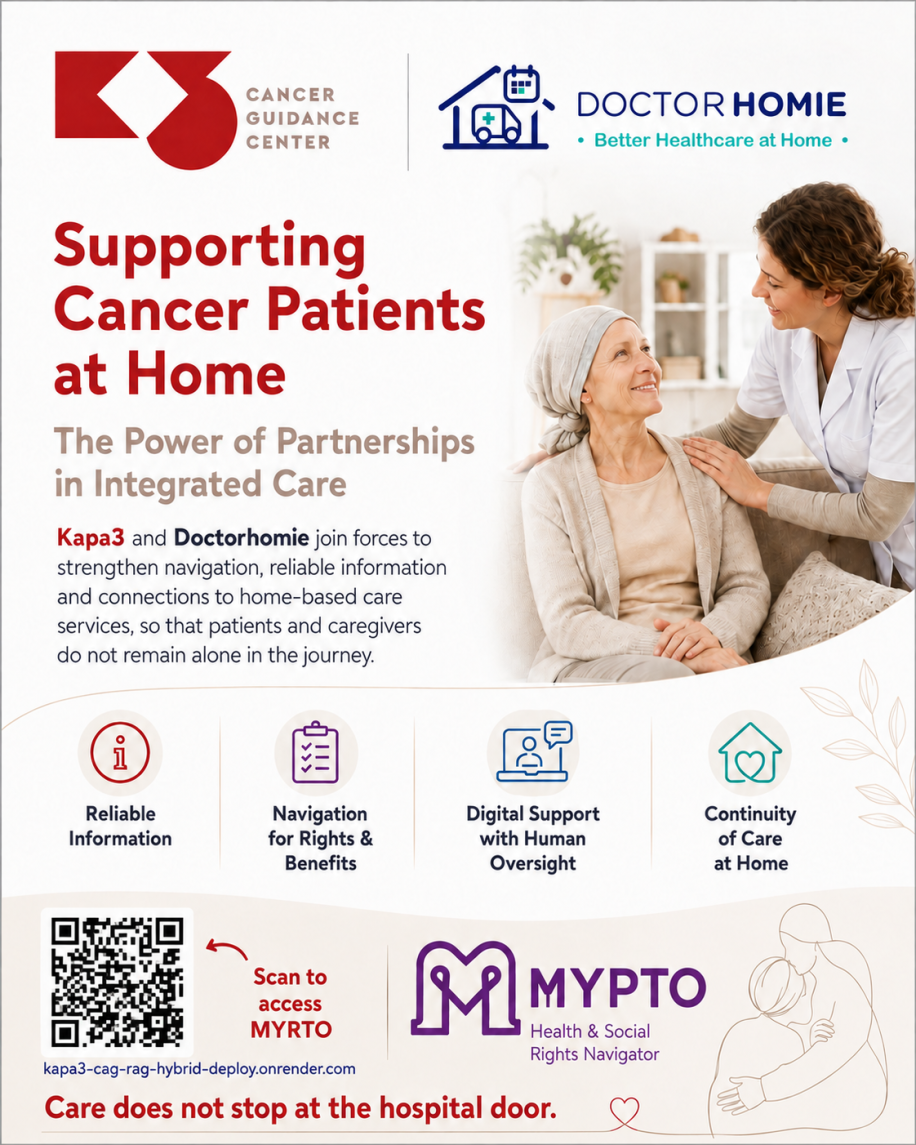
Myrto is a Social Artificial Intelligence intervention in the field of welfare and cancer patient support in Greece. It is an advanced digital tool, integrated into Kapa3’s website, designed to function as a digital health and rights navigator — a Patient Empowerment e-Navigator for people experiencing cancer, their caregivers and the professionals who support them.

Myrto is not limited to simply providing information. Its purpose is to interact, guide and evolve through the real needs of users. With particular attention to accessibility, the psychological dimension of the cancer experience and the everyday reality of patients, Myrto aims to become a human-centred and trustworthy environment for information, empowerment and support.

At Kapa3, we know that the cancer experience is not limited to diagnosis or treatment. It is often accompanied by uncertainty, administrative procedures, the search for rights, the need for social benefits, psychosocial pressure, practical barriers and the need for reliable guidance. For this reason, Myrto is being designed to support people throughout this complex journey in a clear, accessible and understandable way.

The development of Myrto is based on collaboration and co-creation. Recognising the multifaceted work of organisations, professionals and institutions that work daily with vulnerable groups, Kapa3 is inviting partners to contribute to the pilot testing, evaluation and improvement of the tool.

The experience of field professionals is invaluable. Social workers, legal experts, psychologists, healthcare professionals, social care organisations and civil society actors who work closely with people affected by cancer can make a meaningful contribution by identifying the most frequent questions, needs and concerns that emerge in everyday practice.

In this context, Myrto will be developed, tested and evaluated with the contribution of relevant experts, so that it responds to the real needs of cancer patients, caregivers and the professionals who support them. The evaluation will take place both online and in person in different parts of Greece, strengthening participation, accessibility and representativeness.

For Kapa3, technology has value when it serves people. Myrto is not being developed as an isolated technological product, but as part of a broader digital, inclusive and human-centred support framework. Its aim is to strengthen access to information, help patients and families understand available options and rights, and support the work of professionals who stand beside them at every stage of the journey.

The success of the project depends on collaboration. Together with organisations, professionals and communities, we are designing a tool that does not begin with technology, but with people’s real needs.

Myrto is a step towards more accessible, human-centred and equal support for cancer patients. A step that brings together field experience, social care, digital innovation and active participation.

Because real innovation in health and welfare is not only about creating new tools. It is about creating them together with those who understand the real needs.

Participation in CA21152 – Implementation Network Europe for Cancer Survivorship Care

Digital Health and Cancer Survivorship: Kapa3 at the INE-CSC 2026 Conference in Coimbra

The Cancer Guidance Center – Kapa3 participated in the INE-CSC 2026 Conference, part of CA21152 – Implementation Network Europe for Cancer Survivorship Care (INE-CSC), held on 25–26 May 2026 at the Faculty of Medicine (Polo III), University of Coimbra, in Coimbra, Portugal.

The conference was held under the theme “The Next Chapter – Empowering Individuals, Families, and Society for Cancer Survivorship & Supportive Care”, highlighting the need for new approaches to cancer survivorship, supportive care and the translation of innovation into real-world impact for people living with and beyond cancer, their families and society.

Kapa3’s presence in Coimbra represents another important step in its European engagement and in its ongoing effort to connect everyday experience in supporting cancer patients in Greece with European knowledge, research, digital innovation and health policy.

A key highlight was the participation in a round table discussion on facilitators and barriers to the implementation of digital health tools in oncology. The discussion was co-organised by Aristea Kyriaki Ladas and Christos Frantzidis and brought together voices from different European countries and organisations, including representatives from Kapa3, Acreditar Portugal, Liga Portuguesa Contra o Cancro, ORCO / Madrid Regional Ministry of Health, as well as participants from Poland, Latvia and the United Kingdom.

Among the participants in the round table were Yannis Kontogiorgis and Despoina Pistiolis from Kapa3, Greece, contributing to the European dialogue on digital health, oncology navigation and the participatory development of solutions that respond to the real needs of patients and caregivers.

One of the key messages of the discussion was that digital innovation in oncology is not only a technological challenge. It is also a matter of policy, implementation, equity, trust and accessibility.

For digital tools to make a meaningful difference in cancer care and survivorship, they cannot remain isolated applications or pilot projects. They need to become part of real care pathways, be supported by appropriate policy environments, connect with interdisciplinary practice and be evaluated in terms of effectiveness, implementation readiness, accessibility, equity, sustainability and value.

The discussion also highlighted that digital tools must be designed around the real needs of patients and survivors, not only around technical possibilities. Accessibility across countries, languages, healthcare systems and levels of digital and health literacy must be built in from the beginning.

The role of patient organisations and cancer support communities was also identified as essential. These organisations can act as a bridge between technological innovation and the everyday reality of people affected by cancer. They understand the questions, barriers, fears and needs that are often not fully captured by formal care systems.

For Kapa3, this participation is directly linked to the development of Myrto, its digital health and rights navigator, designed as a tool for empowerment, guidance and support for cancer patients and their caregivers.

Myrto is not approached as a simple information tool. It is being designed as a participatory intervention built around the real needs of people with lived experience of cancer. It is connected to access to rights, social benefits, services, practical guidance and human escalation whenever needed.

The Coimbra experience strengthened the view that digital health must be human-centred, accessible, trustworthy and integrated into a broader ecosystem of care. Technology can meaningfully support cancer care only when it is designed with participation, trust, clear purpose and an equity-oriented approach.

Cancer survivorship is not only about completing treatment. It is about quality of life, mental health, social reintegration, work, family, everyday life, access to services and the feeling that no person is left alone after diagnosis or treatment.

Through its participation in European networks such as INE-CSC, Kapa3 continues to contribute to the dialogue on more equitable, participatory and person-centred cancer care. Care that uses technology without losing sight of the human being at its centre.

The future of cancer support will not depend only on better digital tools, but on better collaboration between patients, caregivers, healthcare professionals, researchers, technology partners, patient organisations and policymakers.

For Kapa3, this is at the heart of its mission: transforming knowledge into action, technology into support, and the voice of patients into services that respond to their real needs.

More information: INE-CSC – Implementation Network Europe for Cancer Survivorship Care.More information:
https://inecancersurvivorship.com

6 Awards for Kapa3 at the 4th Vouliagmeni Summer Crossing: Is There Such a Thing as a “Lonely Race”?

The Cancer Guidance Center – Kapa3 participated with great joy and emotion in the 4th Vouliagmeni Summer Swimming Crossing, an important sports and community event organised by the Vouliagmeni Nautical Club.

This year’s participation was particularly meaningful for all of us. The Kapa3 team received 6 awards, sharing a powerful message of participation, endurance, empowerment and togetherness.

But beyond the awards, what we hold most deeply is the message:

Is there really such a thing as a “lonely race”?

For us at Kapa3, the answer lies in our choice. And our choice is togetherness.

Despoina brought the idea — and much more.
Eirini stayed until the very end.

Leoni, Kalliopi, Giorgos, Christoforos, Athina, Christiana and Aria stood together as a true Winning Team.

They competed in every category, participated in every activity, informed, supported and left their own mark of empowerment, endurance and hope.

Leoni, Kalliopi, Giorgos, Christoforos, Athina, Christiana and Aria stood together as a true Winning Team.

They competed in every category, participated in every activity, informed, supported and left their own mark of empowerment, endurance and hope.

For Kapa3, the 6 awards are not only an athletic distinction. They are a symbol. They represent the power of effort, the importance of persistence and the value of community in every difficult journey.

ust as in the sea, the cancer journey requires rhythm, breath, emotional strength and people by our side. Even when a struggle feels personal, it does not have to be — and should never be — lonely.

Kapa3’s participation in the Vouliagmeni Crossing was an act of presence and awareness. It was a way to remind everyone that support for cancer patients, caregivers and families is not limited to information or access to rights and services. It is also about creating a community that stands beside people, encourages them and reminds them that they are not alone.

The sea carries a powerful symbolism. It represents the journey, uncertainty, effort, endurance, but also freedom. Every participant in the Crossing carries their own story, their own effort and their own path. For us at Kapa3, this image is deeply connected to the experience of people affected by cancer.

At Kapa3, we know that the experience of cancer is not limited to treatment. It is connected to everyday life, emotional resilience, access to information, rights, social benefits, transportation, work, family, uncertainty and the need for human presence.

This is why every community action we participate in has a dual purpose: to inform and to unite. To make visible the need for equal access to care, while also reminding everyone that support is not an abstract concept. It is presence. It is care. It is listening. It is guidance. It is the hand that helps someone keep going.

The 4th Vouliagmeni Summer Crossing was another moment of outreach, participation and empowerment for Kapa3. A moment that showed that strength is not found only at the finish line, but also in the decision to start, to try and to keep going.

We are grateful for the support, the care, the participation and the result.

We warmly thank the Vouliagmeni Nautical Club for organising the event, as well as everyone who participated, supported and stood beside us in this initiative.

We continue to choose togetherness at Kapa3.

Because even when a race is individual, it should never be lonely.

Learning by Doing: Participation in the European Service Learning 2.0: CoLab Programme

Learning by Doing: Participation in the European Service Learning 2.0: CoLab Programme

Within the framework of the European programme Service Learning 2.0: CoLab – Erasmus+ Strategic Partnerships KA2, KE: 22707, coordinated by the University of Bucharest, an online workshop and focus group was organised with civil society organisations, focusing on the educational approach of Service-Learning.

Service-Learning is a contemporary experiential learning method that combines academic knowledge with active student engagement in society. Through activities that respond to real social or environmental needs, students develop meaningful skills, strengthen their social awareness and connect theoretical learning with practical action.

The workshop brought together universities and civil society organisations from across Europe, including Université Aix-Marseille, University of Bucharest, University of Salzburg, University of Padova, Sapienza University of Rome, and Eurasianet.eu. The discussion focused on cooperation between universities and NGOs, the exchange of experiences, and the adaptation of practices that can strengthen the social impact of education.

Participation in such initiatives highlights the importance of collaboration between academia, civil society and non-profit organisations.

For Kapa3, the philosophy of Service-Learning is closely aligned with its mission: transforming knowledge into action, empowering people affected by cancer, and building bridges between education, social care and active citizenship.

Through these educational collaborations, the connection between universities and society is strengthened, while new opportunities are created for participatory learning, social innovation and meaningful support for vulnerable groups.

Find more

Flyer – Workshop_ Service Learning (2) Service-learning-key-facts (1)

Service-learning-key-facts (1)

May 27 th 2026 Workshop SL with CSOs

New MELODIC Scientific Publication on the Mental Health of Young Adults with Cancer

Kapa3 participates in the new scientific publication of the European MELODIC project, entitled:

“Educational Needs Regarding Mental Health of Professionals Working with Young Adults with Cancer: A European Survey.”

The publication addresses a highly important issue in contemporary cancer care: the educational needs of healthcare professionals working with young adults with cancer, particularly in relation to recognising and supporting mental health concerns.

Young adults experiencing cancer often face complex psychosocial challenges. Diagnosis, treatment, changes in daily life, impact on studies, work, relationships, body image and future planning can deeply affect their mental health and quality of life.

The European study, involving 271 healthcare professionals from 21 countries, highlighted an important gap between professionals’ willingness to support patients and the systematic use of validated assessment tools. While approximately half of the participating professionals reported feeling confident in identifying mental health issues, only a small percentage reported using validated screening tools.

This finding is particularly important. It shows that awareness and professional experience are valuable, but they are not enough on their own. Targeted education, appropriate tools, interdisciplinary collaboration and clear support pathways are needed so that the needs of young adults with cancer can be recognised early and addressed in a comprehensive way.

The message of the publication is clear: the education of healthcare professionals can make a meaningful difference in the early recognition, support and care of young adults with cancer.

At Kapa3, this approach is a core principle of our work. Before every intervention and every support action, there is education, information and empowerment of the people who stand beside patients.

Kapa3 professionals and collaborators are trained, informed and actively involved in European projects such as MELODIC, ensuring that the support provided is evidence-informed, human-centred and meaningful.

Kapa3’s active participation in such scientific initiatives strengthens its role as an organisation that connects research with practice, European knowledge with real patient needs, and education with everyday care.

We are proud of our participation in the MELODIC project and of our contribution to a European effort that highlights the importance of mental health, early recognition and targeted education in cancer care.

More information: https://lnkd.in/e9Pw4epy