Kapa3 joins the Hellenic Digital Health Cluster (HDHC)

The Cancer Patient Guidance Center – Kapa3 is pleased to announce its participation in the Hellenic Digital Health Cluster (HDHC), strengthening its connection with the Greek digital health ecosystem.

The Kapa3 HDHC collaboration marks the organization’s active integration into a dynamic innovation network. Through this partnership, Kapa3 gains access to a network of 47 innovative organizations, as well as the Foundation for Research and Technology – Hellas (FORTH), aiming to enhance the quality of support services for cancer patients.
The HDHC brings together and connects leading organizations, businesses, and research institutions in the field of digital health in Greece, providing a framework for networking, collaborations, and innovative projects, as well as access to funding and investment opportunities. Its mission is to empower the Greek digital health ecosystem, with the goal of positioning Greece among the leading countries in the sector internationally within the next decade.

Through its participation in HDHC, Kapa3 further strengthens its mission to support cancer patients by adopting modern, technology-driven approaches and innovative practices. As a member, the organization gains the opportunity to take part in events, working groups, and collaborative initiatives, while fostering the exchange of knowledge and expertise with other stakeholders in the ecosystem.

At the same time, this participation creates opportunities for Kapa3 to actively contribute to the development of a sustainable and forward-looking digital health ecosystem in Greece, promoting collaboration, innovation, and shared perspectives towards institutional strengthening of the sector. It also provides access to emerging technologies and best practices that can improve patient experience and enhance the effectiveness of care services.

Through this collaboration, Kapa3 reinforces its role as an organization that connects cancer patient support with the ongoing developments in digital health in Greece and internationally, building bridges between care, technology, and innovation for the community it serves.

You can download our Press Release here 

Text: Ifiyenia Anastasiou for Kapa3
Evangeli Bista on DION TV: Social Support and Kapa3’s Role in Guiding Oncology Patients

On March 19, 2026, Evangeli Bista, Co-founder of Kapa3, gave an interview to Christos Thanasainas, journalist and Scientific Director of Forlife Clinic, on Central Macedonia’s DION TV, during the daily program All About Health, which covers topics on health, nutrition, autoimmune diseases, and recent scientific developments.

The discussion highlighted the importance of social support for cancer patients and their families, both inside and outside the hospital, as well as the critical role of Kapa3 in guiding and providing holistic support to patients.

WHAT IS SOCIAL SUPPORT – TWO WORLDS:

Social support in cancer care is not a single, uniform concept. Inside the hospital, it mainly concerns assistance with the public healthcare system and bureaucratic procedures. Outside the hospital, real life begins: family, caregivers, and decisions the patient must make.

MAJOR SYSTEM CHALLENGES:

As Ms. Bista noted, hospitals face a significant shortage of social workers and related professionals. International literature suggests that there should be 10 social workers for every 2,500 residents—but this is not the case in Greece. In 92 municipalities, there is not a single social worker, while in areas where social workers exist, most are on fixed-term contracts or funded through programs (such as ESIF). The result is a maze of bureaucracy and uncertainty for the patient, who must understand medical and legal terms, make critical decisions, and manage financial consequences—often without support.

THE ROLE OF KAPA3 – SOLUTION, NOT JUST A SERVICE:

In this environment, Kapa3 provides holistic guidance and support, helping patients navigate procedural and practical issues—either independently, if they feel capable, or with active assistance from the organization at every step. Coverage is nationwide, although the complexity and fragmented structure of the system require ongoing study and time for effective support.

THE “HEAVY” MESSAGE – UNDERSTANDING VS. INFORMATION:

As Ms. Bista emphasized:

“The patient doesn’t need more information – they need understanding.”

The process is essentially behavioral: understanding reduces uncertainty, uncertainty reduces anxiety, anxiety affects behavior, and behavior determines health outcomes.

Kapa3 operates within this “maze,” offering holistic guidance and support. Intervention can be supportive, giving patients the ability to act on their own, or active, guiding them step by step. Kapa3 covers the entire country, addressing the growing needs of patients.

THE BIG CHALLENGE: “MYRTO”

“Myrto” represents Kapa3’s major initiative for 2026. After five years in oncology social support, Kapa3 addresses secondary digital exclusion with “Myrto”—a Digital Health Navigator designed to transform knowledge into practical understanding and provide real-time guidance for patients, avoiding the “chaotic wandering” through the healthcare system. The platform is currently in the study and design phase, aiming to meet the real needs of patients and their caregivers.

The interview highlighted the importance of social support, understanding over mere information, and the role of digital technology in modern oncology care. Kapa3 and Myrto strive to bring care from the hospital into patients’ daily lives through a holistic, personalized, and practical approach.

For more information and to watch the full interview, see the video on YouTube here.

(Note: Video in Greek with no English subtitles).

You can dowload our Press Release here

Text/adaptation: Ifiyenia Anastasiou for Kapa3

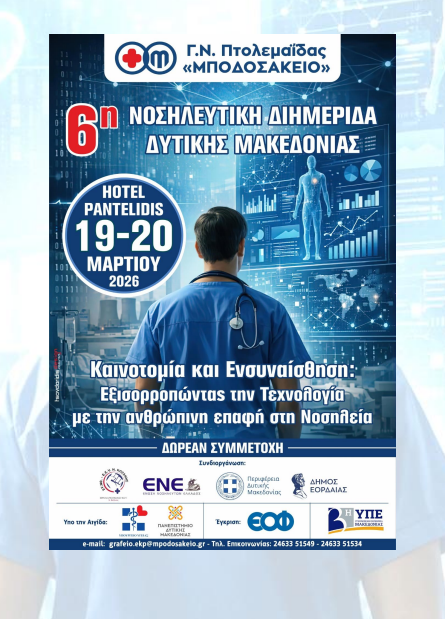
Kapa3’s Contribution to the 6th Nursing Symposium of Western Macedonia: Digital Health, Empathy, and Patient Navigation

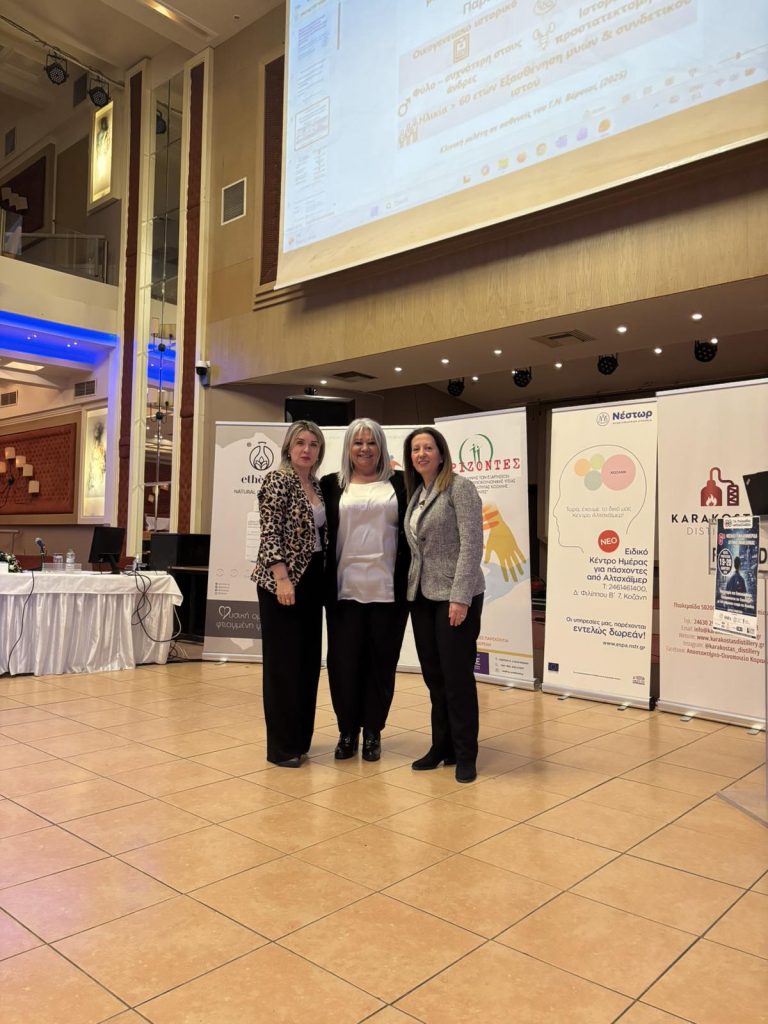
With active participation in a well-established scientific meeting on contemporary nursing issues, Kapa3 took part in the 6th Nursing Symposium of Western Macedonia on “Innovation and Empathy: Balancing Technology with Human Contact in Nursing”, held on March 19–20, 2026, in Ptolemaida.

The Symposium, now a key annual event for the nursing community, serves as a platform for dialogue, knowledge exchange, and highlighting the multifaceted role of nurses in modern healthcare.

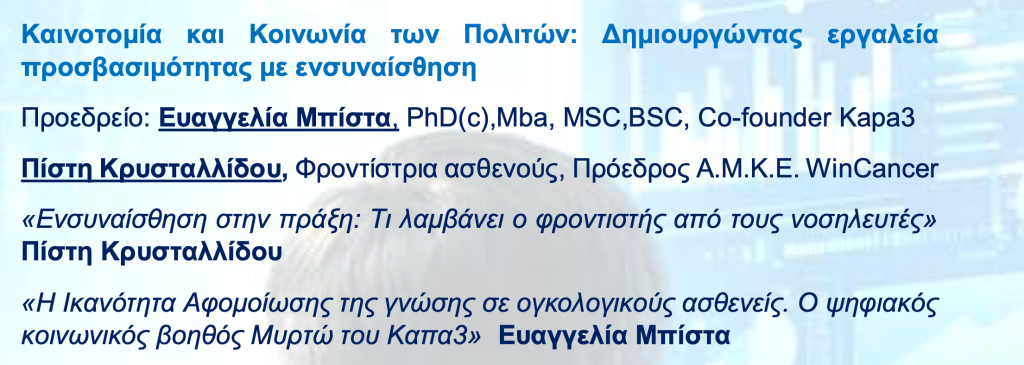
As part of the thematic session “Innovation and Citizen Engagement: Creating Accessible Tools with Empathy”, Ms. Evangeli Bista, co-founder of Kapa3, joined the panel along with Ms. Pisti Krystallidou, President of the NGO WinCancer, showcasing the role of civil society in shaping contemporary, accessible healthcare services.

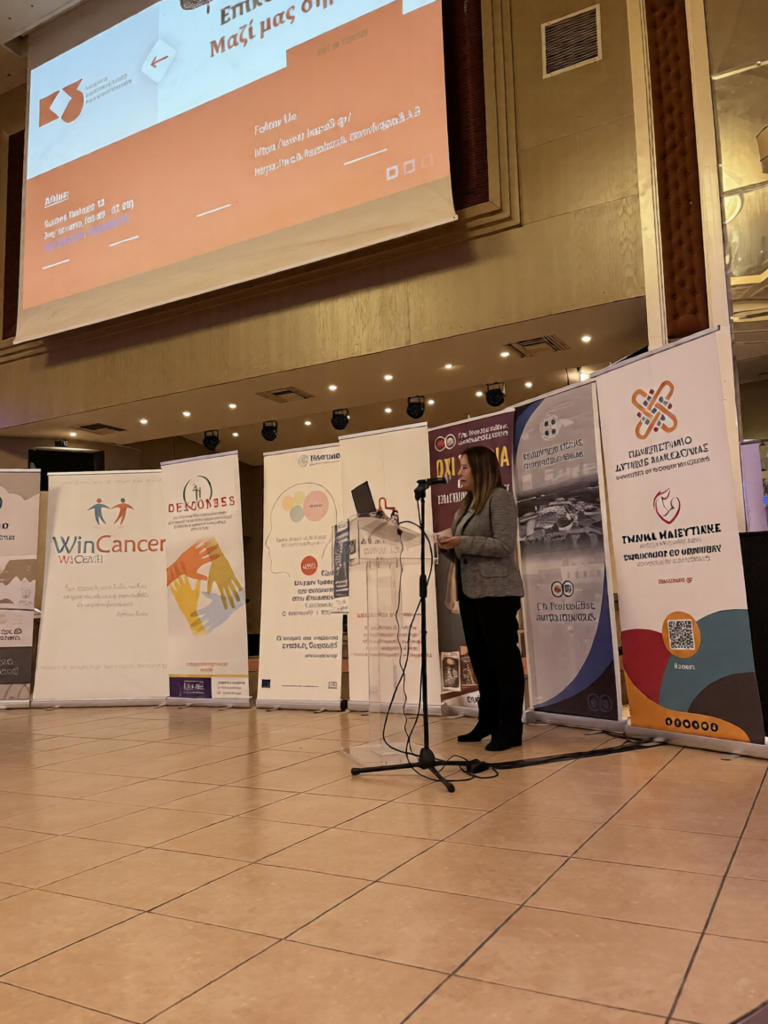
On March 20, Ms. Evangeli Bista and Ms. Pisti Krystallidou actively participated in the Round Table on the same theme. Ms. Krystallidou presented “Empathy in Practice: What the Caregiver Gains from Health Professionals”, highlighting the daily challenges and support needs of people caring for patients. Ms. Bista emphasized Kapa3’s role and the use of digital tools in guiding patients effectively.

During her presentation, Ms. Bista outlined how the healthcare system is transforming: from episodic care to continuous support, from hospital-centered services to daily-life integration, and from the healthcare professional as the sole source of knowledge to the patient as an active participant. In this new environment, digital health and patient navigation go beyond mere tools, focusing on the citizen’s ability to use them meaningfully in everyday life.

Special attention was given to the needs of oncology patients, who require not only access to information but also guidance through a complex healthcare system—knowing where to turn, what they are entitled to, and how to manage critical decisions in daily life. In this context, the importance of patient navigation was highlighted, a model that Kapa3 has implemented since its foundation, acting as a bridge between available services and patients’ real needs.

Finally, the digital social assistant “Myrto was presented, serving as a single reference point for patients, facilitating access to information and services, and translating knowledge into practical, everyday support.

Kapa3’s participation in the Symposium highlighted the importance of combining technological innovation with empathy, confirming that the future of oncology care is not only about personalized treatment but also about personalized understanding of each patient’s needs.

Download our Press Release here 

Text/Adaptation: Ifiyenia Anastasiou for Kapa3

Digital Health Technologies in Europe: New European Commission Report Highlights Opportunities and Challenges

Digital health technologies in Europe are a key pillar in transforming care systems, as highlighted in the new European Commission report (published in 2026), titled “Observatory for Digital Health Technologies in Europe”. The report, prepared for the Directorate-General CONNECT (DG CNECT) by Capgemini Invent and IDC, provides a comprehensive overview of the EU27 digital health market, analyzing both the technology ecosystem and its economic impact.

The report is structured in three main sections. The first focuses on the creation of the Digital Health Technologies Observatory, a strategic tool for monitoring adoption, innovation, and investment in the sector. The second part presents the economic analysis of five selected technologies, while the third contains conclusions and policy recommendations.

The analysis draws on extensive data, including pan-European surveys of healthcare providers and technology companies, expert interviews, mapping of hundreds of providers, and analysis of tens of thousands of investment records. The findings depict a rapidly growing yet fragmented digital health market in Europe.

Artificial intelligence plays a central role in this transformation, with 94% of healthcare providers already adopting or planning to integrate it. Technologies such as Clinical Decision Support Systems (CDSS), automated medical imaging analysis, and digital mental health platforms are highlighted as particularly important for improving care quality and enhancing health system efficiency.

The economic benefits are substantial. CDSS are estimated to enable savings of up to €252 billion over a decade, while automated medical imaging analysis could save up to €192 billion. Similarly, digital mental health platforms support early intervention and reduce the burden on healthcare services, providing significant social and economic benefits.

The report also identifies critical challenges, such as market fragmentation, interoperability issues, and dependence on non-EU providers in strategic areas. Additionally, issues related to digital skills, regulatory frameworks, and equitable access continue to affect the widespread adoption of these technologies.

To address these challenges, the report recommends measures such as strengthening interoperability, supporting small and medium-sized enterprises, promoting innovation in cutting-edge fields (such as AI and genomics), and integrating principles of sustainability, accessibility, and equity.

The positioning of digital health technologies in Europe as a key pillar for the future of care systems is closely linked with initiatives developed at the national level. In this context, Kapa3 invests in digital tools that enhance information, accessibility, and empowerment of oncology patients, such as the “Myrto” Health Navigator. You can read more about it here.

As Europe seeks to build a more resilient and inclusive health system, leveraging digital technologies emerges as a decisive factor in improving patient quality of life and the effectiveness of healthcare services.

Sources:

Text/Adaptation: Ifiyenia Anastasiou for Kapa3

Kapa3 Participation in the 3rd “Mapping the Unknown in Oncology” Conference

Kapa3 actively participated in the conference “Mapping the Unknown in Oncology – From Hospitals to Homes, mapping the future of oncology care”, organized for its third year by the Medical Society for Research and Education under the auspices of HeSMO (Hellenic Society of Medical Oncologists) and the Hellenic Cancer Society, held on February 27–28, 2026 at the Golden Age Hotel in Athens.

During the events on Saturday, February 28, Ms. Evangelí Bista, Head of Operations and Development at the Kapa3 Cancer Patient Guidance Center, took part in the panel titled “e-Health Tools and Educational Platforms: New Paths for Doctors and Patients.” The panel was moderated by Ms. Z. Saridaki and included panelists G. Koukourakis, S. Peroukidis, F. Tyligadas, and Ch. Christodoulou.

In her presentation, titled “Digital Patient Education: The Patient as an Active Partner,” Ms. Bista highlighted the importance of digital transformation in healthcare, which shifts care from episodic to continuous support, moving healthcare from hospitals into patients’ daily lives and empowering patients to become active participants in managing their health.

In this context, Kapa3 announced that for 2026 it will be the only civil society organization fully integrating AI, cybersecurity, and high-performance computing into its processes and services, implementing:

  • An AI-powered digital assistant (chatbot) for immediate patient guidance and support

  • A voice-command system for website accessibility and text-to-speech conversion

  • Service redesign, simplifying processes and reducing bureaucracy

  • An AI-based recommendation system with usage data analysis to personalize services

Special emphasis was placed on patient navigation, as oncology patients need guidance: where to go, what they are entitled to, when to be concerned, and when to wait. Kapa3 addresses this gap, providing not just information but meaningful, personalized guidance within the healthcare system.

The goal is not to add another service but to unite existing services. The next evolution of this model is Myrto, the digital assistant that serves as a reference point, translating knowledge into daily action.

Because the future of oncology is not only personalized treatment but also personalized understanding.

Kapa3’s participation underscores the organization’s commitment to innovation, collaboration, and ethics, demonstrating how technology can significantly enhance the experience and care of oncology patients.


Kapa3 at Athens Digital Health Week 2026 – The Role of Patient Digital Navigators in Healthcare Digital Transformation

As part of Athens Digital Health Week 2026, Kapa3, as a new member of the Hellenic Digital Health Cluster (HDHC), participated in the closed members and partners meeting as well as the panel discussion titled “Synergies to Bridge the Needs of Healthcare Services in Digital Transformation,” presenting the role of patient digital navigators and exploring how digital technologies can strengthen a patient-centered healthcare system.

The discussion focused on a key question: how can available digital solutions effectively address the real needs of the healthcare and social care system?

Special emphasis was placed on the importance of interoperability, evidence-based decision-making, transparency, and comparability, as well as connecting research and governance, promoting equality, and considering the impact of artificial intelligence in the modern healthcare ecosystem.

Kapa3 was represented by Evangeli Bista, who highlighted the critical role of patient organizations in successfully integrating digital technologies into the care journey.

As she noted:

“Digital health is not only about developing technological solutions, but about their meaningful integration into the patient’s care journey. Civil society organizations (patients, caregivers, friends, professionals) can play a crucial role as adoption partners, contributing to design, implementation, and evaluation. Through collaboration within the Cluster, an ecosystem is strengthened where innovation translates into real accessibility and continuity of care with maximum social impact. For the Cancer Patients Guidance Center – Kapa3, developing its role as patient digital navigators can only happen through such synergies.”

The panel also included representatives from Affidea Greece, Gnomon Informatics SA, and REA Maternity & Gynecology Clinic, who contributed their expertise to a productive dialogue on aligning technology, clinical practice, and data governance.

During the closed meeting, the need to strengthen joint research initiatives, interoperability, and systematic collaboration among ecosystem members was emphasized, ensuring that innovation translates into measurable value for both patients and the healthcare system.

For Kapa3, developing its role in the digital health ecosystem as patient digital navigators is a strategic priority. Through such collaborations, patient organizations are empowered to actively contribute to a more transparent, equitable, and truly patient-centered healthcare system, where technology serves as a tool for empowerment rather than an end in itself.

Download our Press Release in pdf or word

Cancer is increasingly becoming a highly manageable disease

In the Sunday edition of To Vima newspaper and Vita magazine (25 January 2026), the views of Ms Evangeli Bista, co-founder of Kapa3, were featured, shedding light on the landscape of modern oncology and the challenges emerging within the current Greek healthcare reality.

Ms Bista addressed the Greek context and highlighted the importance of digital technology as a cornerstone of modern health policy, particularly in the field of cancer care, where treatment pathways are complex, long-term, and deeply person-centred. As she noted, Greece has already made measurable progress: electronic and paperless prescribing, oncology registries, the National Electronic Health Record, and applications such as MyHealthApp are creating the conditions for more coordinated and transparent care. When healthcare professionals, as well as patients themselves, are equipped with appropriate digital skills, patient autonomy is strengthened, treatment outcomes improve, and inequalities—especially those affecting vulnerable population groups—are reduced.

The article is co-authored by distinguished scientists and collaborators: Maria Gazouli, Professor of Biology, Genetics and Nanomedicine at the Medical School of the National and Kapodistrian University of Athens and national representative on the Committee for Advanced Therapies of the European Medicines Agency; Manolis Saloustros, Associate Professor of Oncology at the University of Thessaly and President of the Hellenic Society of Medical Oncology (HESMO); and Christos Frantzidis, Assistant Professor of Informatics and Machine Learning at the University of Lincoln in the United Kingdom.

The contributing experts underline that modern oncology increasingly approaches cancer as a largely manageable chronic disease, through targeted and personalised therapies. The use of innovative technologies—such as next-generation sequencing, mRNA vaccines, PARP inhibitors and cellular therapies—has significantly expanded therapeutic options. At the same time, prognosis is becoming more dynamic and individualised through the use of multi-omics profiling, machine learning algorithms and liquid biopsy techniques. Particular emphasis is placed on the early integration of palliative care and psychosocial support, which play a crucial role in improving patients’ quality of life. Finally, the importance of structured and coordinated healthcare services is highlighted, with the medical oncologist acting as a key coordinator of person-centred care.

Beyond documenting technological advances, the article opens a broader discussion on the digital transition in oncology care, addressing issues of access, meaningful use of data and the need for coordination across different scientific disciplines. Digital health is presented not as an end in itself, but as a tool that requires collaboration, institutional maturity and a shared vision in order to deliver real value to patients.

The overarching message is clear: every step, whether small or large, matters. Progress in oncology is not the result of isolated actions, but of collective effort. Through collaboration among scientists, healthcare professionals, organisations and patients, the conditions for meaningful and sustainable change can be created—always with the human being and their real needs at the centre.

Download our Press release here:  KAPA3_VIMA

Text / Adaptation: Ifiyenia Anastasiou for Kapa3

Kapa3 at the 6th Interdisciplinary Conference “Brain & Mind”

Kapa3 actively participated in the 6th Interdisciplinary Conference “Brain & Mind”, held from December 18 to 20, 2025, at the Book Tower of the Stavros Niarchos Foundation Cultural Center in Athens. The conference brought together scientists, healthcare professionals, and civil society organizations to highlight current challenges and solutions in neuroscience, psychology, and digital health.

During the Round Table “Digital Health and Artificial Intelligence: Current Challenges”, Kapa3 presented its approach to the human-centered dimension of digital healthcare. Litsa Bista emphasized the importance of digital literacy for patients and healthcare professionals, noting that:

Digital technology is evolving as a core pillar of modern, safe, and human-centered care, particularly in oncology. When patients and healthcare professionals have the appropriate digital skills, stress is reduced, access to reliable information is enhanced, treatment outcomes improve, and patient autonomy is strengthened. Reducing inequalities for vulnerable individuals remains a top priority for all of us.

Particular focus was placed on patients’ daily experiences, a key aspect of the therapeutic process. Support for mental resilience, self-management through digital applications, and strengthening self-confidence and self-efficacy were central messages of the intervention, highlighting the value of collaboration with healthcare professionals to achieve reliable, high-quality outcomes.

The discussion also highlighted the main challenges of digital health in Greece, including fragmented applications, difficulties in implementing hi-tech solutions in outdated systems, algorithmic complexity, and the need for transparency. Kapa3’s approach focuses on system interoperability, collection of high-quality patient data, and creation of services that truly meet patients’ needs, ensuring that technology serves people, not the other way around.

Kapa3’s participation in the conference reflects its ongoing commitment to contributing to the public discourse on the ethical, functional, and human-centered use of Artificial Intelligence and digital tools, always keeping the patient and quality care at the center.

Text/Adaptation: Ifiyenia Anastasiou for Kapa3