Memorandum of Understanding between the University of West Attica—specifically the Department of Occupational Therapy—and the NGO KAPA3.

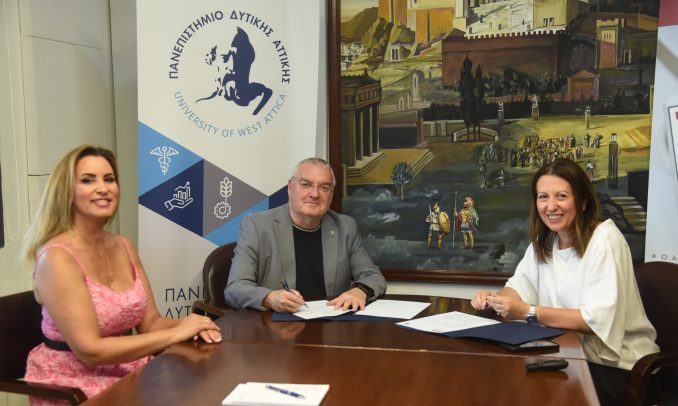
On Tuesday, June 9, a meeting was held to sign a Memorandum of Understanding between the University of West Attica—specifically the Department of Occupational Therapy—and the NGO KAPA3.

The meeting was attended by the Rector of the University of West Attica, Panagiotis Kaldis Penelope Vlotinou, Assistant Professor in the Department of Occupational Therapy Evangelia Bista, co-founder of the organization, as well as representatives from both organizations, including the interdisciplinary team of KAPA3: Despoina Chrysostomou, Psychologist Katerina Georgiopoulou, Social Worker Yiannis Kontogiorgis, Psychologist, and Eleftheria-Irini Polyzoti, an intern from the Department of Social and Educational Policy, as well as students from the Occupational Therapy Department.

During the meeting, a constructive discussion took place regarding the prospects for cooperation between the two organizations, with the aim of developing joint actions and initiatives that will contribute to strengthening education, research, social contribution, and the connection between the academic community and society.

In this context,  it was decided in April to jointly organize a major scientific conference, which will focus on an interdisciplinary and holistic approach to health, on combating social inequalities in healthcare, as well as on the management of chronic disease. The aim of this initiative is to raise community awareness, facilitate the exchange of expertise among professionals and scientific bodies, and disseminate scientific knowledge and information to the general public.

Special mention was made of the innovative work of KAPA3, the digital Health Navigator “Myrto,” a modern artificial intelligence tool currently under development and designed to support cancer patients, their families, and their caregivers. “Myrto” will function as a digital assistant (Chatbot) and Health and Rights Navigator, providing immediate, reliable, and personalized information on health, social welfare, rights, benefits, and available support services. The project aims to empower patients, improve their access to information, and reduce inequalities in health and social care through the use of digital technologies and artificial intelligence applications. The development of “Myrtos” represents a pioneering application of social artificial intelligence in the field of oncology care in Greece and is part of KAPA3’s strategy to promote innovation, accessibility, and the active participation of patients in managing their own health.

The meeting concluded in a particularly positive atmosphere of mutual appreciation and recognition. In this context, the Department of Occupational Therapy at the University of West Attica made a symbolic gesture toward the representative of KAPA3, Evangelia Bista, presenting her with a commemorative gift as a token of appreciation for her many years of valuable social contribution in the field of support for cancer patients. At the same time, as a gesture of hospitality and appreciation, the team was offered a specially produced wine, which is an original creation of the University of West Attica.


Cancer is increasingly becoming a highly manageable disease

In the Sunday edition of To Vima newspaper and Vita magazine (25 January 2026), the views of Ms Evangeli Bista, co-founder of Kapa3, were featured, shedding light on the landscape of modern oncology and the challenges emerging within the current Greek healthcare reality.

Ms Bista addressed the Greek context and highlighted the importance of digital technology as a cornerstone of modern health policy, particularly in the field of cancer care, where treatment pathways are complex, long-term, and deeply person-centred. As she noted, Greece has already made measurable progress: electronic and paperless prescribing, oncology registries, the National Electronic Health Record, and applications such as MyHealthApp are creating the conditions for more coordinated and transparent care. When healthcare professionals, as well as patients themselves, are equipped with appropriate digital skills, patient autonomy is strengthened, treatment outcomes improve, and inequalities—especially those affecting vulnerable population groups—are reduced.

The article is co-authored by distinguished scientists and collaborators: Maria Gazouli, Professor of Biology, Genetics and Nanomedicine at the Medical School of the National and Kapodistrian University of Athens and national representative on the Committee for Advanced Therapies of the European Medicines Agency; Manolis Saloustros, Associate Professor of Oncology at the University of Thessaly and President of the Hellenic Society of Medical Oncology (HESMO); and Christos Frantzidis, Assistant Professor of Informatics and Machine Learning at the University of Lincoln in the United Kingdom.

The contributing experts underline that modern oncology increasingly approaches cancer as a largely manageable chronic disease, through targeted and personalised therapies. The use of innovative technologies—such as next-generation sequencing, mRNA vaccines, PARP inhibitors and cellular therapies—has significantly expanded therapeutic options. At the same time, prognosis is becoming more dynamic and individualised through the use of multi-omics profiling, machine learning algorithms and liquid biopsy techniques. Particular emphasis is placed on the early integration of palliative care and psychosocial support, which play a crucial role in improving patients’ quality of life. Finally, the importance of structured and coordinated healthcare services is highlighted, with the medical oncologist acting as a key coordinator of person-centred care.

Beyond documenting technological advances, the article opens a broader discussion on the digital transition in oncology care, addressing issues of access, meaningful use of data and the need for coordination across different scientific disciplines. Digital health is presented not as an end in itself, but as a tool that requires collaboration, institutional maturity and a shared vision in order to deliver real value to patients.

The overarching message is clear: every step, whether small or large, matters. Progress in oncology is not the result of isolated actions, but of collective effort. Through collaboration among scientists, healthcare professionals, organisations and patients, the conditions for meaningful and sustainable change can be created—always with the human being and their real needs at the centre.

Download our Press release here:  KAPA3_VIMA

Text / Adaptation: Ifiyenia Anastasiou for Kapa3