New National Patient Registry for Hospital-at-Home Care (NOSPI)

Patient care at home in Greece is becoming more organized and secure with the establishment of the National Registry of Patients Receiving Hospital-at-Home Care (NOSPI), as published in Government Gazette 1995/07.04.2026. The NOSPI program is already in pilot implementation at selected hospitals nationwide, with the goal of full development and operation by the end of 2026, including a digital platform and patient registry.

The new registry aims to systematically record patients receiving NOSPI services, ensuring that care is tailored to individual therapeutic needs. Patient groups eligible for inclusion include, among others, those with tracheostomies, on non-invasive mechanical ventilation, receiving long-term oxygen therapy, on parenteral or gastrostomy feeding, as well as those requiring intensive physiotherapy or mobility rehabilitation. Currently, enrollment primarily focuses on children with severe health conditions and chronically ill patients needing pulmonary care, in collaboration with pilot Reference Centers.

While the NOSPI program is already operating in a pilot phase, universal access for all patients in the country has not yet been achieved. Its development is gradual, with full operation—including digital infrastructure and registry-based documentation—planned by the end of 2026. Strengthening Hospital-at-Home care enables better monitoring and improvement of home care services for patients with long-term needs.

Through the registry, authorities can collect accurate and essential health data, enhancing the quality of services and supporting the design of targeted health policies. Implementation respects personal data protection in line with the General Data Protection Regulation (GDPR), ensuring transparency and public trust.

For families and caregivers, patient enrollment in the NOSPI National Registry means access to more coordinated care, with support delivered directly to their homes. Furthermore, documentation helps evaluate and improve home nursing services, enhancing patient safety and quality of life.

This initiative, combined with the development of the digital platform and registry, aims not only to upgrade home care services but also to reduce hospital congestion and ensure high-quality services for all patients in the future.

Sources (text in Greek) : Government Gazette NOSPI, ODIPY

Text/adaptation: Ifiyenia Anastasiou for Kapa3

Launch of Free MELODIC Training Programme – Greece

We are pleased to announce the launch of the free eight-week online training programme implemented in Greece within the framework of the European project MELODIC, in which Kapa3 participates as one of 13 partner organisations from 6 European countries.

The programme is addressed to doctors, nurses, other health professionals, and social care professionals working in oncology.

MELODIC is an international collaboration aimed at strengthening mental health support for young adults with cancer and their families, promoting high-quality, holistic oncology care.

Through the programme, participants will have the opportunity to develop skills in:

  • Assessing mental health needs using validated and evidence-based tools

  • Supporting families and caregivers

  • Delivering high-quality psychosocial care

  • Interprofessional collaboration

  • Sustaining personal and professional wellbeing

The programme is divided into an asynchronous part (on the Moodle platform), which participants can complete at their own pace, and four contact lessons, constituting the synchronous part via Zoom. Upon completion, participants will receive 5 ECTS credits and a certificate of completion.

Sessions will take place from March to April 2026.

The contribution of health professionals is crucial for the accurate assessment of mental health needs of young adults with cancer and their families, as well as for delivering high-quality, person-centred care. The MELODIC programme strengthens their skills, promoting collaboration, responsibility, and sustainable professional practice in oncology.

For further information, please contact:
Ifiyenia Anastasiou
email: ifi.k3team@gmail.com | phone: 690.62.65.170

The Impact of the Kapa3 Internship Programme: 30 Young Professionals in Our First 5 Years of Operation

The Impact of the Kapa3 Internship Programme: 30 Young Professionals in Our First 5 Years of Operation

In the five years since our establishment, thirty young people have had the opportunity to learn and grow through the Kapa3 Internship Programme.

International scientific literature highlights that internships are far more than a first work experience. They serve as a fundamental mechanism of experiential learning, enabling students to connect theoretical knowledge with real-world professional contexts.

Through their involvement in a civil society organisation like Kapa3, interns developed reflective and critical thinking skills—core elements of modern professional education. By engaging with real needs and challenges, students strengthened their professional identity and gained a deeper understanding of their role as future practitioners in health and social services. In many cases, the internship at Kapa3 played a significant role in supporting their transition from university to the labour market, enhancing their confidence, social skills, and clarity of professional direction.

Furthermore, the structured field experiences offered opportunities to build professional networks, a key factor in long-term career development.

At Kapa3, the value of internships is evident across all aspects of our work. We strive to create an environment where students can deepen their academic knowledge, apply their skills to real cases, and map out the next steps of their careers with realism and self-awareness.

The result is a community of young professionals who are both socially conscious and scientifically equipped to contribute meaningfully to health and social care. We are proud to be at the forefront of education and warmly thank our partner universities for their trust and collaboration.


Biomarkers Open New Paths in Cancer Treatment in Greece

Good news for cancer patients in Greece — access to personalized treatments is now becoming a reality.

A recent decision by the Ministry of Health (ΦΕΚ Β’ 5627/20-10-2025, Απόφαση Δ3(α) 41081/2025) approves and reimburses a wider range of biomarker tests, marking an important step forward for modern oncology care.

Read the Government Gazette here

But what are biomarkers?
They are special indicators detected through molecular tests that help doctors understand the unique characteristics of each patient’s cancer. In simple terms, biomarkers act like a “compass,” guiding doctors to choose the most effective and safest treatment for every individual.

Until now, only a few biomarkers were covered by the public health system — for example, molecular signatures that determine whether a woman with early-stage breast cancer needs chemotherapy (approved in 2018), or BRCA1/2 gene tests that reveal inherited risk for breast and ovarian cancer.

The new decision significantly expands this list, adding additional biomarkers for 39 indications. This allows oncologists to tailor treatments to the specific profile of each patient’s tumor, bringing Greece closer to international standards of personalized medicine.

KAPA3, which consistently supports patient education and empowerment, welcomes this development as a vital step toward more human-centred, targeted care.

This progress brings hope, better quality of life, and greater trust in the healthcare system. It is only the beginning, but it lays strong foundations for a future where every patient has access to the right treatment, at the right time.

Learn about patient rights via KAPA3’s extensive library here

Learn more about cancer biomarkers here

Text/Adaptation: Ifiyenia Anastasiou for Kapa3

Depression and Cancer Mortality: A Critical Link Across Major Cancer Types

Depression is a common but often underrecognized condition among cancer patients, affecting up to 20–30% of individuals diagnosed with the disease. Beyond its impact on quality of life, mounting evidence suggests that depression can significantly influence cancer outcomes, including survival. A recent meta-analysis of 65 cohort studies spanning colorectal, breast, lung, prostate, and mixed cancers provides compelling evidence that depression diagnosed after a cancer diagnosis is associated with a substantially increased risk of mortality.

The analysis revealed that patients with depression faced an 83% higher risk of dying from colorectal cancer, a 59% higher risk in lung cancer, a 74% higher risk in prostate cancer, and a 23% higher risk in breast cancer compared to non-depressed patients. Across mixed cancer types, depression increased the risk of cancer mortality by 38%. These findings underscore that the psychological burden of cancer is not merely an emotional challenge but a critical factor affecting survival outcomes.

Mechanisms Linking Depression and Cancer Outcomes

Depression may influence cancer progression through multiple biological and behavioral pathways. Biologically, depression is associated with chronic systemic inflammation, dysregulation of the hypothalamic-pituitary-adrenal (HPA) axis, immune suppression, autonomic dysfunction, oxidative stress, and impaired DNA repair. Elevated pro-inflammatory cytokines, including interleukin-6 (IL-6) and tumor necrosis factor-alpha (TNF-α), can contribute to tumor growth and metastasis. In older patients, depression may exacerbate age-related immune dysfunction, creating an environment more permissive to cancer progression.

Behaviorally, depression affects health-related actions and treatment adherence. Depressed patients are more likely to delay seeking medical care, adhere poorly to chemotherapy, radiotherapy, and hormonal therapies, and engage in unhealthy habits such as smoking, poor nutrition, and physical inactivity. Social isolation and reduced support systems further increase vulnerability, compounding the negative impact on survival.

Clinical Implications and Interventions

The strong association between depression and cancer mortality highlights the urgent need to integrate mental health care into routine oncology practice. Psychological interventions, such as cognitive-behavioral therapy (CBT), supportive-expressive therapy, and mindfulness-based approaches, have shown promise in reducing distress and improving adherence to cancer treatment. Pharmacological management, including selective serotonin reuptake inhibitors (SSRIs), may also support mental health and potentially influence cancer outcomes, though more research is needed to understand their role fully. Early identification and treatment of depressive symptoms should be considered a priority for oncologists, mental health professionals, and healthcare policymakers alike.

Limitations and Future Directions

While this meta-analysis provides robust evidence, several limitations should be noted. The observational nature of the studies prevents establishing causality, and differences in study design, depression assessment methods, and patient populations contribute to heterogeneity. Future research should explore longitudinal and randomized studies to clarify causal pathways and identify the most effective interventions to reduce depression-related mortality. Investigating the interactions between depression, inflammation, and cancer biology may also reveal targets for novel supportive therapies.

Depression is not just a psychological burden for cancer patients—it is a significant predictor of mortality across multiple cancer types. These findings call for systematic depression screening and tailored interventions as integral components of oncology care.

Organizations like Kapa3 play a vital role in supporting the mental health of cancer patients, offering resources and guidance that can improve both quality of life and treatment outcomes. Integrating psychological support into cancer care ensures that mental well-being is recognized as an essential part of the healing process.
In line with this mission, Kapa3 participates in MELODIC, a new European initiative dedicated to supporting the mental health of young adults (18–30 years old) living with or beyond cancer.

Read the original article here

Read more on MELODIC project here

Explore more about mental health through a selection of articles on our website: article1 article2,article3, article4, article5, article6 

Text/adaptation: Ifiyenia Anastasiou for Kapa3


The Power of Social Support in Cancer Care

Why connection is as vital as treatment

Mental health professionals consistently emphasise the value of a strong social support network. Social support is among the strongest predictors of emotional well-being and overall quality of life. It refers to the extent to which our social and emotional needs are met through the people and communities around us, such as family, friends, colleagues, and groups that share our values and experiences.

Group interventions, for example, have been shown to reduce psychological stress by providing individuals with chronic illnesses the opportunity to connect and share experiences (Jackson et al., 2019).  Studies have found that cancer patients who felt more supported by family, friends, or their community experienced less distress, coped more effectively, and had a greater sense of control during treatment. Tangible support, in particular, was more significant for older patients, who may face greater physical challenges due to age or disability (Ahmad et al., 2013).

Furthermore, social support fosters optimism and resilience, which are key factors that help patients adapt to illness. By strengthening hope and inner confidence, social connections help protect against anxiety and depression, acting as a buffer against the emotional impact of stress (Ruiz-Rodríguez et al., 2022).

But what comes first — support or coping? The systematic review by Bottaro and colleagues (2023) suggests the relationship is bidirectional: people who receive strong support cope better, and those who cope better are more likely to seek and maintain strong relationships. It’s a cycle of connection that reinforces recovery.

The source of support also plays a crucial role. Patients often view family, friends, and partners as the most important sources of support for coping with diagnosis and treatment. However, when the type of support offered doesn’t align with the patient’s needs, it can feel less meaningful or even unhelpful.

While loved ones form the core of emotional care, healthcare professionals are often the first and most consistent source of reassurance. According to the literature, patients who feel heard, respected, and well-informed by their medical team cope more effectively and experience less anxiety. Ruiz-Rodríguez and colleagues highlight that optimism and resilience grow when medical staff communicate openly and offer encouragement. Compassionate communication from healthcare providers strengthens patients’ ability to manage their illness, creating a positive feedback loop between support and wellbeing (Bottaro et al., 2023).

At Kapa3, we witness this truth daily. Through our community programs, research, and advocacy, we work to create environments where no one faces cancer alone. Social support is not only emotional, it’s practical, cultural, and profoundly human. Healing doesn’t happen only in hospitals; it happens in homes, workplaces, and communities.

 References

Ahmad, M., Khan, M. A., & Shirazi, M. (2013). Perception of Social Support by Cancer Patients. International Journal of Psychology and Behavioral Sciences3(5), 115–122. https://doi.org/10.5923/j.ijpbs.20130305.01

Bottaro, R., Craparo, G., & Faraci, P. (2023). What is the direction of the association between social support and coping in cancer patients? A systematic review. Journal of Health Psychology28(6), 135910532211311. https://doi.org/10.1177/13591053221131180

Jackson, M., Jones, D., Dyson, J., & Macleod, U. (2019). Facilitated group work for people with long-term conditions: A systematic review of benefits from studies of group-work interventions. British Journal of General Practice69(682), 363–372. https://doi.org/10.3399/bjgp19x702233

Ruiz-Rodríguez, I., Hombrados-Mendieta, I., Melguizo-Garín, A., & Martos-Méndez, M. J. (2022). The importance of social support, optimism and resilience on the quality of life of cancer patients. Frontiers in Psychology13. https://doi.org/10.3389/fpsyg.2022.833176


Article by: Despina Chrysostomidou, Psychologist for Kapa3 Research Insights


Raising the Standards: Europe’s QA Scheme for Breast Cancer Services

The European Quality Assurance (QA) Scheme for Breast Cancer Services, part of the European Commission Initiative on Breast Cancer (ECIBC), is a voluntary certification program covering the full care pathway—from screening to palliative care.

Designed to support quality improvement across Europe, it provides evidence-based guidelines and common quality and safety requirements.

The scheme has been piloted in multiple European countries, confirming its feasibility and usefulness in real healthcare settings. Services meeting the standards can apply for accredited certification, ensuring consistent, high-quality care.

The program is coordinated by the Joint Research Centre (JRC) in collaboration with DG SANTE, under Europe’s Beating Cancer Plan.

To learn more, click here 

October – Breast Cancer Awareness Month

October is internationally recognized as Breast Cancer Awareness Month, a time dedicated to education, prevention, and support for everyone affected by the disease. Breast cancer remains the most common cancer among women worldwide, yet early diagnosis and advances in treatment have significantly improved both quality and length of life.

The event began in 1985 as a week-long awareness campaign by the American Cancer Society, in partnership with Imperial Chemical Industries, a British company that made tamoxifen. The campaign eventually grew into a month-long event.

The core message of this month is simple but crucial: awareness saves lives. Regular mammograms, self-examinations, and timely medical advice when suspicious signs appear are the most powerful tools for prevention and early detection. International studies show that women who participate in screening programs are more likely to be diagnosed at an early stage, allowing for more effective and less invasive treatment.

However, October is not just about medical tests. It is a month that highlights the importance of psychosocial support and solidarity. Breast cancer affects not only the body but also the mind and spirit. Women – and men – facing this diagnosis need a supportive network of family, friends, healthcare professionals, and organizations to guide, encourage, and stand by them every step of the way.

The Kapa3 Cancer Guidance Center joins the international community in emphasizing the value of accurate information and equitable access to healthcare services. Through informative articles, prevention guides, and psychological support, our goal is to stand by every person in need, providing reliable knowledge and meaningful assistance.

Breast Cancer Awareness Month is more than a campaign: it is a reminder that life can be won when prevention, education, and solidarity become part of our daily practice. October calls on all of us to raise our voices, promote screening, and embrace those fighting their own battles—because no one should face cancer alone.

Kapa3 participation in the MELODIC consortium meeting in Lisbon

We are delighted to announce that Kapa3 had the opportunity to take part in the recent MELODIC consortium meeting, which was held in Lisbon. Although our participation was online, it was in real time, and our team contributed actively to the discussions, which focused on the development of the training program for healthcare professionals and the design of the intervention study, both aiming to support the mental health of young adults living with cancer.

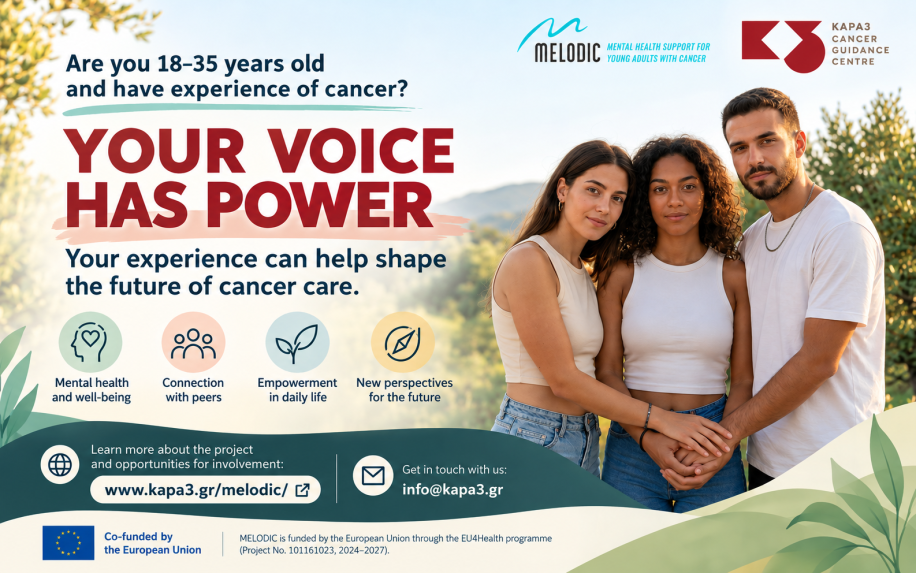
The MELODIC project, funded by the EU4HEALTH program with a total budget of €1.8 million, addresses a critical yet often overlooked issue: the mental health of young adults aged 18–35 living with cancer.

During the meeting, partners exchanged experiences and findings from European research and interviews with healthcare professionals, families, and young adults with cancer. These insights strengthened collaboration and the formulation of strategies for timely psychosocial support.

Next spring, the project will launch the intervention phase, focusing on social prescribing and the use of green and blue spaces—harnessing the power of nature and community to promote well-being.

Kapa3 continues to work closely with its European partners to ensure a meaningful impact on the lives of young adults facing cancer.

Read more on the Melodic project here