Co-creation in health research: from participation to meaningful influence

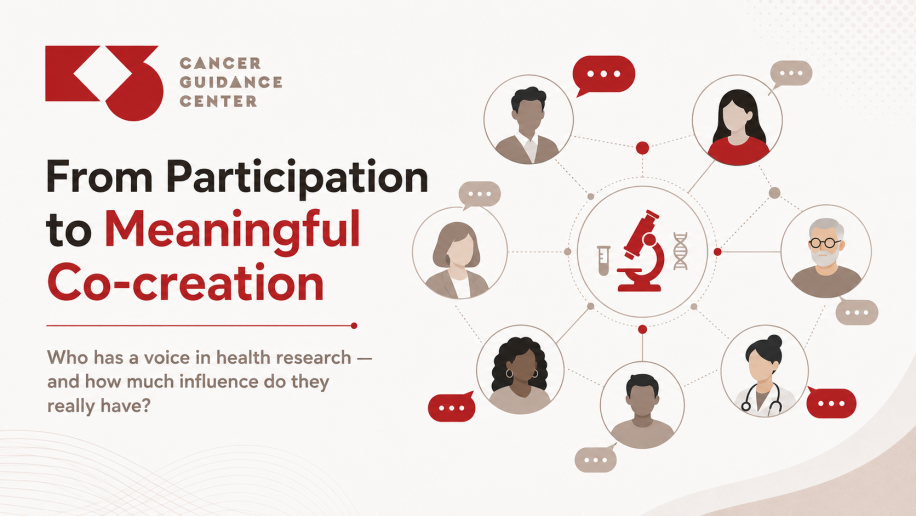
Co-creation in health research: from participation to meaningful influence

A new scientific study proposes a framework for understanding who participates in research, when they participate, how they contribute — and how much influence they actually have

Co-creation is becoming increasingly important across public health, research, social innovation and the design of healthcare services. Patients, caregivers, citizens, healthcare professionals, researchers and communities are more frequently being invited to contribute to the development of interventions, services and solutions.

Yet an important question remains:

What does “participation” actually mean?

The presence of a patient or community representative in a meeting does not necessarily mean that they can influence the design, decisions or outcomes of a research project. Similarly, being asked to complete a survey is fundamentally different from helping to design an intervention, interpret findings or determine how results are shared.

A new open-access study, published on 19 August 2026 in the Journal of Public Health, addresses this challenge. Katrina Messiha, Mai J. M. Chinapaw, Johannes C. F. Ket, Renée I. Wink and Teatske M. Altenburg developed the Co-creation Roles Framework, an operational framework designed to systematically describe and classify the roles of different stakeholders in co-creation research.

Moving beyond “who was involved?”

One of the study’s most valuable contributions is its shift away from simply recording whether stakeholders participated towards examining the nature, depth and quality of that participation.

The framework captures eight key dimensions:

  • the research stage at which participation occurs,
  • the target group or stakeholder involved,
  • the aim of involvement,
  • how stakeholder knowledge is used,
  • the level of engagement and influence,
  • the form of co-creation,
  • the platform through which engagement takes place,
  • and the duration of engagement.

The relevant question therefore becomes much more precise than “Were patients or citizens involved?”

Instead, researchers can ask:

When were they involved? What were they asked to contribute? How was their knowledge used? And how much influence did they actually have over decisions?

What did the study find?

To demonstrate the practical application of the framework, the researchers conducted a systematic review following PRISMA guidance.

They analysed 39 scientific articles representing 19 youth-focused public health projects based on co-creation, Youth Participatory Action Research or Community-Based Participatory Research approaches.

The analysis revealed substantial variation in the ways stakeholders were engaged.

One particularly striking finding was that, under the strict definition used in the framework, none of the 19 projects reached the highest level of engagement — “empowerment”, where stakeholders hold genuine decision-making authority.

During the implementation stage, consultation and involvement were the most frequent levels of engagement, while consultation was also the most common approach during evaluation.

This finding matters.

It demonstrates that describing a project as “co-created” does not automatically mean that the people for whom an intervention is being developed have meaningful power to shape it.

Participation should not end when the research ends

Another important finding concerned dissemination and reporting.

Only 4 of the 19 projects included a reporting stage extending beyond conventional academic publication.

In some cases, young stakeholders were involved in presenting findings, communicating results within their communities, or developing dissemination materials and practical tools. Overall, however, stakeholder involvement in the final stages of the research process remained limited.

This is highly relevant to health research.

People who contribute their lived experience, time and knowledge to a study should not be considered merely a source of data. They can also play an important role in interpreting findings, shaping key messages and helping return knowledge to the communities from which it originated.

From patient participant to patient co-creator

This discussion has particular relevance for cancer research and cancer care.

Patients and caregivers hold a form of knowledge that clinical evidence alone cannot provide: the lived experience of illness and care.

They understand what treatment means in everyday life; where administrative, social or practical barriers interfere with care; whether a digital health service is genuinely understandable and accessible; which questions remain unanswered; and which outcomes actually matter to the people living with cancer.

Using this knowledge is not simply a matter of representation.

It is a matter of research quality.

For a patient-support organisation such as Kapa3, co-creation therefore means more than inviting patients into an existing process. It requires creating the conditions in which lived experience can become knowledge, knowledge can shape design, and design can ultimately lead to more relevant, accessible and person-centred services.

A framework for planning future research

The authors emphasise that the Co-creation Roles Framework may be valuable not only for describing completed research, but also for planning and evaluating future projects.

Research teams may use it prospectively to clarify stakeholder roles from the beginning, while funders, ethics committees and scientific journals could potentially use such structured approaches to assess how clearly and meaningfully stakeholder participation has been planned and reported.

At the same time, the framework should not yet be regarded as a definitive standard.

The authors explicitly call for external validation across diverse co-creation settings. They also recognise an important limitation: non-academic stakeholders were not directly involved in developing the framework itself, which may limit its sensitivity to some experiential and contextual understandings of stakeholder roles.

Recognising these limitations is itself an important part of advancing more rigorous participatory research.

The next challenge: not simply more participation, but more meaningful participation

Co-creation should not become another box to tick in a research proposal.

The more important challenge is to be able to demonstrate:

who had a voice, when that voice was heard, how it influenced decisions and what ultimately changed because of that contribution.

As healthcare moves towards more participatory, person-centred and digitally supported models of care, the shift from research about patients to research with patients, and ultimately towards research shaped together with patients, may become one of the defining requirements for research that is both scientifically robust and genuinely relevant to people’s lives.

Scientific source

Messiha K, Chinapaw MJM, Ket JCF, Wink RI, Altenburg TM. Development and application of a framework for classifying stakeholder roles in co-creation research: a Health CASCADE study. Journal of Public Health. Published 19 August 2026. DOI: 10.1007/s10389-026-02881-2.

Messiha_et_al-2026-Journal_of_Public_Health

Evangeli Bista Joins the PATH Expert Group as an Independent Expert: Bringing the Patient Perspective into the New Era of AI in Cancer Care

A new contribution to the European dialogue on safe, responsible and human-centred Artificial Intelligence in healthcare

Evangeli Bista, Co-founder and Head of Operations and Development of Kapa3 – Cancer Guidance Centre, has been invited to join the Expert Group of the European research and innovation project PATH – Patient AI Treatment Hub as an independent expert.

Her participation is undertaken in a personal and independent capacity, with her professional affiliation to Kapa3 – Cancer Guidance Centre, creating an opportunity to bring into the European dialogue experience gained through direct engagement with people affected by cancer, survivors, caregivers and healthcare professionals. The PATH Terms explicitly define Expert Group members as acting independently rather than as partners, employees, agents or subcontractors of the Consortium.

What is PATH – Patient AI Treatment Hub?

PATH – Patient AI Treatment Hub is a European research and innovation project focused on supporting the safe and effective integration of Artificial Intelligence into cancer care through the development of a secure, interoperable and privacy-preserving digital platform.

The project aims to explore how Artificial Intelligence tools can be safely integrated into cancer-care pathways, supporting healthcare professionals and contributing to more personalised approaches while safeguarding privacy and health data.

At the heart of this effort lies a critical question:

How can technological innovation create meaningful value for patients while preserving trust, human oversight, safety and equity?

Participation in the PATH Expert Group

As a member of the PATH Expert Group, Evangeli Bista will contribute independent expertise, opinions, input, comments and feedback in relation to selected project use cases and activities.

The experience developed through Kapa3’s work can contribute to discussions around issues such as:

  • patient-centred cancer care,
  • patient navigation across health and social-care systems,
  • equitable access to information and services,
  • health and digital literacy,
  • health and social rights,
  • responsible use and protection of health data,
  • transparency and human oversight in Artificial Intelligence systems,
  • meaningful involvement of patients and civil society in technology design,
  • and translating technological innovation into real value for people.

Why the Patient Voice Must Be Part of Innovation

Artificial Intelligence is creating new possibilities for healthcare and cancer care. At the same time, its growing use raises important questions concerning trust, transparency, safety, equitable access and human oversight.

For Kapa3, the development of a digital solution cannot begin solely with the question of what is technologically possible.

It must also ask:

What does the patient actually need?

Can people understand the information they receive?

Do they know where that information comes from?

Can they trust the system?

Is it clear when Artificial Intelligence is being used and when human professional judgement is required?

Could digital inequalities lead to new inequalities in healthcare?

And ultimately, does innovation genuinely improve the experience and pathway of a person facing cancer?

These are questions that we believe should remain at the centre of the European discussion on Artificial Intelligence in healthcare.

Kapa3’s experience in digital health

Evangeli Bista’s participation in the PATH Expert Group comes at a time when Kapa3 is systematically expanding its work in digital health, patient navigation and the responsible use of emerging technologies to support people affected by cancer.

This broader work also includes MYRTO – Digital Navigator for Health and Social Rights, an independent Kapa3 initiative developed to help transform complex and often fragmented information on rights, benefits and administrative procedures into more accessible, structured and evidence-based guidance for patients and caregivers.

MYRTO is not part of PATH, and the two initiatives are independent from one another.

However, the experience of developing patient-facing digital services has reinforced several principles that Kapa3 considers essential:

reliable information, transparent sources, understandable communication, data protection, human oversight and a clear pathway to professional support when technology alone is not enough.

This distinction is also important from an intellectual-property perspective, since the PATH Terms preserve intellectual property that exists independently of the Expert’s Services and is not incorporated into PATH Contributions.

From information to trust

Digital transformation in healthcare is not simply about more data, more algorithms or more applications.

It is about creating greater understanding, better access and stronger trust.

For a person facing cancer, information has value when it can be translated into a meaningful next step.

Technology has value when it reduces — rather than increases — complexity.

And Artificial Intelligence has value when it strengthens, rather than replaces, human care, professional judgement and the patient’s ability to participate meaningfully in decisions affecting their life and health.

A new opportunity to contribute to the European dialogue

For Kapa3, the invitation to Evangeli Bista to participate as an independent expert in the PATH Expert Group represents an important opportunity to bring into the European dialogue experience, needs and concerns emerging from the real-world context of cancer care and patient support.

The objective remains clear:

Artificial Intelligence in healthcare should advance with safety, transparency, responsibility, equitable access and meaningful involvement of the people it is designed to serve.

Because innovation creates real value when it is designed with people and for people.


PATH – Patient AI Treatment Hub | At a glance

Field: Artificial Intelligence and data in cancer care
Project: PATH – Patient AI Treatment Hub
Focus: Safe and effective integration of AI into cancer care through secure, interoperable and privacy-preserving approaches.
Expert Group: Independent external experts providing expertise, opinions, input, comments and feedback to the Project.
Independent Expert: Evangeli Bista
Professional role: Co-founder & Head of Operations and Development
Affiliation: Kapa3 – Cancer Guidance Centre


Kapa3 Cancer Patient Support Center and the USTEP Institute announce the launch of their strategic partnership

The Kapa3 Cancer Patient Support Center and the USTEP Institute announce the launch of their strategic partnership, aimed at providing meaningful support to cancer patients and promoting equal opportunities in scientific, social, and educational levels.

The partnership was formalized through the signing of a Memorandum of Understanding, which was signed in Athens on May 26, 2026, by Evangelia Bista, Co-founder and Head of Development and Operations at Kapa3, and Vasileios Stavrou, Co-founder and Scientific Director of the USTEP Institute.

As part of the collaboration, the two organizations will develop joint initiatives that include:

Organizing workshops and conferences focused on patient education, improving the quality of care, and strengthening the relationship of trust between patients and healthcare professionals.

The implementation of information and awareness campaigns on prevention, symptom management, and combating myths and social stigma surrounding cancer.

Collaboration on national and European programs aimed at developing innovative initiatives and actions with a social impact.

Conducting joint research and disseminating the results at the national and European levels.

This partnership reaffirms the two organizations’ commitment to actively contribute to the creation of a more supportive and inclusive environment for people living with cancer, by enhancing access to knowledge, information, and social empowerment.

The Memorandum of Cooperation is valid for one year, with the option to renew upon mutual written agreement by both parties.


Confirmation of AMKA for Child and Parent

A major institutional development is set to simplify the lives of cancer patients and their families by eliminating unnecessary bureaucratic hurdles. The new ministerial decision introduces digital proof of kinship for the dispensing of High-Cost Medications (FCM). The Kapa3 team presents a detailed overview of all the changes affecting insured individuals’ daily access to their essential treatments.

A Digital Leap Toward Equal Access to Care

The new decision provides for the launch of the specialized online service “AMKA Verification for Child-Parent.” This service is directly integrated into the “PLATFORM FOR THE DISTRIBUTION OF PHARMACY-ISSUE MEDICATIONS BY PRIVATE PHARMACIES/EOPYY PHARMACIES” information system.

For the people Kapa3 serves every day, this development translates into an immediate reduction in bureaucracy and hassle. From now on, the verification of family relationships will be performed automatically, ensuring that vulnerable groups and their caregivers do not waste valuable time waiting for approval of their necessary treatment regimens.

 This upgrade is a matter of respect and dignity for the patient who is fighting their own battle. At Kapa3, we continue to stand by every cancer patient and their family, ensuring that information and care reach those who truly need them—quickly and easily. Because when it comes to health, every minute we gain is precious.

What’s Changing in Patients’ Daily Lives

Until now, in order to obtain approval for the dispensing or delivery of an expensive medication for a child or dependent, it was often necessary to submit additional documents (such as family status certificates) or in-person verification of the parent-child relationship. 

What sets Decision 3 of this Government Gazette apart is the following:

Automatic Data Matching: It digitally connects information systems in real time. The EOPYY platform now automatically “reads” the relationship between a parent’s and child’s AMKA numbers through the Interoperability Center.

Immediate Approval of Requests: The parent or close relative logs into the digital “FYK DISPENSATION PLATFORM” using their own credentials and can submit the request immediately, without the process being held up due to a lack of the child’s identification.

Flexibility in Pickup: It facilitates faster scheduling of appointments at EOPYY pharmacies or pickup from private pharmacies, dramatically reducing wait times for vulnerable patients


Reducing bureaucracy is not merely a digital upgrade; it is a matter of respect and dignity for the patient who is fighting their own battle. At Kapa3, we continue to stand by every cancer patient and their family, ensuring that information and care reach those who truly need them—quickly and easily. Because when it comes to health, every minute we save is


World Health Day 2026: Together for Health, Guided by Science

Every year, on April 7th, the World Health Organization (WHO) reminds us through World Health Day that health is a fundamental human right. World Health Day 2026 highlights, through its central message “Together for health. Stand with science”, the importance of scientific knowledge, research, and collaboration as key pillars for a fairer and more effective health system.

In an era where information is more accessible than ever—but not always reliable—science remains the solid foundation on which modern healthcare is built. This is not merely theoretical knowledge but a dynamic system grounded in data, clinical studies, and continuous evaluation. Thanks to science, recent years have seen significant advances in the prevention, diagnosis, and treatment of serious illnesses such as cancer, improving both survival rates and patients’ quality of life.

However, this progress is not equally accessible to everyone. In Greece, health inequalities remain pronounced and multifactorial. A significant proportion of citizens report not receiving the necessary medical care due to cost, geographical limitations, or long waiting times, while nearly 1 in 10 households faces severe financial burden from healthcare expenses. Residents of remote areas often need to travel to major urban centers to access specialized services.

At the same time, innovative treatments already available in other European countries may take considerable time to reach Greek patients, limiting timely access to the benefits of scientific progress. This unequal access clearly demonstrates that science, however vital, is not enough on its own—it requires the right mechanisms to ensure its benefits reach everyone.

In this context, technology can serve as a bridge. Artificial intelligence (AI), when based on scientifically validated data, can play a key role in providing accurate and reliable information, reducing misinformation, and improving access to support. Kapa3’s digital assistant, Myrto, is one such example, bringing scientific knowledge closer to patients and supporting their daily needs, always in complement to healthcare professionals.

Stand with science” therefore means not only trusting science but actively applying it in everyday life. It means seeking reliable information, using modern tools grounded in data, and advocating for equal access to innovations that can improve patients’ lives.

At Kapa3, this commitment is reflected through continuous updates on advances in oncology, new therapeutic approaches, innovative care practices, as well as through collaborations, participation in initiatives, and European programs such as MELODIC. (You can explore related articles here, here, and here.)

World Health Day 2026 offers a valuable opportunity to reflect not only on the achievements of science but also on the challenges that remain. By investing in knowledge, strengthening collaboration, and reducing inequalities, we can shape a health system that is more accessible, fair, and humane for all.

Health should not depend on where one lives, what one knows, or what one can afford. Science exists—the key is to make it reach everyone.
In this context, to “stand with science” ultimately means standing with every person in need of care.

Text/adaptation: Ifiyenia Anastasiou for Kapa3


Sources: