
Expansion of High-Cost Medicines Available Through EOPYY Private Pharmacies – What Changes for Patients

The Hellenic National Organization for the Provision of Health Services (EOPYY) is expanding the list of new high-cost medicines available through private EOPYY pharmacies, facilitating patient access to high-cost treatments. The recent decision was published in the Government Gazette.

This development represents another step toward simplifying patient access to high-cost therapies, reducing the need for physical visits to EOPYY pharmacies.

The new regulation includes the addition of further medicines, broadening the scope of the measure. Among these are treatments for multiple sclerosis, such as the active substance ocrelizumab, as well as anticancer agents like imatinib and capecitabine, widely used in oncology. This expansion is expected to significantly benefit more patients, who until now had to be served through specific distribution points, often facing longer waiting times. Patients will gain convenience and improved continuity of care, as access to treatments becomes faster and more reliable.

The option to collect medicines from private EOPYY pharmacies is expected to substantially improve patients’ daily lives, reducing hassle and enhancing accessibility, especially for those with chronic or serious conditions. This change is also part of the broader digital transformation of health services, aiming for a more flexible and patient-centered system. Healthcare providers will be able to monitor medicine distribution more efficiently, ensuring timely support and guidance for patients throughout their treatment.

According to the Government Gazette:

The start date of the medicine distribution process, with supply by EOPYY and final delivery at the private pharmacy specified in ministerial decision EΑLE/GΠ/oικ.51724/19-11-2025, as listed in the table below, is set as the date when EOPYY’s upgraded electronic platform (fyk.eopyy.gov.gr) becomes fully operational for the submission of patient requests under the new procedure defined in the above ministerial decision.

You can read the Government Gazette here (greek text)

Read our previous articles on the HCM procedure here and here

Text/Adaptation: Ifiyenia Anastasiou for Kapa3
Colorectal Cancer Awareness Month – March

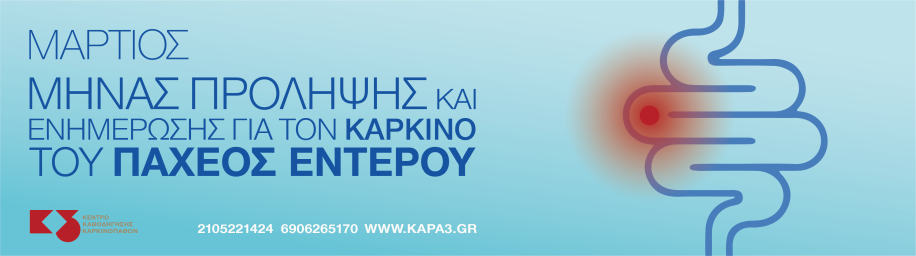
March is dedicated to raising awareness and promoting prevention of colorectal cancer, one of the most common but also highly treatable cancers when detected early. It is also referred to as colorectal carcinoma.

According to a European Commission report published in March 2021, colorectal cancer accounted for 12.7% of all new cancer diagnoses and 12.4% of all cancer-related deaths in the EU-27 countries in 2020. By 2045, it is estimated that 3.29 million new cases will be diagnosed worldwide, leading to 1.66 million deaths.

The disease occurs more frequently in men than in women, with age being a significant factor. Approximately 90% of people diagnosed with colorectal cancer worldwide are over 50 years old.

Prevention and early detection save lives.

Regular screenings, such as colonoscopy, can detect early lesions or precancerous changes before they develop into serious disease. During a colonoscopy, tissue samples (biopsies) can be taken for histological examination if a suspicious lesion is found, and polyps can be removed to prevent progression to cancer.

Treatment options depend on the stage of the disease, the tumor’s molecular characteristics, and the patient’s overall health. Standard therapies include surgery, chemotherapy, radiotherapy—which plays a key role in rectal cancer—as well as targeted therapies and immunotherapies guided by specific molecular biomarkers.

Through the National Colorectal Cancer Screening Program, the goal is to detect precancerous lesions or the disease itself early, allowing prompt intervention and treatment. Adenomatous polyps or early-stage neoplasms have a 100% cure rate when managed at an early stage, highlighting the critical importance of early detection.

For more information, visit the National Colorectal Cancer Screening Program website: https://colon.gov.gr

For any questions, you can contact the service department at tel. 11401 or via email: prolipsis-helpdesk@idika.gr.

Sources:

High Cost Medicines: One More Addition to Help Patients – Up to Three People Can Now Collect on Their Behalf

As of Monday, February 16, 2026, High-Cost Medicines for cancer patients can now be collected by up to three designated representatives, offering greater flexibility and easier access to treatment through community pharmacies.

This new possibility is particularly important for patients who require regular access to High Cost Medicines but may have difficulty getting to the pharmacy or live far from a pharmacy. By allowing representatives, care becomes more flexible and adapted to everyday needs, while ensuring the safety and correct use of the treatment. In this way, access to therapy is faster, more human-centered, and free from unnecessary hassle.

In this first phase, the option applies to patients with cancer and multiple sclerosis, and it will gradually extend to other High Cost Medicines categories. The steps for collection remain the same: the insured person logs into the platform using Taxisnet + AMKA, selects the pharmacy of their choice, and monitors the progress of their order.

For more details, see our previous article.

Text/adaptation: Ifiyenia Anastasiou for Kapa3
International Universal Health Coverage Day – December 12

International Universal Health Coverage (UHC) Day is observed every year on December 12 to remind us that access to quality, affordable healthcare is a fundamental human right and a cornerstone of just and sustainable societies. The United Nations established this day to strengthen global commitment so that all people, everywhere, can access the health services they need without financial hardship. (WHO)

Statistics

Universal health coverage is not just a goal. It is a central element of the United Nations  Sustainable Development Goals for 2030. Despite progress in recent decades, the reality remains challenging. Approximately 4.6 billion people worldwide still lack access to essential health services. At the same time, 2.1 billion face financial hardship in accessing care. Finally 1.6 billion pushed into poverty due to health expenditures.

These statistics demonstrate that universal coverage remains far from fully achieved, with significant inequalities between countries and within societies: poorer populations, rural residents, people with lower education, and other vulnerable groups face much greater barriers to healthcare. (WHO – World Bank Report)

Situation in Greece

In Greece, although universal coverage exists in principle through the National Health System, access to care is not always equitable or complete. Only a small percentage of citizens report high satisfaction with service availability, while around 12.1% of people have unmet healthcare needs, a rate significantly higher than the OECD average. (OECD)

Out-of-pocket healthcare expenses particularly affect lower-income households. Nearly nearly 10% of households facing catastrophic health spending, forcing families to sacrifice essentials such as food or housing. (WHO – Health Care Greece)

These inequalities are not just numbers—they have real consequences for quality of life. For cancer patients, universal coverage means timely diagnosis, access to treatments, continuous monitoring, psychosocial support, and palliative care. Lack of comprehensive, accessible care can worsen disease outcomes and increase psychological and financial burden for patients and their families.

At Kapa3, we strive to ensure that no cancer patient or their loved ones feel alone. Through educational initiatives, experiential programs, psychosocial support, and guidance materials, we advocate for healthcare access that respects human dignity, life, and real needs.

Universal Health Coverage Day is not just a date—it is a call to action for broader access, reduced inequalities, and genuine support for all. Together, we can make meaningful change.

Text/adaptation: Ifiyenia Anastasiou for Kapa3

Dispensing High-Cost Medicines (HCM) Through Private Pharmacies – What Changes for Patients

A recent Ministerial Decision (Government Gazette B’ 6333/27.11.2025) introduces significant changes to the distribution of High-Cost Medicines (HCM), allowing patients to receive these medicines not only from EOPYY pharmacies but also from private community pharmacies. This new framework replaces the 2020 regulation and aims to ease patient access, reduce inconvenience, and improve the delivery of essential therapies.

The list of HCM medicines included in this process is available in the corresponding Government Gazette here.

What Changes for Patients

  • The prescribing physician issues the prescription through the national e-prescription system (IDIKA).
  • Patients may choose to receive their medicine either from an EOPYY pharmacy or a private community pharmacy.
  • Through the dedicated HCM application (using Taxisnet credentials + AMKA), patients select the private pharmacy that will serve them.
  • Patients receive electronic notifications regarding the status of their order and the availability of the medicine for pickup.
  • Medicines are dispensed with zero patient co-payment.
  • The time from approval to pickup may not exceed 10 days.

What Changes for Private Pharmacies

Private pharmacists now assume an expanded role in handling High-Cost Medicines, with specific responsibilities and procedures.

  1. Medicine Receipt
  • The pharmacist scans the product’s barcode in the EOPYY system to complete the warehouse reconciliation process for EOPYY’s pharmaceutical depot.
  • The patient is automatically notified via the system once the medicine arrives at the pharmacy.
  1. Prescription Verification and Dispensing

The pharmacist must verify:

  • the patient’s identity or the presence of a valid authorization,
  • the accuracy of the prescription and its alignment with the prescribing physician’s instructions,
  • the correct medicinal product,
  • the presence of any required supporting documents,
  • the authenticity labels or deactivated safety features,
  • the physician’s signature and the recipient’s signature.

The pharmacist then signs and stamps the prescription to complete the dispensing process.

Failure to comply with these procedures may lead to sanctions under Presidential Decree 121/2008.

  1. Pharmacist Remuneration

For each dispensed HCM prescription, pharmacists receive:

  • a scientific service fee of €20.00 + VAT,

without the need to issue transport documents.

This cost is not included in the total pharmaceutical expenditure ceiling of EOPYY.

  1. Monthly Submission of Prescriptions

Every month, pharmacists must send:

  • the dispensed prescriptions,
  • the consolidated report,
  • and the service invoice
    to the EOPYY Department of Prescription Processing and Review.

Electronic images of prescriptions remain available for audit.

  1. Unexecuted Prescriptions

If a prescription is not executed:

  • the medicine is returned to the pharmaceutical company after 5 days,
  • and the company issues a credit invoice to EOPYY.
  1. Loss or Damage of Medicines

If the medicine is lost or damaged due to pharmacist responsibility,
EOPYY charges the pharmacist the procurement value of the product.

Why This Change Matters

The updated system:

  • reduces patient inconvenience,
  • relieves congestion in EOPYY pharmacies,
  • ensures faster access to essential therapies,
  • strengthens the role of community pharmacists,
  • and modernizes the distribution of High-Cost Medicines.

This development significantly improves the daily lives of patients who rely on regular access to specialized treatments — including many oncology patients. KAPA3 continues to stand by cancer patients and their families, offering reliable guidance and practical support so that every patient feels safe and fully informed about their rights and benefits.

Text/Adaptation: Ifiyenia Anastasiou for Kapa3