Participation in CA21152 – Implementation Network Europe for Cancer Survivorship Care

Digital Health and Cancer Survivorship: Kapa3 at the INE-CSC 2026 Conference in Coimbra

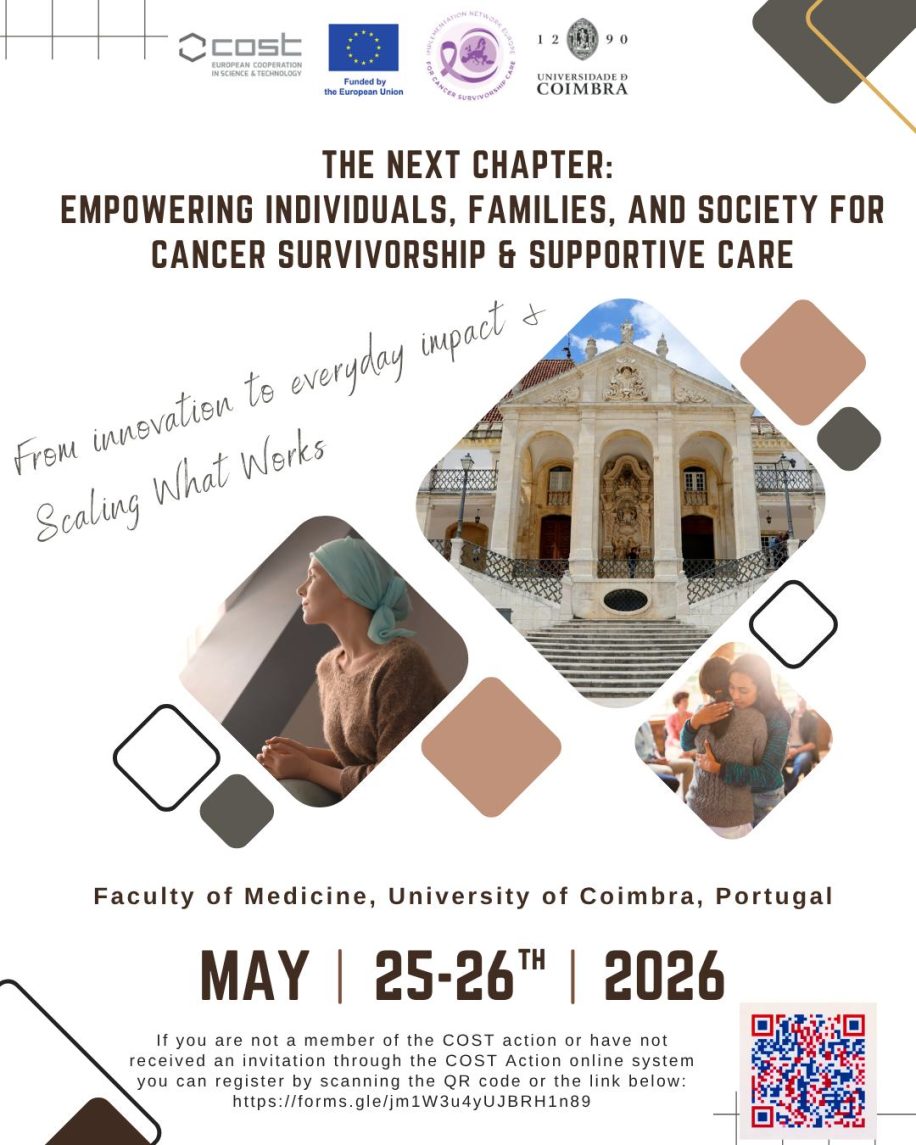
The Cancer Guidance Center – Kapa3 participated in the INE-CSC 2026 Conference, part of CA21152 – Implementation Network Europe for Cancer Survivorship Care (INE-CSC), held on 25–26 May 2026 at the Faculty of Medicine (Polo III), University of Coimbra, in Coimbra, Portugal.

The conference was held under the theme “The Next Chapter – Empowering Individuals, Families, and Society for Cancer Survivorship & Supportive Care”, highlighting the need for new approaches to cancer survivorship, supportive care and the translation of innovation into real-world impact for people living with and beyond cancer, their families and society.

Kapa3’s presence in Coimbra represents another important step in its European engagement and in its ongoing effort to connect everyday experience in supporting cancer patients in Greece with European knowledge, research, digital innovation and health policy.

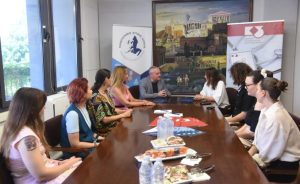
A key highlight was the participation in a round table discussion on facilitators and barriers to the implementation of digital health tools in oncology. The discussion was co-organised by Aristea Kyriaki Ladas and Christos Frantzidis and brought together voices from different European countries and organisations, including representatives from Kapa3, Acreditar Portugal, Liga Portuguesa Contra o Cancro, ORCO / Madrid Regional Ministry of Health, as well as participants from Poland, Latvia and the United Kingdom.

Among the participants in the round table were Yannis Kontogiorgis and Despoina Pistiolis from Kapa3, Greece, contributing to the European dialogue on digital health, oncology navigation and the participatory development of solutions that respond to the real needs of patients and caregivers.

One of the key messages of the discussion was that digital innovation in oncology is not only a technological challenge. It is also a matter of policy, implementation, equity, trust and accessibility.

For digital tools to make a meaningful difference in cancer care and survivorship, they cannot remain isolated applications or pilot projects. They need to become part of real care pathways, be supported by appropriate policy environments, connect with interdisciplinary practice and be evaluated in terms of effectiveness, implementation readiness, accessibility, equity, sustainability and value.

The discussion also highlighted that digital tools must be designed around the real needs of patients and survivors, not only around technical possibilities. Accessibility across countries, languages, healthcare systems and levels of digital and health literacy must be built in from the beginning.

The role of patient organisations and cancer support communities was also identified as essential. These organisations can act as a bridge between technological innovation and the everyday reality of people affected by cancer. They understand the questions, barriers, fears and needs that are often not fully captured by formal care systems.

For Kapa3, this participation is directly linked to the development of Myrto, its digital health and rights navigator, designed as a tool for empowerment, guidance and support for cancer patients and their caregivers.

Myrto is not approached as a simple information tool. It is being designed as a participatory intervention built around the real needs of people with lived experience of cancer. It is connected to access to rights, social benefits, services, practical guidance and human escalation whenever needed.

The Coimbra experience strengthened the view that digital health must be human-centred, accessible, trustworthy and integrated into a broader ecosystem of care. Technology can meaningfully support cancer care only when it is designed with participation, trust, clear purpose and an equity-oriented approach.

Cancer survivorship is not only about completing treatment. It is about quality of life, mental health, social reintegration, work, family, everyday life, access to services and the feeling that no person is left alone after diagnosis or treatment.

Through its participation in European networks such as INE-CSC, Kapa3 continues to contribute to the dialogue on more equitable, participatory and person-centred cancer care. Care that uses technology without losing sight of the human being at its centre.

The future of cancer support will not depend only on better digital tools, but on better collaboration between patients, caregivers, healthcare professionals, researchers, technology partners, patient organisations and policymakers.

For Kapa3, this is at the heart of its mission: transforming knowledge into action, technology into support, and the voice of patients into services that respond to their real needs.

More information: INE-CSC – Implementation Network Europe for Cancer Survivorship Care.More information:
https://inecancersurvivorship.com

Patients’ Rights in Public Administration: Less Bureaucracy and More Transparency

With Law 5293/2026 (Government Gazette A’57), a new framework is introduced for the operation of Public Administration in Greece, directly linked to patients’ rights in public administration, aiming to create a more citizen-friendly, efficient and transparent system.

These changes affect everyday interactions with public services, improving the way citizens are served, informed and supported.

The main provisions of the law can be grouped into three key pillars:

1. Simplification of procedures and reduction of bureaucracy

A central element of the reform is the simplification of administrative processes.

Article 3 – Replacement of supporting documents

According to Article 3, citizens may, in several cases, replace official supporting documents with a solemn declaration, when these documents cannot be directly retrieved by public services.

In practice, this means:

  • fewer documents need to be submitted
  • public authorities are responsible for retrieving the required information
  • procedures can start immediately without delays

At the same time, verification mechanisms are in place, including checks and sanctions in cases of false declarations.

Article 5 – Faster processing of requests

Article 5 strengthens the obligation of public services to process requests within specific deadlines, reducing delays in administrative procedures.

2. Transparency and digital access to information

The second pillar focuses on improving transparency and access to information.

Article 5 – Case tracking

Citizens are given the ability to digitally monitor the progress of their requests.

They can access information such as:

  • the current stage of the process
  • the estimated completion time
  • the responsible department
  • contact details for further communication

Article 6 – Mandatory publication of circulars

All administrative circulars:

  • must be published online
  • are valid only after publication

This ensures that citizens have access to up-to-date and valid information.

Article 7 – Online publication of public service hours

Public authorities are required to publish and regularly update:

  • their operating hours
  • public service hours

This helps reduce unnecessary visits and waiting times.

3. A new way of operating public administration

The law also introduces a new approach to administrative procedures, aiming to increase efficiency.

Article 4 – Certified professionals

Public administration may collaborate with certified professionals who:

  • are registered in official registries
  • meet specific qualification and certification criteria
  • can prepare reports, certificates or draft decisions used in administrative processes

These professionals are subject to:

  • random checks
  • penalties and fines in case of errors
  • removal from the registry if necessary

At the same time, accountability mechanisms (particularly under Article 3) ensure the reliability of the system.

What this means for patients

While these measures apply to all citizens, they are particularly important in relation to patients’ rights in public administration.

Reducing bureaucracy, enabling digital access to information and speeding up procedures can significantly ease the burden for patients, especially in processes related to:

  • healthcare services
  • benefits and allowances
  • administrative approvals

Towards a more accessible public administration

Law 5293/2026 represents an important step towards a more efficient, transparent and accessible public administration.

For patients and their families, every improvement that reduces complexity and uncertainty is not just an administrative change, but a meaningful support in their daily lives.

You can find the Government Gazette A’57 here (Greek Text): ΦΕΚ Α 57 Ν 5293_2026

Text/adaptation: Ifiyenia Anastasiou for Kapa3