On Wednesday, October 18, from 10:00 to 19:00, Activities and Workshops were held at the Multi-Purpose Hall of Syntagma Metro Station, aiming to provide information and social support to oncology patients, caregivers, and their families.
The Cancer Center Kapa3, the Department of Marketing and Communication of the Athens University of Economics and Business, the General Laiko Hospital of Athens, STASY, WinCancer, and the Research Laboratory “Care of Adult Patients with Cancer” of the Nursing Department of the International Hellenic University, under the auspices of the Municipality of Athens, ELLOK, the Greek Patients’ Union, and HESMO, joined forces under the campaign “Think of a word that starts with K,”(*) with the goal of raising awareness about best practices in cancer prevention and patient management across healthcare units throughout the country.
The daily and strong presence of all the above organizations on the front line of addressing the disease, in hospitals across Greece, was transferred to the very heart of Athens, in an event with a clear and singular purpose: the advocacy of privileged social rights for oncology patients, as well as raising awareness around best practices for prevention and patient care.
During the opening of the event, WinCancer Manager Ms. Krystallidou referred to the ongoing struggle of organizations and non-profit entities for the prevention and fight against cancer. She emphasized that collaborations such as the one organized by Kapa3 are exactly the kind of synergies WinCancer seeks to support—an effort both demanding and relieving—guided by Kapa3’s core message: “No One Alone.”
Subsequently, Ms. Michalopoulou, Vice President of ELLOK, which placed the event under its auspices, spoke about the central goal of ELLOK and all cancer-focused organizations: prevention. Early detection, she stressed, is what empowers patients and positively influences the course of the disease, while she also highlighted the importance and value of digital health literacy in today’s world.
On behalf of the Department of Marketing and Communication of the Athens University of Economics and Business, Professor and Head of the Department Mr. Intounas welcomed the event, expressing his sincere thanks and congratulations to all students who voluntarily supported the action, as well as to Kapa3 for taking the initiative. He also referred to a new short educational program developed by the department in collaboration with Kapa3, titled “Marketing and Civil Society.”
The inspiration behind the letter “K,” as shared by Mr. Gravaris, Head of Public Relations and Communication of the Greek Patients’ Union, was the word “wine.” In his address, he compared wine—associated with health and quality of life—to initiatives such as the present one, which aim to restore health, safeguard well-being, and support the continuation of life for cancer patients. The Greek Patients’ Union embraced the initiative from its inception and placed it under its auspices.
The presence of Mr. Michail Nikolaou, Vice President of the Board of HESMO, was also significant, as was his statement during the greeting that cancer is not invincible. He emphasized, however, that prevention must be addressed far more seriously if we are to suppress the disease. “Prevention is not only about quitting smoking; it is also about loving and taking care of oneself,” Mr. Nikolaou concluded, noting that Kapa3 will be a key ally in this effort.
Ms. Bouki, Director of Corporate Communication & Passenger Experience of STASY, representing its President Mr. Damaskos, spoke about the importance of organizing events like this one, which bring people “closer,” strengthen support for patients, and empower their journey toward regaining health. STASY emphasized its ongoing commitment to standing by people and supporting their needs, making “CLOSE” its chosen word for the day.
Finally, Ms. Theoni Zougkou, Head of the Nursing Services Directorate of General Laiko Hospital, praised Kapa3’s efforts in the fight against cancer and spoke about the hospital’s collaboration with the organization. She thanked the nurses and the psychologist who were present to inform the public about cancer prevention and management, and highlighted their significant work in providing healthcare services to oncology patients at General Laiko Hospital.
Closing the greetings, Ms. Evangelia Bista, Head of Development and Operations of Kapa3, deeply moved by the presence and support of so many key health organizations, warmly thanked all attendees for supporting Kapa3’s mission. She also expressed heartfelt thanks to all volunteers who embraced the idea and helped make the event a reality. “Kapa3 was created to cover the crucial area of social support and guidance for oncology patients along the difficult path of illness,” Ms. Bista emphasized, committing to even more actions so that no one feels—or is—alone in the fight against cancer and in favor of life.
Throughout the day, many attendees received information on registering for digital prescriptions and scheduling preventive health appointments. At the same time, visitors were informed about the adoption of Kapa3’s digital applications—innovative and unique tools in Greece. This initiative was supported by volunteers from the Department of Marketing and Communication of the Athens University of Economics and Business, who enthusiastically provided guidance and assistance.
Participants who attended the two workshops were also given the opportunity to schedule a free digital mammogram or breast ultrasound through the Biomedicine Group, an event supporter, under the message #TakeControl #TakeCareOfYourself. Every woman should have her first mammogram at the age of 40 and then annually thereafter. For women with confirmed BRCA1 or BRCA2 gene mutations, annual digital mammography is recommended from the age of 30.
At the same time, staff from General Laiko Hospital provided guidance on self-care for oncology patients and distributed informative leaflets on the subject.
The all-day activities also included the distribution of informational material on breast cancer prevention by the Research Laboratory “Care of Adult Patients with Cancer” of the International Hellenic University, as well as additional educational materials from reputable scientific organizations, available on Kapa3’s website under the ODYGIA K3 section.
Workshops titled “Giving Meaning to Cancer – A Psychological Perspective” by psychologist-psychotherapist Vasileia Mari of General Laiko Hospital, and “Breast Cancer Prevention” by nurse (MSc) Eirini Throuvala from the Gynecological Cancer Unit of Elena Venizelou Maternity Hospital, offered valuable information and guidance to patients, caregivers, and family members through interactive and accessible discussions.
All activities were supported in Greek Sign Language by “HANDS UP,” emphasizing the importance of accessibility for all patients and caregivers to information that concerns them and supports effective care.
“Good Morning,” “Kindness,” “Close,” “Duty,” “New,” “Guide,” “Condemn,” “Reassure,” and “Summer” prevailed over “Cancer” and “Malignancy” in an event full of meaning, positive emotions, and hope.
No one is alone in the fight for life—and Kapa3, together with all the organizations and groups that supported this event, powerfully demonstrated the true meaning of that message.
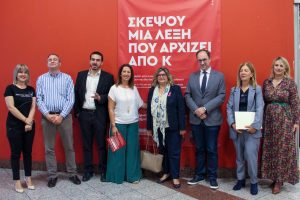
|(*) Note: In Greek, the campaign and event creatively play on words starting with the letter “Κ” (Kappa), which is also the first letter of “καρκίνος” (cancer). Many of the positive words highlighted during the event—such as “Καλημέρα” (Good Morning), “Καλοσύνη” (Kindness), “Κοντά” (Close), “Καθήκον” (Duty), “Καινούργιος” (New), “Καθοδηγώ” (Guide), “Καταδικάζω” (Condemn), “Καθησυχάζω” (Reassure), and “Καλοκαίρι” (Summer)—intentionally start with the same letter to symbolically “overcome” cancer.
Text/Translation: Ifiyenia Anastasiou for Kapa3