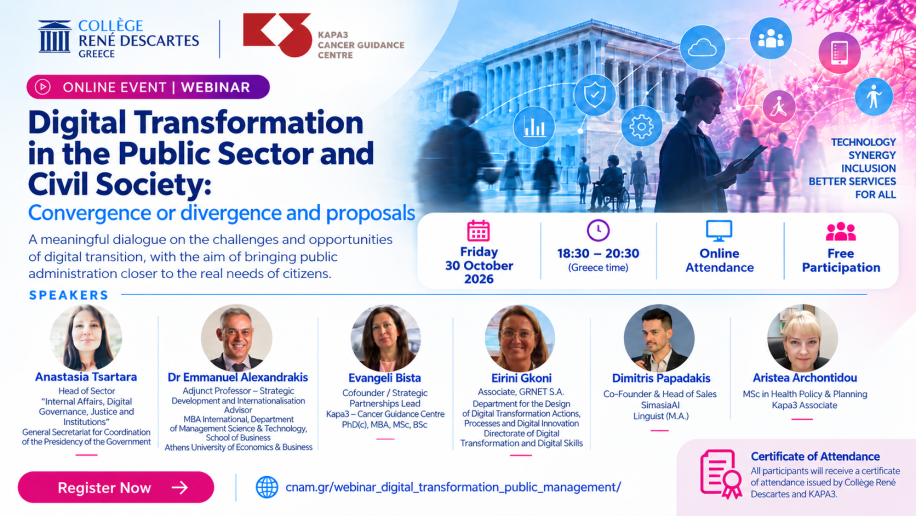
Kapa3 – Cancer Guidance Centre, in collaboration with Collège René Descartes, invites you to an online webinar entitled:
“Digital Transformation in the Public Sector and Civil Society: Convergence or divergence and proposals”
📅 Date: Friday, 30 October 2026
🕡 Time: 18:30 – 20:30
💻 Attendance: Online
🎫 Participation: Free of charge
Digital transformation is now a key factor shaping how public organisations operate, how services are delivered to citizens, and how social support and participation initiatives are developed. Although important progress has been made, the transition to a more digital environment does not unfold in the same way across all organisations and social groups.
This webinar aims to open a meaningful dialogue between theory and practice, examining digital transformation from both the perspective of the Public Sector and that of Civil Society. Special emphasis will be placed on:
- the changes brought by digitalisation in the way organisations function,
- the relationship between the state, organisations and citizens,
- the opportunities created by digital technologies,
- the challenges arising from unequal access to and use of digital tools,
- and the need to develop sustainable, human-centred and inclusive digital solutions.
Main question of the discussion
Does digital transformation lead to greater convergence between the state, organisations and citizens, or does it create new forms of divergence and inequality?
Who should attend
The webinar is addressed to:
- public sector professionals and employees,
- representatives of civil society organisations,
- professionals involved in the design or implementation of digital services,
- management and human resources professionals,
- social and humanitarian service professionals,
- educators, researchers, academics and students,
- and, more broadly, anyone interested in the relationship between technology, public administration and society.
Main topics
The webinar programme includes themes related to:
- digital transformation as organisational change,
- innovation in public administration,
- practical experiences and good practices from the public sector,
- inclusion, accessibility and social needs,
- the relationship between the public sector and civil society,
- artificial intelligence, data and new opportunities,
- and proposals for a meaningful, sustainable and human-centred digital transition.
Speakers
The webinar features:
- Anastasia Tsartara, Head of Sector “Internal Affairs, Digital Governance, Justice and Institutions”, General Secretariat for Coordination of the Presidency of the Government
- Dr Emmanuel Alexandrakis, Adjunct Professor – Strategic Development and Internationalisation Advisor, Athens University of Economics & Business
- Evangeli Bista, Cofounder / Strategic Partnerships Lead, Kapa3 – Cancer Guidance Centre
- Eirini Gkoni, Associate, GRNET S.A.
- Dimitris Papadakis, Co-Founder & Head of Sales, SimasiaAI
- Aristea Archontidou, MSc in Health Policy & Planning, Kapa3 Associate.
Certificate of attendance
All participants will receive a certificate of attendance issued by Collège René Descartes and Kapa3.
Registration
Participation is free. You may register through the official form:
🔗 https://cnam.gr/webinar_digital_transformation_public_management/